Episode Transcript
[00:00:00] Speaker A: Did you know that first year nurses experience the highest turnover of any group?
[00:00:07] Speaker B: That reality is staggering, but it also
[00:00:10] Speaker A: tells us something important.
You are not alone and your growth matters.
Welcome to the All One Nurse Podcast, where we are bridging the gap between the stethoscope and the soul through real nursing stories and nursing conversations.
Here, our mission is simple. To get back to the human side of healthcare.
I'm your host, nurse Chanel Tompkins, and I'm also your mentor and nurse educator. And this space was created just for you to breathe, to learn, to grow, and most importantly, feel supported no matter where you are in your nursing journey.
So take a deep breath and let's step into your next breakthrough.
[00:01:02] Speaker C: Welcome Back to the All1Nurse podcast where I'm your host, Chanel Tompkins, and I'm so glad that you're here with me.
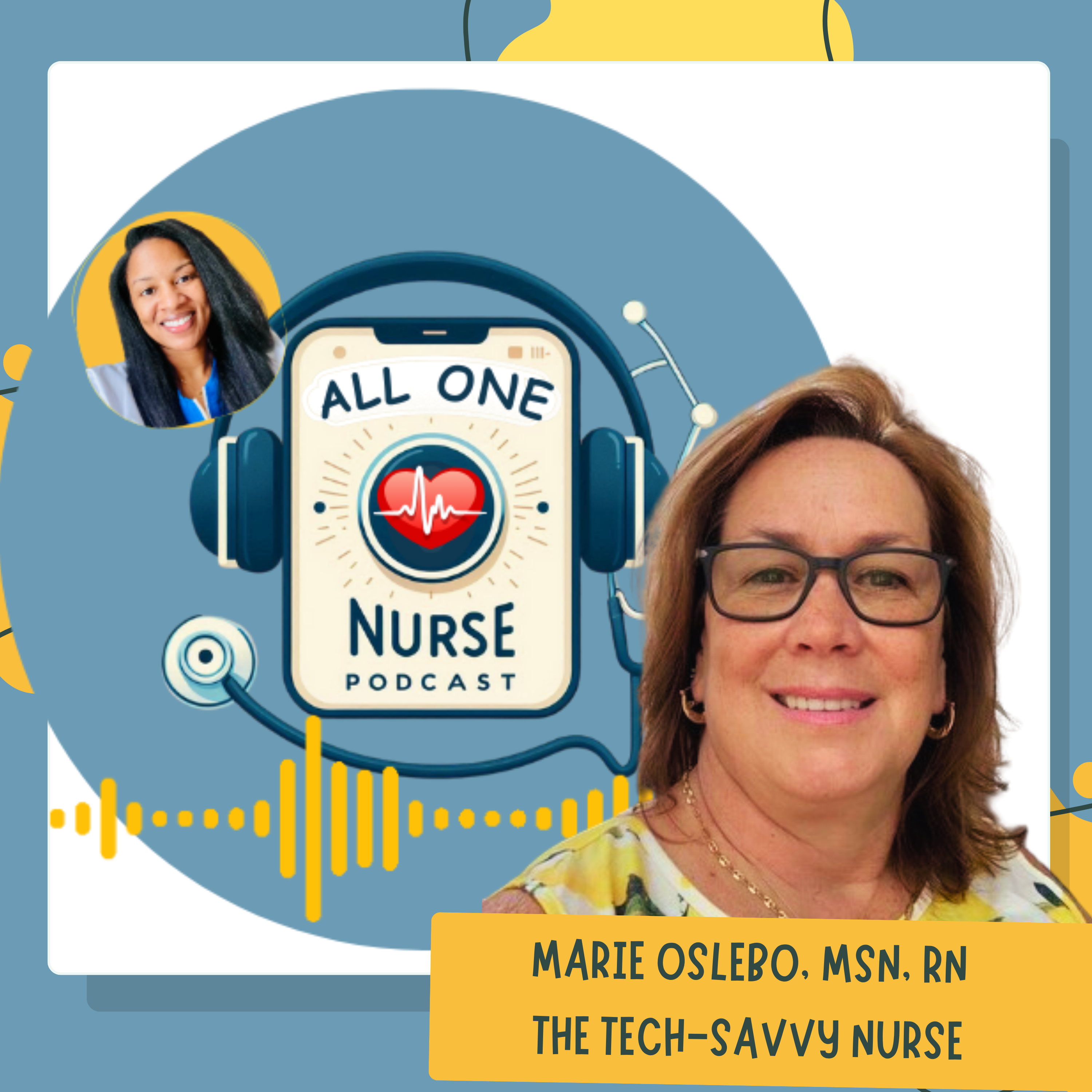
Hopefully you celebrated Nurses Week and got all the discounts that you could handle from different brands and fast food companies. And if it's your first time celebrating Nurses Week as a licensed professional, congratulations. Now, today's episode is really exciting because I get to sit down with Ms. Marie Osliebo, the tech savvy nurse. And we're diving into a conversation that every nurse, from new grad all the way to a seasoned clinician, needs to hear. Because in today's healthcare scheme, we are becoming just more and more digital, whether you like it or not. And a 2025 study showed that nurses reported their lowest confidence in digital tools like electronic health records, online resources for patients, and even health apps. It's just think about even in your role as a nurse, moving from the bedside will probably require more digital skills, especially as a remote nurse. And that lack of confidence isn't just a tech issue, it's a career barrier. And when you don't feel equipped to navigate digital systems, then guess what?
You may hesitate into, step into new roles, new nursing roles, new opportunities, or new levels of leadership. But here's the good news. Confidence is a skill. And so is digital literacy, where skills can be learned, strengthened and mastered.
So today we're talking about what it really takes to build confidence. Tech confidence as a nurse. Not from a place of pressure, but from a place of empowerment. And that's why I love this conversation with Ms. Marie. Whether you're charting, communicating or educating or innovating, because as nurses, we do a lot.
You deserve to feel capable and confident in every digital space that you step into.
And big congratulations. If you're graduating around the time of this episode release, and I'm so Proud of you. Also, be sure to tune in till the very end so that you can learn how to connect with Ms. Marie, whether it's through her social media or an upcoming webinar and her website, as well as updates that I have for you. Okay, let's dive right in.
[00:03:39] Speaker B: Hi, Ms. Marie. How are you doing today?
[00:03:42] Speaker D: I'm well. How are you, Chanel?
[00:03:44] Speaker B: All is well. Sal. I am so excited to have you here on the All One Nurse podcast with us.
[00:03:50] Speaker D: I am so excited to be here.
[00:03:52] Speaker B: Yes, ma'. Am. So, of course, we're going to dive into your personal journey, your nursing journey, and then everything else that you have to share with us. But I just want to let our listeners know that I met you at the Nurses Making Business Moves Conference.
[00:04:08] Speaker C: Yes.
[00:04:09] Speaker B: Yes, ma'. Am. In March with Barra Lawrence. And it was just a blessing.
It really was. Yes. And I'm so grateful to have met you. And now we're here. I'm super excited that you get to get on here and tell everyone about you. Tell us, who are you, Ms. Marie, and how did you get into nursing?
[00:04:29] Speaker D: So I have been using, you know, computers has. Has always been part of my life. Okay. I started with computers back in the early 80s, and that's probably more than what people are used to, right? Especially nurses. And I in it for over 20 years.
And then my job was being outsourced, and I saw the writing on the wall, and I was always the person that family and friends came to when it became a medical question. And, Marie, what do you think? Or Marie, how do you. So I said, you know what? Since that kind of world is closing their doors, I said, let's look at nursing.
So I applied to nursing school, got in, and I was the oldest one in my class when I graduated. And I've been a nurse for over 10 years, and I've dabbled a little bit in a variety of settings, and currently I am in occupational health as their informatics nurse.
[00:05:31] Speaker B: Awesome. So you're still doing tech.
[00:05:34] Speaker D: I am, yes. And what I found when I became a nurse is that nurses really weren't taught how to use technology.
They were taught how to scan. A bracelet. Give me your name and date of birth. Here's your Metoprolol. Yeah. Kind of thing, Right?
[00:05:52] Speaker B: Yeah.
[00:05:52] Speaker D: So when they wanted to move beyond bedside and Covid had a lot to do with this, I think they struggled because you need to have some tech experience.
You need to be able to work with an Excel spreadsheet. You need to be able to do a decent report.
And I found that even my managers didn't know how to put a PowerPoint presentation together.
So that is what kind of founded tech savvy nurse. So I am the tech savvy nurse.
[00:06:22] Speaker B: Yes. And it's so funny that you said that, because thinking back, even when I graduated nursing school in 2011, there were paper charts. And then during that time, that two years of being at the first hospital I was with, we went to Electronic Mars.
And so that's one thing. And then it was something else she mentioned as far as, like, with COVID during the year of COVID I had my son and I had actually switched from bedside and CBICU to staff development specialist.
And to get into that educational role is more desk work, computer work. And guess what? One thing they asked me in the interview was how comfortable was I with Excel? And even now I'm like, I'll figure it out. But I usually, like, copy somebody else's, like, format if they've already formatted it. If I get a good expel sheet, I'm like, oh, I'm gonna use this. I save it as a copy and go and use it as my own. Now with that, tell us more about.
No, let's go back. Let's go back because when you, you say you were the oldest, oldest one in your class, because, you know, my audience is predominantly new nurses or nurses aspiring nurs.
Just letting them hear your origin story, especially being one of the oldest ones in your class to graduate. What type of program was it? Was it a ADN or bsn? And what was it like for you?
[00:07:48] Speaker D: So I've always been a lifelong learner, right? So I have other degrees, not just in nursing. I have a business degree. So I've always been in school. Right.
My original program was an ADN program.
It was just get me in the door, let me get it done, right? And let me get working because I got bills to pay, I have a family, I can't go to school full time kind of thing, right? So just let me get my ADN done. Well, I got that done. And I said, well, most of the hospitals nowadays really want nurses to have at least a bachelor's.
So I said, okay, let me just get my bachelor's done. Just so I can say, all right, I'm done.
So I, as soon as I graduated, I applied to my bachelor's. I graduated in December. I started my bachelor's in February.
So I was like, just barely got my, you know, NCLEX test done, and I'm into my bachelor's yeah. And then I stayed at my bachelor's for a few years.
And computers has. Has always drawn me. It's just something. It's just innate for me. Right. So I said, what else can I do? Right. How else can I improve nursing care, really?
And so I went and I got my master's in nursing informatics.
[00:09:16] Speaker B: Got you. So either way, it's like it's all aligned together, your nursing and your tech skills. Now, with your adn, was that. That was in person or was that online as well?
[00:09:29] Speaker D: My ADN was in person. We had clinicals.
[00:09:33] Speaker B: Okay.
[00:09:34] Speaker D: So I was in school, I think four out of five days a week between classes, labs, and then clinicals, usually at night, you know, like 3 to 10 or something like that.
And then with my bachelor's, I didn't so much have a quote unquote clinical, but I had a project I had to present.
It was all online, but I had a project I had to present within the community.
[00:10:00] Speaker B: Okay, got you.
[00:10:01] Speaker D: For my capstone.
[00:10:03] Speaker B: Got you. Okay. Thank you for sharing that.
Now, going into your personal insights, your one word or your why for nursing was empowerment.
So what does empowerment look like to you when it comes to nursing and healthcare professionals?
[00:10:21] Speaker D: So nurses have a lot of autonomy. Right. And to have that autonomy really empowers them to drive healthcare.
They make the changes.
Now, there are several nurses that I follow on LinkedIn as well as other platforms that are really paving the way for nurses.
You know, we have a few of them, I'm not sure if you want me to mention them or not, that really do pave the way for nurses to be influential, to be powerful enough to make change and helps them with their tools to make those changes, you know, even in the tech world.
Right. Wow.
Yeah. So there are summits that go on to.
Nurses can say, you know what, I have this idea and this is how it's going to change nursing for the better or change health care for the better.
[00:11:20] Speaker B: Yes.
[00:11:21] Speaker D: So that, to me, that is what we need. We need nurses, healthcare professionals.
I don't care where you are in the spectrum, you know, whether you're a janitor doing something that you find that needs to be improved upon, up to the CEO, if something can be improved, we need to empower our nurses, our healthcare professionals, our organization to make those changes so that healthcare can be better.
Because it's not at that place right now.
[00:11:56] Speaker B: Yeah.
[00:11:56] Speaker D: You know, I've seen it time and time again, and people are angrier over and over, and the healthcare environment can't sustain it like that.
[00:12:06] Speaker B: Yeah.
I think you said a whole word and I think we can even apply that to society. Like, we have to get back to, I say get back to the basics. Like, absolutely, like just doing the right thing and wanting to be intentional about being present. Being present and honestly seeing a problem and wanting to find a solution instead of complaining about the problem.
And it's like, how can we be solution oriented, be present wherever we are, whether it's at work, at home, in our community, and then like you said, whether it's the janitor all the way up to the CEO, how can we just do our part and really empower one another? And you know, it's funny, I had wrote a blog years ago on, you know, we are all one body because it takes all of us from the person at the top making the decisions all the way down to housekeeping to keep the facility clean. Like that matters. So you said a lot because, you
[00:13:09] Speaker D: know, not to bash any, you know, leadership, but if they're not on the front lines, they don't see and do what the frontlines people do in their various roles. Right. So they may have been there 10, 15, 20, 30 years ago, but things have changed.
Even in this short time, things have changed. And there are better ways to do certain things and they need to be able to listen and hear, right?
[00:13:41] Speaker B: Yes.
[00:13:42] Speaker D: Because there is a difference.
[00:13:44] Speaker B: Yes. Now, in your role as an informatics nurse, how do you use a lot of your data to help bring about change, to help show them, like, hey, this is what's going on over here. And maybe do you get to present problems or can you help them address what they see, what they may not see?
Right.
[00:14:05] Speaker D: So currently we rolled out a new EMR in our occupational health department back in December. Right. So we're still tied.
Exciting and scary.
[00:14:17] Speaker B: Yes.
[00:14:22] Speaker D: Yep.
And so we're still, I don't want to say learning the system, but learning where it kind of falls a little flat and where it's like, it puts a big bright light on certain areas that, ooh, we didn't think about that kind of thing. Right. So, you know, when you're comparing EMR systems, you know, you've been working on this one for so long and now you're moving over to this, this one that's supposed to be better and greater and all of that, you know, you gotta weigh the pros and cons. And some things are better in the old, some things are better in the new.
So to be saying that, am I explaining data and showing data of where we could do improvement? Not necessarily But I'm highlighting areas that we may need to look at more closely because that data wasn't easily available to us in the old system where it is now.
That's good, right? So you gotta kind of balance those
[00:15:22] Speaker B: two and that helps bring about change as well, because now there's a way to obtain that type of data. Thank you for sharing that. I know we can go techy all day. I'm kind of a nerd, so I. I love it.
[00:15:39] Speaker C: Let's take a moment for our faith intermission Note. There's a verse that that's been echoing in my spirit lately, and it is ecclesiastics.
What has been will be again.
What has been done will be done again.
There is nothing new under the sun. At first glance, it sounds like Solomon was talking about history repeating itself. But when we look closer, it's also a reminder that even when we step into unfamiliar spaces, God's wisdom still applies. Virtual learning, telehealth, digital charting, these may feel new to us, but the principles of grace, patience and stewardship haven't changed. The same God who guided nurses through handwritten charts and bedside prayers is the same God that's guiding us through screens and monitors and software.
So when technology feels overwhelming, I want you to remember there's nothing truly new under the sun. The tools may change, but the calling remains to serve, to heal, and to be, to bring light, whether they're through a monitor or a moment of presence.
So let's carry that with us as we continue this conversation, confident that God equips us with for every season, even the digital one. Let's get back to our conversation with Ms. Marie, because she's awesome and she has a lot more to tell us.
[00:17:23] Speaker B: Diving right into patient and professional impact in your experience. Ms. Marie, how does improving tech skills directly impact patient care or workforce flow? Safety?
[00:17:36] Speaker D: So nurses need to document in the time right when they're doing patient care, ideally in the time. Does that happen?
Not always.
Right. They're like, no, I, I gotta go do this, or oh, I gotta go do that, or the computer just froze on me. Now what do I do? Yeah, right. So then it's call it or is however people refer to them these days, get that up and running and then I have to go back and document. So improving tech skills really helps nurses kind of troubleshoot the little things, right?
So I've worked with a number of nurses over many years and I've taught them little tips and tricks on what you can do to kind of self diagnose, if you will. Tech issues, Right.
So I've had one nurse that sent to me after, of course, she wasn't going to come to me beforehand because people feel embarrassed because I do have a lot of tech knowledge, technology skills, all of that. Right. Education. I have all of that. So they feel, I don't want to say intimidated, but they don't want to feel, quote unquote, and I do use that term, stupid. Right? Right. They don't want to be. I should know this. And I really tell them, you know what? It took me years to get where I am.
Right? It took me years to get the technology skills and the knowledge to get where I am today. Right. You've been a nurse for 30 years. You've got a heck of a lot more skills than I do.
So I bow to you. And you know what? We can, we can go back and forth on this, but I helped a nurse that didn't want to come to me because she was having a monitor issue.
Her monitor was black all day for her.
[00:19:31] Speaker B: Wow.
[00:19:31] Speaker D: Black screen. And she works remote. Right? So now she struggles.
And then she told me the following day, she goes, yep, I sat here and I said, I am not calling Marie. I am not calling Marie. I'm going to figure this out. And you know what?
She figured it out. She did figured it out.
[00:19:51] Speaker B: Go, girl.
[00:19:52] Speaker D: She didn't have to call me. And that really helped boost her self confidence because she didn't feel like she needed someone to help her walk through this. She said, no, Marie has taught me certain things that I can start to do these things and then if I run into a problem, then I can reach out to her and say, okay, I've tried this, this and this, just like you've explained.
Now what do I do?
So by empowering them to just do some little things with their tech skills, they can, they can do a lot. They really can. And it really boosts their confidence.
[00:20:32] Speaker B: Yes. It's amazing that you say that. And you know, I've had even with teaching computer class at work for training for the EMR system, you'll be surprised. A lot of nurses just like this computer, they can provide awesome patient care.
[00:20:48] Speaker D: Yes.
[00:20:48] Speaker B: But that computer just holds them up. And guess what? We just continue to upgrade. Like technology, just continue upgrading. And next thing you know, they gotta do something different or do something different when all they want to do is
[00:21:00] Speaker C: scan the arm band, pass these meds
[00:21:02] Speaker B: and chart and they wish they could write it versus having to use the computer. But it's amazing that you say that, mentioned just being uncomfortable with the computer itself. Using the computer itself. Now I want, I'm thinking about because I've had individuals come to me are needing help, especially when they're older and they're going back to school and everything is so virtual now, I think before they even get to the bedside.
Like everything is so virtual now. So tell us a little bit about, or tell us a lot about what you do as tech savvy nurse and how you help, how you can help those individuals as well. Because a lot of it is Microsoft Office that they have to use. That includes Excel and documents and a lot of their assignments. Like I've gotten phone calls about assignments that they can't even, they're just like,
[00:21:57] Speaker C: I don't even know how to do
[00:21:58] Speaker B: this assignment or how to even put in the answers to the document and submit it the way the instructions are. So tell us a little, tell us about what you do. And with Tech Savvy Nurse, sure.
[00:22:12] Speaker D: So Tech Savvy Nurse was built so that nurses can get more comfortable with computers. Right. So I have a, what I call a mini course, Right. It gives you the bare bones of learning general computer skills.
Some introduction to Microsoft Word, some introduction to Microsoft Excel, some introduction to Microsoft Exc Outlook because that is your email system, usually in hospital Systems and Microsoft PowerPoint. Because if you're going to be beyond the bedside, right. And you want to go into either leadership or education or something like that, you're going to need to learn how to put a presentation together.
[00:22:56] Speaker B: So witness to that.
[00:22:58] Speaker D: Right.
So my, my mini course really is just the foundation of here. Let's get your feet wet, let's get you comfortable. Let's give you a little bit of skill so that you can build your confidence by using these tech tools. Because most healthcare organizations use Microsoft Office Suite, you know.
[00:23:21] Speaker B: Yep, you do.
[00:23:22] Speaker D: I focus on that because it is so well known, Right. It is so well versed. It's been around for a long time. I do not see it going anywhere in anytime soon.
Right. And now with the introduction of AI and Copilot, now some organizations are using Copilot, other organizations are using all the other AI components. So that is coming down the pipe. I do not focus on AI at this point. I'm not saying it's off the table, but I have just not dived into that because my focus is really getting computer skills to the nurse. I'm not here to make you an expert. Yeah. I'm not here to make you do pivot tables and have your eyeballs spin back into you Know your head. That is not my goal. My goal is to give you basic skills so that you can, when your manager or someone in leadership say, hey, put a presentation together on XYZ topic by tomorrow, you can be like, I got it, no problem, and pop it right out in a couple hours.
[00:24:32] Speaker B: That's good, right?
[00:24:33] Speaker D: Instead of struggling.
[00:24:34] Speaker B: Yeah. So what I'm hearing you say is your goal is to give them a foundation. Give them a foundation instead of feeling less than or feeling stupid or just feeling. Because it just feels foreign. So now it's like, I am your go to person. Like, come to me and with. And you're here to help boost their confidence and teach them honestly how to be functional on a computer and using the most common programs that they'll most likely use in their role. And I can even say, go ahead
[00:25:07] Speaker D: and not be overwhelmed using them.
Right.
That, that is the most important thing. Because when a nurse or any other healthcare professional. Because I really don't want to just say it's a nurse. Any healthcare professional that needs to use Microsoft Office and are struggling, they're going to be overwhelmed.
They're going to be going down a rabbit hole and being like, I can't do this. And it's going to take them three, four times as long to finish something that they could have done in an hour or two or less, you know, depending on what they need.
[00:25:42] Speaker B: That's so true. And that's even before. And that's what I was going to say. Just those issues before even becoming a nurse, trying to get the nursing assignments done online, it's taking two hours to do something that should have taken 15 minutes.
[00:25:57] Speaker D: Absolutely.
[00:25:59] Speaker B: So you have. That's a.
You are basically a saving grace.
You're like an angel. You know, whenever I see help come my way that I actually need, I'm like, oh, I see a halo around their head. When I see them come down the hallway. If I just spoke them up and they're like, coming. I was like, I see an angel. So you're like an angel, especially when it comes to tech skills. Because if you're not well versed in it, but you know you, but you know you feel called to go into nursing and it's like, I want to serve, I want to be a great nurse. But this big obstacle of having to use a computer to get through the program and to do majority of my work. And like you said, even with AI, it appears that AI is here to stay.
But you can't even think about AI if you can't even get Past turning the computer on and getting to Microsoft Document and saving it.
Yes.
[00:26:57] Speaker D: To even get to finding it after you saved it.
[00:27:00] Speaker B: Yes. Yeah. Like, where did it go?
[00:27:03] Speaker D: Right. And I go over that as well.
You know, I go over how to. How, you know, you should properly name your files. What? You shouldn't name your files.
Right. Because you shouldn't say document one. Yeah, no, no.
[00:27:19] Speaker B: Yeah, yeah, that's good. That's good. I think you.
[00:27:22] Speaker D: I really. Right. So I really do start at the foundation. Because you don't know what you don't know.
Right. You just think, okay, I'll figure it out.
And then you're going to spend hours trying to figure it out where I can help you cut that time in half or more, quite honestly, because once you get the foundation down, man, you are unstoppable.
You are unstoppable. That's good.
[00:27:52] Speaker B: This is a good question. I want to ask it. What's one myth about technology in nursing that you wish we could retire for
[00:28:02] Speaker D: good, that it's going away?
Technology is not going away. It's going to expand. AI is changing the way that our organizations, our businesses, our health care, how everything functions. Right. And you know, when a computer systems go down, we are back to paper and pen.
Right.
Called downtime forms.
[00:28:31] Speaker B: Yes.
[00:28:31] Speaker D: I just have to say, yeah, downtime forms. And boy, the old timers and I. And I need that in a loving way. They're like, yay, I love downtime forms where us tech people are like, how do you hold this thing?
[00:28:46] Speaker B: What do I write?
That is too funny.
[00:28:50] Speaker D: Or. Or you get the. And I don't have a prop here.
I did, I did have one.
[00:28:58] Speaker B: What was it?
[00:28:59] Speaker D: It had the four color pens. Remember the four color pens?
[00:29:03] Speaker B: Yes, yes.
They still use it sometime for report, like to write their reports down.
[00:29:10] Speaker D: Right. But before my time, I was told that, you know, black was like day shift or blue was day shift, red was night shift, green was like 3 to 11 or something. I forget what the color codes were. But yeah, each shift had their own colors because again, it was in a book that you would write all your notes in. So.
[00:29:32] Speaker B: Wow.
Now that's interesting.
[00:29:35] Speaker D: That's for sure. Bless them.
[00:29:38] Speaker B: You said, thank God for technology. That's all I'm saying. Yes.
Thank God for technology.
[00:29:44] Speaker C: Yes.
[00:29:45] Speaker B: Well, I think you have something awesome.
I think you're solving a big problem for individuals who have it, and I think that's awesome. I think again, on both ends, on as they're trying to get through nursing school as well as coming through nursing School and, you know, working in their career, and they're like, okay, I want to advance, but it's remote and I gotta work with a computer. And I really want this job because I'm tired of bedside. Or I'm just wanting to advance from bedside. Or I would love to teach adjunct, you know, at the college or work at the college as an instructor. I'm trying to get my words out. But they basically don't do it because of the computer skills that's required.
[00:30:30] Speaker D: Right. Because they feel overwhelmed. Yeah, they feel overwhelmed. They feel like they are not smart enough to do it.
And that is so far from the truth. Obviously, you are brilliant because you went to nursing school, you passed the nclex, and you keep individuals alive every day of your life.
[00:30:56] Speaker C: Yeah.
[00:30:56] Speaker D: Right.
[00:30:57] Speaker B: Yeah.
[00:30:57] Speaker D: And you take fabulous care of them. So don't let tech hold you back, because that is one small thing. One small thing out of your entire career. Tech is one small thing, but it can make such a huge impact on your life as well as everybody that you're caring for. Because once you understand tech a little bit better, you get quicker at it. Right. So now you can click, click, go back to your patient.
[00:31:28] Speaker B: Yeah.
[00:31:29] Speaker D: It's that much easier.
[00:31:30] Speaker B: Yes. It's like you take what I'm hearing you say. It's like you take something that seems like a mountain and turn it into a molehill. Like, it's not as big. It's not as big as you make it in your head, in your mind. And you come along and you help them see it from a different perspective.
[00:31:50] Speaker D: Right.
[00:31:50] Speaker B: And help them be optional.
[00:31:55] Speaker D: It's like one small bite at a time.
That's all it is. That's. That's all you're doing. You're taking one small chunk and you're gonna. I don't wanna say perfect it, but you're gonna get that so that it becomes more routine for you versus.
Okay, what did she tell me to do? What am I supposed to do here?
No, you get that as a routine, and then you move on to the next thing, and then you get that as a routine, and now you have two things, and then you do something else, and then you have three things, and it's like, wow, six months ago, I couldn't do this. Now look at me.
[00:32:29] Speaker B: That's good.
[00:32:29] Speaker D: Yeah, Exactly.
[00:32:31] Speaker C: Yes.
[00:32:32] Speaker B: So tell me, how can listeners connect
[00:32:35] Speaker D: with you so they can find me on all the platforms? I'm on Facebook, I'm on Instagram, I'm on LinkedIn. I'm on TikTok. I just started a YouTube channel. I'm over on Substack. Let me see Pinterest. I am hitting all the platforms so if they want to DM me, feel free.
[00:32:55] Speaker C: Okay.
[00:32:55] Speaker D: Look for tech savvy nurse. You should find me.
[00:32:58] Speaker B: Yes, yes.
[00:32:59] Speaker D: If not, they can go to my website. That's fine too. TechSavvyNurse.com that's fine too. Yep.
[00:33:05] Speaker B: And what can I expect? Because I know you mentioned a mini course early on.
What other services do you have?
[00:33:13] Speaker D: So I have a bunch of freebies that are on my website now and they vary between Excel, Outlook, PowerPoint. I mean I've got a variety of them out there.
I also, I'm actually hosting a 60 minute workshop next week focused specifically on Excel and it's a really good price point for 60 minutes.
It's called Fix Excel Frustration.
[00:33:45] Speaker B: So techsavvynurse.com Fix ExcelFrustration so techsavvynurse.com backslash Fix ExcelFration.
[00:33:59] Speaker D: Yep.
[00:33:59] Speaker B: I said, right, you know, I'm kind of country.
[00:34:03] Speaker D: Yep. And then of course, if they wanted to work one on one, we can customize a program one on one so that if they just need, you know, something specific for them, even if it's just, you know, they want one session, I'm happy to do that as well.
[00:34:19] Speaker B: How often do you plan on doing webinars? Is that something that we can expect more often? Like you plan on doing one every three months or whatever with you mention in it?
[00:34:32] Speaker D: Yeah. So I'm thinking at least one or two a quarter, you know, like maybe like every other month I'm going to hold one.
[00:34:40] Speaker B: Okay. And we in. We look at we we can find.
Because I'm interested in this Excel frustration. So we can find it on the website.
[00:34:50] Speaker D: So I have a landing page. So that's fix your frustration landing page. I haven't built it out as a part of my website per se because they're, you know, one and done kind of thing because I'm not going to use the same URL for other things.
[00:35:07] Speaker B: Yeah, yeah, that's smart. So visit the website and based on the landing page they may find that you have an event coming up. A webinar. Got you. Well, thank you so much for sharing with us today. Yes, ma'. Am. And I will also put your website or Ms. Marie's website in the show notes below along with any link like straight to the mini course. But I really appreciate you for getting on here with us today.
[00:35:36] Speaker D: I so appreciate you. Chanel.
[00:35:39] Speaker B: Yes, ma'.
[00:35:39] Speaker D: Am. This is great.
[00:35:41] Speaker C: Thank you.
[00:35:42] Speaker B: Now Is there anything that we did not cover that you would like to cover before we depart?
[00:35:49] Speaker D: The only thing I want to reinforce is that nurses are expected to know technology, but they have never been taught it. And that is a real unfair advantage.
Right.
So nurses, please do not let tech hold you back from what you want to accomplish because I am here and I am willing to help you just reach out.
[00:36:15] Speaker B: Awesome. Thank you so much.
Thank you. You make me want to reach out.
Yes. Well, I really appreciate it, Ms. Marie, and I cannot wait to see what all you're doing to help us move forward, especially in the techie world, because like you said, it's not going anywhere.
[00:36:34] Speaker D: No. Thank you.
[00:36:38] Speaker C: If Marie's story inspired you to embrace technology with confidence, be sure to check out her upcoming webinar Fix Excel Frustration, where she helps nurses simplify spreadsheets and reclaim their time. You can find the link to register along with all of Marie's social media and website details right in the show description below. And before we close, I want to take a moment to celebrate our community.
Congratulations to Tammy, the winner of our faith over fear all one nurse giveaway.
She received a $100 digital gift card right to her email inbox as a small reminder that faith and courage always lead to new opportunities. And to everyone listening, thank you. Thank you for showing up here and even joining us in the All One Nurse Facebook community, which is private and I do Monday devotionals in there.
I also have a weekly meetup on Thursday nights at 7pm Central Time.
It's every Thursday except for the last Thursday of the month. And I also plan on doing another mentorship program which is a 10 week program sometime I believe in July. I think July is going to be the time July in 10 week program to really build your foundation as a new nurse and guide you with all the nursing principles, fundamentals of nursing that you may need to get more insight on, like documentation your assessment skills as well as the faith based part of it. Let's tie some scripture to what we actually do as nurses because as nurses we are God's hands when we're taking care of patients.
We want to do it with integrity. We want to do it with empathy given the role that we have chosen, the calling that we have chosen. And thank you for being with me today. I'm your host Chanel and until next time, let your light shine.
[00:39:00] Speaker D: Sam.