Episode Transcript
[00:00:00] Speaker A: Did you know that first year nurses experience the highest turnover of any group?
That reality is staggering, but it also tells us something important.
You are not alone, and your growth matters.
Welcome to the All One Nurse Podcast, where we are bridging the gap between the stethoscope and the soul through real nursing stories and nursing conversations.
Here, our mission is simple. To get back to the human side of healthcare.
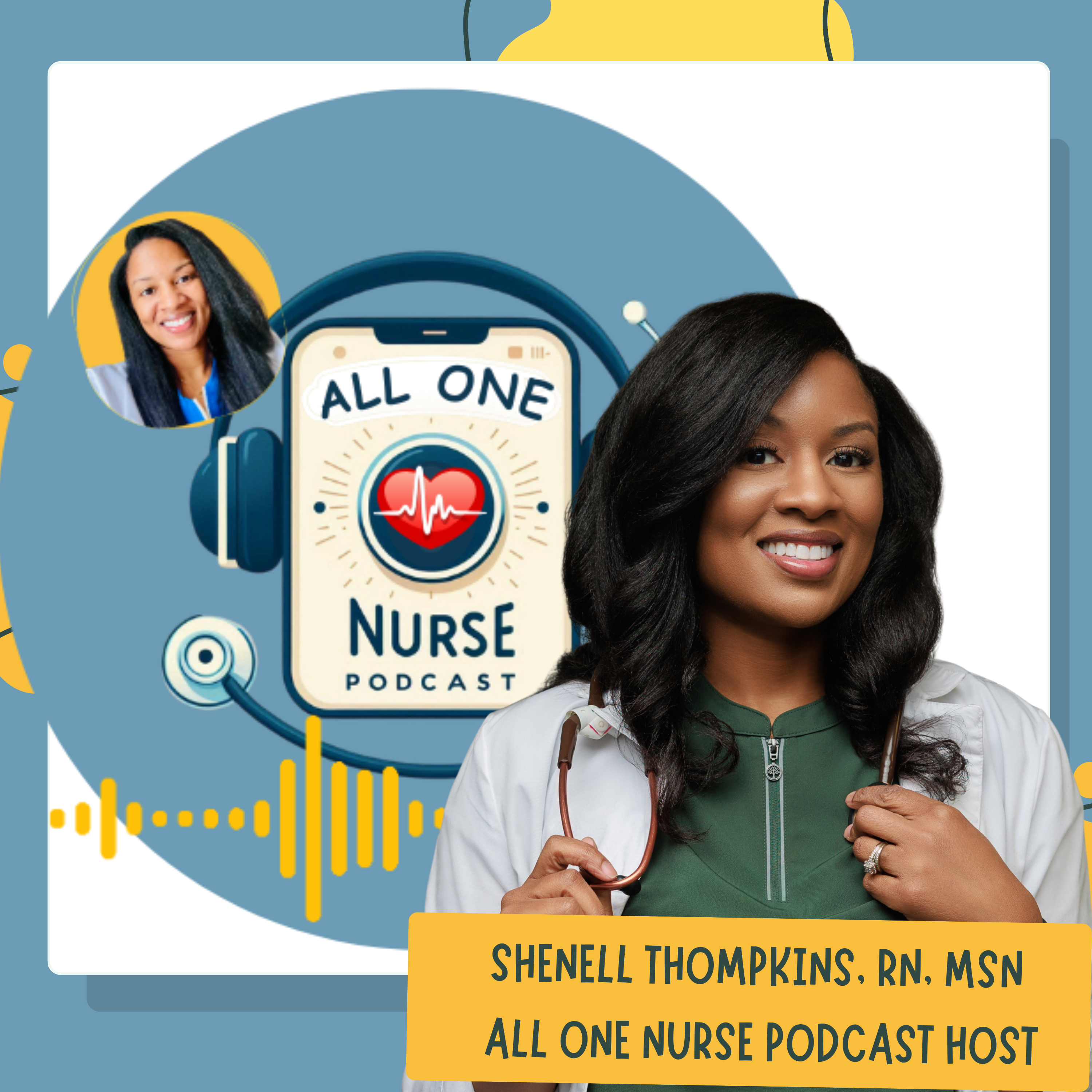
I'm your host, nurse Chanel Tompkins, and I'm also your mentor and nurse educator. And this space was created just for you to breathe, to learn, to grow, and most importantly, feel supported no matter where you are in your nursing journey.
So take a deep breath and let's step into your next breakthrough. Did you know that burnout is common and severe? The American association of Critical Care Nurses reports that about 25 to 33% critical care nurses show symptoms of severe burnout. And up to 86% have at least one classic symptom of burn burnout, which includes, but not limited to, emotional exhaustion, depersonalization, or low sense of accomplishment that resonates with nurses at every stage.
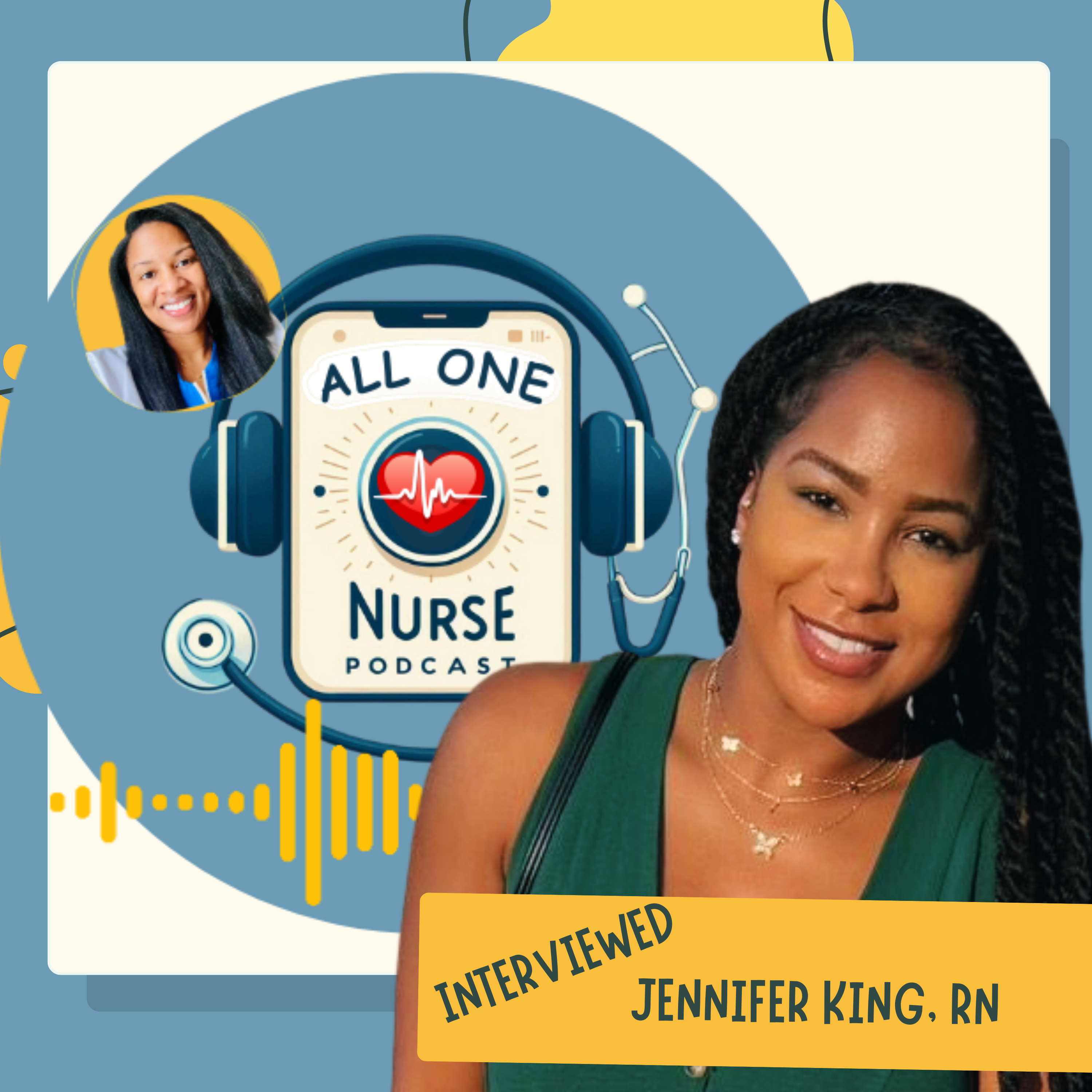
Welcome back to season four of the All One Nurse Podcast, and I am so excited because today we're honored to connect with Jennifer King, a dedicated registered nurse whose journey through critical care nursing is both inspiring and deeply rooted in compassion. Jennifer brings a calm strength, clinical wisdom, and a heart for mentorship that resonates with nurses at every stage. And in this episode, she opens up about the realities of ICU life, the moments that have shaped her calling, and how faith and resilience fuel her purpose. So whether you're a student nurse, a seasoned clinician, or someone seeking encouragement in your own healthcare walk, Jennifer's story will speak to your spirit. But before we dive in, I would love for you to subscribe to wherever you're tuning in from, because these conversations are changing lives.
And stay tuned to the very end to learn about our private All One Earth Facebook community, as well as mentorship, opportunity, and all things All One Nurse and how to connect with Jennifer King. So let's dive right in. Hi, Jennifer. How are you doing today?
[00:02:56] Speaker B: I'm good. How are you?
[00:02:57] Speaker A: Good. Thank you for being with us here on the podcast.
[00:03:01] Speaker B: Thank you for having me.
[00:03:02] Speaker A: Yes. Now, as always, you have to tell us, tell us a little bit about you and why you chose nursing.
[00:03:09] Speaker B: So I chose nursing because I'm actually the sixth nurse in my family, so it's kind of like a little legacy thing. But I've always wanted to be a nurse.
I always feel like, you know, I'VE always been like a protector over people. And I always feel like you have to fight for people who can't fight for themselves. And that's just been my biggest drive. And that's like my motto, my personal motto, you know, for my patients is fight for those who can't fight for themselves. And so that's just been one of my biggest things that's like pushed me to be a nurse is just to want to help people.
[00:03:36] Speaker A: Awesome. So what I hear off top is advocacy.
Yes, advocacy. And so just tell us a little bit about your nursing journey.
[00:03:45] Speaker B: So I'm actually an ICU nurse. I've been an ICU nurse for two years. I started off as a new grad in the icu.
I did of course, had regular clinicals and like med surg and OB and PEDs, but. And then I also did my preceptorship in the er and I just like, knew I was gonna be an ER nurse. And I actually applied for like three ER positions because I was like, I know I'm gonna be ER nurse. And I got none of those. And then I ended up applying for an ICU position.
And I pretty much got offered the position like at the end of the interview. And that's just where God wanted me to be. So that's where I am now.
[00:04:19] Speaker A: Awesome. Awesome. Now going back for my ni, for my nursing students who are tuning in. Tell us a little bit about your journey. Like, did you do a BSN program? ADN Associates? What was that like?
[00:04:31] Speaker B: So I actually did an accelerated Associates programs. It's supposed to be a year, but it was really more like 10 months between like holidays. And then like right before we took our exit essay, we had like a month out to study for that. So really it was like a 10 month program.
So we learned everything very, very quickly. I would advise people to do it if you can keep up with like the schedule of it. I did end up having to, like quit my full time job and, you know, go part time, just only working 16 hours a week. And then once my preceptorship kicked in, I actually had to completely quit my job. So those are things that you kind of have to think about when you are doing accelerated programs. You might have a whole bunch of life changes. So that was pretty much my experience with nursing.
[00:05:16] Speaker A: So for one, you did accelerate it. And two, I did not know that they had an. That there was an accelerated ADN program, which is your associate's degree in nursing. So kudos to you. Thank you. Kudos to you. And Now, I can actually recommend that to some of the nurse, well, aspiring nurses who want to go back to school, and they're like, what should I do? And I'm like, whatever works for you.
Your lpn, or get your associates, and then go on and get your bsn. Whatever works for you. Like, it's up to you, not anyone else, right? Pretty much. So I love that you shared that. Thank you. What would you say was your biggest challenge? I know you said you had to quit work, and so. But what would you say your biggest challenge is and how did you overcome it? Because I have some mentees who are in an accelerated program.
[00:06:10] Speaker B: I would say the biggest challenge in, like, my personal life was not having a life, really. Unfortunately, There were times that, like, you know, I would want to FaceTime with my family and my nieces, you know, my nephews, and I'm like, hey, y', all, I have to go. You can't really hang out with, you know, your friends as much as you would like. You kind of see them in passing, and then you have to say, hey, I have to go study. The biggest challenge in nursing, like, school life, I think, was just, you have to adapt and adjust to, like, different professors. And some professors are stricter than others. Some are less, you know, you know, less. More lenient, and just kind of relearning, you know, professors. And then also the classwork, I think is fine, but you also have to, like, balance between, like, what you think is important and what's really important. And then kind of once you figure that part out, it does help out a lot. And then also taking your hesis, like, I didn't really know how to pass the hesi, because I was never taught how to answer the questions. You know, you go to nursing school thinking that you study and you're going to take the hesi, but in actuality, psychomets, you have to know how to answer the questions. It's not really always about knowledge. And I think that was my biggest challenge. Like, in fact, I actually never passed any of, like, the end of the semester hesis until it was my very last hesi. But that was only after I was taught how to answer the questions. And then I was one of, like, 10 people that actually passed on the first try.
[00:07:30] Speaker A: Wow.
[00:07:30] Speaker B: So, yeah, so that was very, very challenging because it kind of does discourage you. You know, it makes you feel like, why can't I do it? Why haven't I passed? And so I had to just keep trusting God. And, you know, that helped a lot.
[00:07:41] Speaker A: Helped. Thanks for Sharing that. That's awesome. Now, when you say you had to learn, did you. What kind of resources did you depend on? Was it a tutor? Was it a prep program?
[00:07:52] Speaker B: So our nursing program actually provided someone to come in from Elsevier, and it was like a three day, kind of like crash course. They provided like resources, you know, like nclex books and stuff on how to help pass. And so that really helped out a lot. Just having a person, it's kind of like having your own personal tutor. And then also I asked a lot of questions. If I don't understand something, I'm not going to pretend like I understand it. I'm going to ask and then you'll kind of see, like you'll be able to know if I truly understand it. And then I'm like, you know what? Let me still just ask. Because asking questions has gotten me to this point to where I was able to pass my hesi, my exit hesi. On the first trial, like I said, it was only about 10 people. So, you know, think about that percentage and then you just ask them questions. Just gets you to be able to pass something and be able to move on to graduation. So they just having somebody hands on really, really helped me out a lot.
[00:08:41] Speaker A: Good. That's awesome.
So just since we're already into personal insights, can you tell us what was your biggest motivation coming through the accelerated program and leading up to just your. The way you nursed today?
[00:08:57] Speaker B: One of the biggest things is my faith. I knew that this is where God wanted me to be. And that plays a big part in, like, how I do everything every day that motivated me because I have to do my part and God has to do his part, you know, but I also have to meet Him. And so I was like, you know what? I'm just going to study. I'm going to, you know, take this serious. I'm going to make sure that I can learn everything that I'm supposed to learn. And then that continued to help motivate me because I saw, I saw the ending, you know, I knew like, what the end game was supposed to look like. And that's all I saw. That's what I kept at the forefront was like, I know where I'm supposed to be, but I just have to trust God and do my part. And so that really helped motivate me throughout nursing school. Even when times got hard, even when I didn't pass my head, I'm like, this isn't the end, you know, this is just a step in the road that I just have to, you know, get over. But things that helped motivate me, like, to this day is just knowing that, like, what my purpose is, you know, nursing is definitely a unique career. It's something that I feel like people. There's an emotional aspect to it, there's a business aspect to it, but you always have to remember your why, why, why did you become a nurse? And I think that that continues to motivate me and to be able to just see, like, lives being changed, to have a patient, to just tell me thank you, to have a family, thank you, you know, for taking care of my loved one and doing all you could for us. You know, even when people even having preceptor show love to you, you know, just because of who you are and the type of nurse that you are and what you give, that really motivates me. Those things. People think that it's not important, but it's very important to us. You know, it really goes unrecognized. So just having somebody else recognize you also helps motivate you.
[00:10:35] Speaker A: That. That is such valuable insight, Jennifer. And I love that you mentioned that. So just thinking about or just jumping into patient perspective, your icu. So you went straight into ICU out of nursing school. And that is the most sought after unit specialty amongst new grads as well. In addition to, I believe, ER and NICU, like PEDs. And so what advice do you have for new grads coming into that type of setting, the icu, and. And give us insight on how long you've been in ICU as well.
[00:11:11] Speaker B: Okay, so I've been in ICU for two years. The advice that I would give is you have to do it even if you do it scared. That was one of the biggest things that, like, I had to tell myself. And we actually had a residency graduation and ICU nurses, the new ICU nurses, were asked to speak at the graduation. You know, so that was in front of a class of like 25 new grads. And that was one of the things that, like I mentioned was do it, but do it scared. Because ICU is one of those. It's very intense and it's very scary and you just have to trust yourself. But you also have to ask questions.
Yes, that is one of the biggest things. Ask questions. If you do not know, I tell everybody, please ask questions. Because you have a lot of drips that you have to titrate. You have vasopressors, you have sedation, you might have paralytics, you might have Lasix drips. I mean, all of These things are very, very important. And you have to, you know, titrate these things to certain parameters, and you just. That's just the biggest thing is learning how to titrate and doing it safely. You don't want to have a patient that's paralyzed and they're not sedated, you know.
[00:12:15] Speaker A: Yeah.
[00:12:17] Speaker B: And just being able to just do things safely and be safe, I think is practicing safe. So just asking questions will be my biggest thing. Studying outside of work, being receptive to feedback. Being receptive to feedback. Don't feel like somebody's out to get you. Don't get upset if somebody corrects you. Trying to think what else I could say. But those are my biggest things. It's just like the things that I just mentioned pretty much is what I would give advice to them for.
[00:12:40] Speaker A: Yeah. So. So basically, if you were talking to your younger self, it would be what I'm hearing you say is ask questions. And a big one was study outside of work. And I actually ask orientees that now. Like, do you study on your days off, like, wherever you like to go and sit and hang out, whether it's in your house, go to a bookstore, coffee shop, take a journal and, like, truly journal down, reflect on what was your patient like, what did you do? And honestly, do research on. Okay, the drips that you actually were administering to the patient. And so just imagine having to be in the critical care setting because something is obviously not going well and it's critical. And so as a new nurse, I'm sure that could be frightening. But like you said, ask plenty of questions, be confident in what you do know, but always ask questions to validate and study.
Jumping into patient perspective. Jennifer, how would your patients describe you?
[00:13:38] Speaker B: My patients, they will say that I'm funny. They will probably say I'm way too outgoing. They will probably say she is too talkative, but we have a good time. I cuddle with my patients, but they will also let you know that she's very caring. I'm very attentive.
My patients know that, like, whenever they're pressing the call, I'm there. I always tell them, hey, if you need me, call me. I'm always trying to make sure that they feel like that they're not bothering me because I'm there to help them. Most of the patients didn't ask for these things to be done to them to get them to the hospital, let alone icu. So I would never want somebody at my lowest point in my sickest time in life to make me feel like I'M bothering them because then that doesn't help a patient's emotional health, you know, and their overall wellness. It doesn't help. But that's what I think that they would definitely say about me is, you know, I'm a great nurse to them.
[00:14:24] Speaker A: Yes. And just the fact that you say you're talkative, I'm pretty sure once you once you're talking to them and explaining everything, that they really don't have a tendency to really call that often because you probably give them the layout of what the plan of care is for the day. And I just love that. I love that. And that's the whole reason why I am doing this, the All One Nurse podcast, so that nurses like you can get on here and just show and be the proof that it doesn't have to be so negative. It's all about the lens in which we view patient care and view our roles as nurses. We would what I have found is that when individuals tend to complain about certain things, it may be because their perspective is not so positive. Not saying that the issues or the challenges are not there, but when I feel that when we approach things from a positive perspective, that in that sometimes we can make the situation better versus making it worse or do nothing. Have you had an instance where you got report and they said that, oh, this is a difficult patient, this is a difficult family member. And you're just like, I'm here and you actually have a good day with this family member, a good day with this, with the patient, because your perspective was different and how you even tended to the patient and how you saw your patient care.
It's time for a quick nurse note, a moment to pause, reflect and reset. In Galatians, chapter 6, verse 9 reminds us, Let us not grow weary in doing good, for at the proper time we will reap a harvest if we do not give up.
There are seasons when the work feels invisible, when the prayers feel unanswered, when the pouring out feels like it's costing more than it's returning. But this verse reminds us the harvest is coming. Not always in the way that we expect, not always on our timeline, but in God's perfect time. The seeds you've sown in faith, in love, in service, will bear fruit.
So if you're listening today and feeling tired, tired in your purpose, tired in your waiting, tired in your giving, know this, your labor is not in vain. God sees, heaven keeps count, and the harvest is already being prepared. Let this be a reminder to keep going, keep showing up, and keep sowing Good.
Now let's return back to our conversation with Jennifer.
Yeah.
[00:17:20] Speaker B: So you will have people that will say that this patient is difficult, their family is difficult. But it also just kind of depends on, like, your tolerance, you know, for people and what you feel like you should tolerate and what you shouldn't. But I never go into a situation, and I'm like, this family is going to be tough. Let me.
My whole day is gonna be bad with them. My whole interaction is gonna be negative. Because if you do go in with that mindset, then every interaction is going to be negative. So like you said, you have to kind of reframe your thoughts. And, yes, that's that person's opinion. But then I also. You also have to think about that person as a nurse. How is their personality? I'm one of those people that I feel like I've never met a stranger. I feel like, you know, I can go in any room and talk to anybody. But I also know how to read the room, and I know how to approach people and how to address people to make them feel comfortable with me. And if somebody is kind of upset with me, I try to tell them, like, hey, I understand your frustration. Like, this is your family. I would feel that same exact way. But I want you to understand, I'm here for you. I'm here for the patient, and I want to do what's best for the patient. So I kind of just, you know, make sure I throw that disclaimer out there, and I treat them fairly. I still give them a chance. And I think that's the biggest thing, is you have to give people a chance. I want them to give me a chance, so I need to give them a chance. And you might have people that are still difficult, but it's just water under the bridge. Don't get upset about it. Think about the position the family's in. We never know the family dynamics. We don't know what stress those family members have outside of the hospital. This is just another factor added into it. So you have to just remember that these people are human, and they're just going through the same emotions that we probably would be going through if we were in their position.
[00:18:57] Speaker A: Yes. And we can never tell people how to act when they're vulnerable, when they're sick, when they're not feeling their best, or when life has totally threw them a curveball, because nobody wants to be confined to a hospital room. And if you've been a patient before, then you would know after you get through the illness or you make it through the illness, then there comes the expenses, right, the bills. Like you have to think about all the things that come with being a patient. Being a patient. And just imagine dealing with healthcare expenses on top of life expenses, especially post Covid. And so we have to have grace. And what I'm hearing you say is that you still approach patients with empathy regardless of the situation. And you don't take it personal. You don't take it personal.
So thank you, Jennifer. Being a nurse in the ICU when tending to patients who may have grim diagnosis or poor outcomes, how two years in, how do you stay emotionally resilient?
[00:20:01] Speaker B: I will say one of the biggest things is I have to remind myself that the patient's diagnosis still gonna be in God's hands regardless. You know, I can do everything that I have done for that patient. And I also have learned to accept that it's life and that we all have to. And not saying it's life like, oh, well, it's life. No like in we all are going to be there one day. And so the realization kind of has hit for me that it's the inevitable for, you know, everybody. And when it's our time, it's just, you know, it is our time. And that's helped me out a lot because when I first started, things would affect me a lot. Like I feel like I had a lot of secondary trauma.
I don't know if that's the right word, but I took on the emotions of like the families and I feel like I took on the just being sad that a patient's here on the ventilator and they can't breathe for themselves. And it still makes me sad to this day. But I also think that I've just learned and just kind of taught myself that it's, it's going to happen and it's out of my control. And I think that that's just made it easier. Um, I don't want to seem like I'm heartless and I don't want to seem like I'm not empathetic. But you just kind of have to separate and know I did what I could for the patient. Unfortunately, this was still the result. And you don't beat yourself up about it. I think that's just the best answer is you fought a good fight for them. And that's honestly the best way that I can really answer it.
[00:21:33] Speaker A: Got you. And so what I'm hearing you say is it's hard to explain it in a way that it, that it sounds cold hearted, but you do have to build some type of resilience, to not take it on so personally. Am I correct? Like, you can't take it very personal or else that does take an emotional toll on you. And at first you were like that. And that's that human heart and that's that want to be there, that I want to take care of them, and that's that humanness. But also to, to stay in it for the long run or the long haul, you have to have some type of emotional resilience as well that you can't break down every time a patient passes. And you have to be able to be strong even from a professional standpoint. Right. We can't be in there crying harder than the family. Even though sometimes, you know, there's those instances where you may find yourself and you know what, and that's okay, but it can't be every time. The chaplain can't be consoling you and the daughter just lost mom. So, you know, we do have to have some emotional resilience. I think you've answered it very well, Jennifer.
And so what advice would you have for new nurses, newer nurses coming into the ICU setting? Because, and this is one thing that I, I feel that some people, they just want a small nurse to patient ratio. And they're like, you only get two patients in the icu. That's where I want to work at. And I'm like, you don't understand all the work that goes behind taking care of these two critically ill patients.
So what do you have to say to that, Jennifer? What would you say to a new nurse, knowing what you know now, that.
[00:23:14] Speaker B: If you come to the ICU with the mindset that you only have two patients, those two patients can feel like five patients. You can also be tripled in the icu. So I mean, it's the, the patient ratio. Yes. Is great because it's two. Majority of the time, especially where I work, my managers really strive to give us two. Now sometimes we might have three. They still come and help out. That's one good thing about my managers and director is they will still come and help us out on the floor. Yes. So kudos to them. But the thing is though, like, there have been days that I might have one patient, especially if a patient is a one to one, like a CRRT patient. Some places they're one to one that I've worked and you will be ripping and running all your 12 hours. Those patients are on CRRT for a reason, which is continuous renal replacement therapy. It's where you're not able to tolerate hemodialys because either like your blood pressure is going to be dropping or, you know, something's happening, but for the most part, they're not able to hemodynamically tolerate hemodialysis. So if they are on crrt, then you're giving probably a lot of vasopressors. They might be maxed out on vasopressors, they may be maxed out on sedation. It just depends on the patient. But you're always constantly chasing blood pressure, constantly trying to make sure, I mean, you have to document hourly on these patients, accurate I's and O's. Everything that you give in, you're going to have to either take out or minus. You know, add 50 to that number and take out more. I mean, it just depends on the doctor's orders. But like, they're hourly patients. Everything you do with them are hourly. So just because you have two patients or you have one patient does not make the assignment easier. So that's just the biggest thing, is don't come into it with the mindset that it's going to be easier because you have two patients.
[00:25:00] Speaker A: That's good. That's good. I actually did step down before I went to the ICU setting. So step down is like 1 to 4, 1 to 5, which I'm gonna be honest, we might have gotten up to six if, based off the patient acurity level, if they were ready to transfer a discharge. And some days I'm like, give me them six walking, talking patients, I'll take em. But even in the icu, like you said, one patient can work you the whole 12 hours. The whole 12 hours. And I remember telling one nurse coming into the ICU and I had worked the day before, and then the next day I told her, I said, look, you take this one patient, I'll take all three of these. And they were like, okay. And I said, I'll still help you. Because I knew the work that was entailed for that, that particular room. But I'm like, hey, I'll take care of these, these three, because I had already had one of them. And so sometimes it's like, hey, it's not about the ratio. It's not about the ratio. It's about the patient, the patient care and what's needed for them. So thanks for sharing that. So jumping right into educational insights, Jennifer. Now, I know you didn't really want icu it sound like initially, but now since you're there, what has drawn you to stay?
[00:26:13] Speaker B: Yeah, so that's correct. When I first wanted to think about what type of nurse I wanted to be, I was 100%, like, ER nurse all the way. And it's so funny because everybody else kept telling me, even my teacher, she's like, I see you being an ICU nurse, and I'm just like, no, ICU nurses. That's just. That's just too slow for me. And. And my mom even was like, I think you should do icu. And I'm like, no, mom. I just don't want that high acuity of a patient. I was psyching myself out of ICU because intensive care unit, as a nurse, like, who just did clinicals, like, you're not thinking that I'm ready for that level of care. So once I did not get er, I said, you know what? Everybody has been saying icu, I'm just going to give it a go. I'm going to give it a try. And if it's got it, that's your will. That's where I'll go. And it surely was his will, because, like I said, I got the job offered at the end of the interview. And I'm like, okay, but the thing that, like, kept me there is I fell in love with icu. Like, God will give us things that we don't think that we want or need. Like, we. I thought I wanted er. And the funny thing is I've had, like, new grad classmates, and they tell me how they would, you know, be crying when they came home from their shifts. And I'm like, I never cried in the icu. I've always had support, and I've always had just, like, great preceptors and tenured preceptors. And ICU is just one big, like, team. And that's the biggest thing is, like, we all help each other because my patient is your patient, your patient is my patient. There is no, that's your patient. That's. If I walk past the room and I see a patient desaturing, hey, let me stop by and see what's going on. You know, if a patient's call light is on and it's not my patient, well, I'm still going to go answer it. I'm still going to see what that person wants. It's just teamwork. Like, everybody helps everybody. You know, people will volunteer themselves to help you.
And when patients come in, we do what's called, like, a swarm. So everybody comes in, helps get the patient over to the new ICU bed, you know, gets the patient attached to the monitors. If There are any drips, you know, we need to start. People are going and getting that. I mean, everybody just works so well together, especially my unit. And so I think that's the biggest thing is, like, the teamwork. Yeah. And the camaraderie, you know, those are the things that have really drawn me in to the ICU and have, like, really made me stay. And also, like, my managers, like I said, my manager and director, they are great. I've never seen where any other manager or director will come and help you, you know, get your patients situated, help you take your patients to MRI, CT. I mean, what managers and directors do, you know, that do that besides.
[00:28:46] Speaker A: Right, right. Kudos to them. I'm just saying. Yes, yes. And I think that says a lot. They are setting the example of the culture that they want to have in your unit. It sounds like, like, they are servant leaders. Like, it's not about, oh, this is, I'm in charge and you do X, Y, Z. It's like, no, we're in this together. How can I truly help you in your role? Even if it means getting some gloves on and being present at the bedside? So kudos to them. Kudos to them. That is awesome. I think it all starts with the individuals that's actually working to set that example and to honestly raise others up or train others up as new people come along, like, literally training them up to be team oriented as well. So I think that's awesome. And again, kudos to your manager and your director for just being the example of what true teamwork looks like. Now, from your experience, what's often overlooked or misunderstood by providers and nurses when it comes to ICU care. I know we talked about the patient ratio, but in addition to that, I.
[00:29:56] Speaker B: Will say the things that I feel like are overlooked when people. Well, with ICU patients, the biggest thing for me is going to be like, the time that it takes to do certain things. I think some providers, whoever it is, whether it's like a resident provider, nurse practitioner, some of the things I think is just a time that it takes to do certain things. And sometimes people forget that you're only one person. There's only so much that you can do. And also thinking that we can do every single thing right when they want it to be done, or that they can wait until the end of the shift to put in 10 orders. And because it puts a lot on us as nurses, like, especially towards the end of the shift, we are trying to get our eyes and nose together. We're trying to make sure that Our patients are clean. Make sure that we've, you know, replenish any medications or drips that are hanging and everybody is doing that. Like, if you have a 20 bed ICU, you have 10 nurses and everybody's busy.
So when we get these orders that are put in after 5 o', clock, it really puts a burden on nurses because not only do you not have people available to help you do certain things, especially like if somebody puts a stat ct in at 6pm I think it's just the biggest thing that, like, people don't understand about being ICU nurses or nurses in general. Not even just ICU nurses, just nursing in general is just kind of waiting until the end of the shift to get everything because we just don't have the time.
[00:31:27] Speaker A: That's good.
So basically, get your orders in. Get your orders in. Okay, what are some of your final thoughts?
[00:31:35] Speaker B: Final thoughts is. Well, for one, I think that this is a great podcast. I think that what you're doing is amazing because it does help, you know, aspiring nurses or even nurses in general who have not experienced certain things be able to get like firsthand, you know, like examples and of like, what nursing is. Or somebody might be an aspiring ICU nurse that's already a nurse and they may be able to listen to the podcast and just get some information. Or somebody might, like you said, be an aspiring nurse and they can just grab information from this podcast. And I think that it really opens people's eyes to like, different types of nursing, especially when it comes to like, you know, NICU nursing, OB nursing, or mother baby, like you mentioned earlier, CVICU nursing. Yeah, I mean, it's so many different things. Med surg nursing. I mean, pacu. I mean, there's so many types of nurses that you can be like. I'll be interested to see like, what somebody from PACU says. So even though I'm an ICU nurse, I mean, you know, who knows, you, you know, eventually I might want to branch off to something else. And just getting somebody else's insight and perspectives really does help out a lot. So I think that this podcast is like the great place, you know, the best place to do it at.
[00:32:44] Speaker A: So thank you so much, Jennifer. That means a lot. Now you got me blushing.
[00:32:48] Speaker B: You're welcome.
[00:32:50] Speaker A: Thank you. Thank you.
[00:32:52] Speaker B: You're welcome.
[00:32:53] Speaker A: Yes. So how can the all one nurse community support you?
[00:32:57] Speaker B: I think just continuing to just put out, you know, your videos and providing us with the resources. I think just whatever you're doing now, I think continuing to do that is going to be what can help.
Because it's like, yes, I am a nurse, but I'm only an ICU nurse. I don't have the other perspectives and, you know, go through things that other people go through. And so there may be, like, resources or people that I can, you know, pull information from that are on your show. Sorry, on your podcast, that can, like, actually, you know, that is. That's beneficial to me. So, yeah, I think exactly what you're doing is what's going to, you know, help. Help me.
[00:33:32] Speaker A: Yes.
What's so funny is it's like, okay, God, you have given me something to steward. And so, you know, as we discussed before we even started recording is you're like, chanel, I'm here for you. And I'm like, no, Jennifer, I'm here for you. Like, it's all about you. So that just lets you know that we cannot beat each other's giving, so we won't try. But I just. I just want to be a vessel. And I think I just. It's just safe to say that, like, I am only human, and God has given me this. And by the grace of God, just through doing it, afraid with applying to podcastfornurse.org I mean, actually winning to be one of the top 10 hosts, like. Like God, like, helped put some things in motion. Yes. Yes. And that's how we got here. That's how we got here. It was like, podcasting is a great way. And so nurse.org definitely helped pave the way for me to turn all one nurse into a podcast in addition to a blog. So you never know. And here we are, and I get to interview wonderful nurses like you. And you're not just an ICU nurse. You are an awesome ICU nurse. And you're not just confined to the icu as you see through other nursing stories by other nurse guests here on the podcast. So I just really appreciate you as well. I appreciate you as well. And how can listeners connect with you?
[00:34:59] Speaker B: You guys can follow me on TikTok, the IC nurse Jen. And I'm also on Instagram as the same username. So if you guys want to follow me, feel free to follow me. I'll be glad to have you all.
[00:35:10] Speaker A: Yes. And you can also find Jennifer's Instagram and TikTok in the show notes below as well. Jennifer, we really.
Jennifer, we really, really, really appreciate you being here with us today.
[00:35:25] Speaker B: Thank you so much for having me.
[00:35:27] Speaker A: Now, as we wrap up this episode of the All One Nurse podcast, I just want to say thank you for rocking with me your host Nurse Chanel Tompkins for another season, Season four and it's so exciting.
And so as mentioned in this episode, go follow Jennifer King on Instagram and TikTok as the iCunurse Jen and I will have it down in the show notes below. And also follow me your host whether it's on Facebook, TikTok, Instagram, YouTube, all the platforms at all one nurse. And I'll have those listed down in the show notes as well. And I hope that this episode really resonated with you. Look at the show notes so that you can find more resources made available by All One Nurse. And I'm just thankful that you're here. And be sure to subscribe so that you'll get notified with the next episode of the All One Nurse podcast, in which I have multiple guests coming up.
And be sure to share this podcast with others.
If you have any recommendations, let me know. DM me on TikTok DM me on Instagram, Facebook. Hey, I'm here for it. And I just want to share the nursing journey of those who are truly compassionate, knowledgeable and have expertise that they want to share with the All One Nurse community so that we can continue to not only survive, but thrive and support aspiring nurses and new nurses as you take on that journey of being a healthcare professional. And so thank you for just being in this space and being here with me and our wonderful guests. And until next time, let your light shine. Bye.