Episode Transcript
[00:00:00] Speaker A: Did you know that first year nurses experience the highest turnover of any group?
That reality is staggering, but it also tells us something important.
You are not alone, and your growth matters.
Welcome to the All One Nurse Podcast, where we are bridging the gap between the stethoscope and the soul through real nursing stories and nursing conversations.
Here, our mission is simple. To get back to the human side of healthcare.
I'm your host, Nurse Chanel Tompkins, and I'm also your mentor and nurse educator. And this space was created just for you to breathe, to learn, to grow, and most importantly, feel supported no matter where you are in your nursing journey.
So take a deep breath and let's step into your next breakthrough.
Did you know that increasing the number of black providers doesn't just diversify the workforce, it literally saves lives. Research highlighted by KFF shows that communities with more black primary care providers experience higher life expectancy and lower mortality rates among black patients.
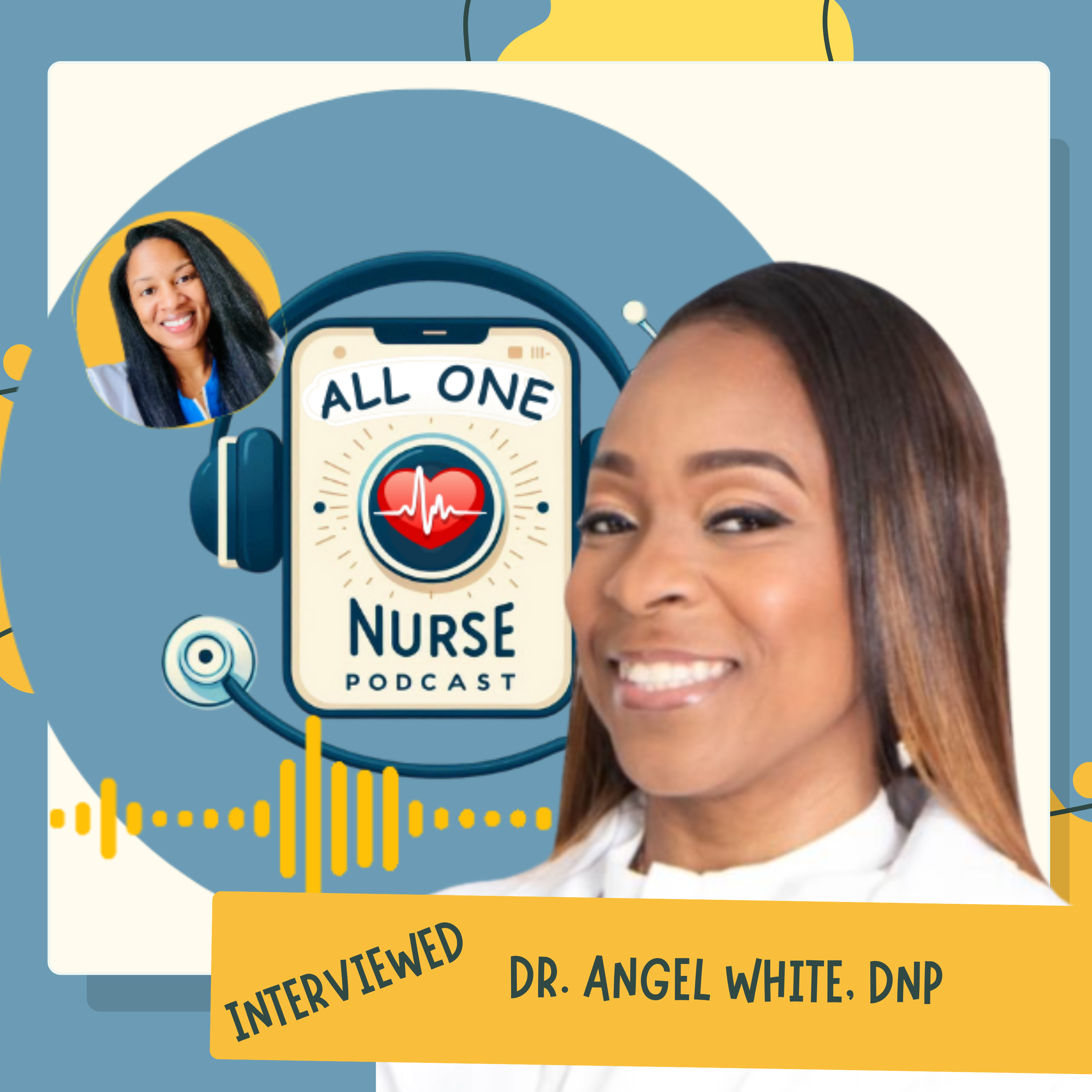
That's the impact of black excellence in healthcare. When representation rises, outcomes rise with it. Hey, friend. Welcome back to the All One Nurse Podcast and welcome to season four. I'm so grateful you're here with me today, truly. Thank you for pressing play, for growing with me, and for allowing this space to walk alongside you in your nursing journey. Every season is a blessing, and so stepping into another year feels especially meaningful as I step into it with you. And if this is your first time listening, welcome. I'm talking directly to you. I'm honored that you're here, and I pray that this becomes a place where you feel seen, supported and strengthened, but not just as a nurse, but as a whole person. So today we're starting this season with someone extraordinary, Dr. Angel White, who has her DNP and she has her advanced Nurse Practitioner degree as a board certified family nurse practitioner. She is a powerhouse in nursing leadership, a champion for patient advocacy and patient care, an educator, and a woman whose accomplishments speak for themselves. But more than that, she leads with heart, humility, and purpose. Her story will inspire you, challenge you, and remind you of the impact that you carry every time you step in your step into your role. So settle in to take a deep breath and let's step into season four together with gratitude, expectation, and a whole lot of faith. Welcome. Dr. Angel White. Thank you for being with us today. How are you?
[00:03:12] Speaker B: I'm fantastic. And thank you for having me.
[00:03:15] Speaker A: Yes, ma'. Am. Now, where are you tuning in from?
[00:03:17] Speaker B: I'm tuning in from Illinois, which everybody probably know as Chicago.
[00:03:22] Speaker A: Yeah. Oh, man. I know. Is it cold up there?
[00:03:25] Speaker B: Freezing.
[00:03:25] Speaker A: Freezing. Okay. Yeah.
[00:03:27] Speaker B: So.
[00:03:27] Speaker A: So being down in Tennessee, it was around 20 degrees like last week, and now it's like back up to almost. I think it is 60 at the time of this recording. So we gonna all be sick. Not me, but we're gonna have a lot of sick people. I ain't gonna speak it over me in my household, but thank you so much for being with us. Thank you so much for having me. Yes. Now tell us, what inspired you to go into nursing? Tell us, who are you?
[00:03:53] Speaker B: I'm just little old angel.
Since I was a very, very young child, I always knew I wanted to go into a field where I care for others. Because when I was younger, I used to get in trouble for giving my clothes away, always feeding somebody.
[00:04:10] Speaker A: Wow.
[00:04:11] Speaker B: So it was one of those things. And my mom was like, you always just giving your stuff away. And I worked hard for that. And so, you know, got cussed out a few times.
But it also, you know, showed me the type of person that I am, that I'm a caring person, that I feel like I'm a servant to others, you know, and supposed to help others.
When I was in high school, I was on the research and a lot of people was telling me, like, you know, you would be a great nurse. Okay, a great nurse. Not a medical doctor.
[00:04:36] Speaker A: Right.
[00:04:37] Speaker B: So, no. So I did the research. I did the research with nursing, and I did the research with becoming a medical doctor. And all my. My values and the things that I believe in it align more with nursing. So I went into nursing straight after high school. I think I became a nurse at like 22, 23 years old.
[00:04:56] Speaker A: Awesome. Same. Did you go straight into the BSN program? Tell us a little bit about.
Because you're doctor now.
[00:05:03] Speaker B: We had a little challenge this day.
[00:05:05] Speaker A: Okay. Come on.
[00:05:06] Speaker B: Got a full ride scholarship. I was planning on going to Atlanta, and things just didn't work out that way. I ended up getting pregnant, and then I end up having a stillborn for my first child. Sorry to hear that that happened. I just stayed home and I went to a community and I got my adn, my en, my Associates in Nursing. And then I just. I just kept going. Went for my bsn, my msn, and then my D.
Awesome.
[00:05:33] Speaker A: Awesome. Well, again, sorry to hear that.
[00:05:36] Speaker B: Thank you.
[00:05:37] Speaker A: But I commend you for still getting back into the program. Like, getting back into, hey, let me go ahead and still do what I need to do. And you still followed nursing. Because what I have found, even with some mentees now, is that they knew they wanted to do Nursing. But because of life, they started doing other things. And now they're finding theirselves in nursing school now in their 30s, in their 40s. So. That's awesome. That's awesome.
[00:06:03] Speaker B: Now, I try to tell people to, you know, kind of remember their why. Because although you may have planned for it to go this way, and I'm taking this path, you know, sometimes it don't work out that way. And I tell people sometimes your path have to change, but that never changes. Your goal, your end goal of wanting to become that nurse.
[00:06:21] Speaker A: So.
[00:06:22] Speaker B: So I'm a living proof, my path to amen. But I still was able to accomplish that, my ultimate goal.
[00:06:30] Speaker A: Awesome. Now, what I heard you say was, your path may change, but your goal is still the same.
You just spoke a whole word right there, Dr. White.
[00:06:39] Speaker B: Just a little bit.
[00:06:40] Speaker A: Yes, just a little bit. Thank you. Thank you. When we talk about other challenges that you may have faced during the programs, what was the difference between your end. Well, I went straight into bachelor's. And so I know the whole, you know, getting into the burnout with the bachelor's program. But what would you say your. Your different challenges were from your associates to your bachelor's program? Like, what. What would you say your key challenges were and how did you overcome them?
[00:07:08] Speaker B: So, to be honest with you, that ADN program was the worst. I mean, well, not the worst, the hardest. I ain't gonna say the worst.
[00:07:15] Speaker A: There we go. I know. I know what you mean.
[00:07:16] Speaker B: Hardest degree to obtain out of all my degrees. It's like getting that foundation, that basic registered nurse education.
And actually my BSN was less stressful. It was less stressful. So I think I like that route better.
It wasn't expensive. Okay. You know, that's a big thing when people try to say, well, should I do the ADN or should I go straight for my bachelor's? It really just depends on the person in their mindset, in their mental capacity, and also what your finances look like or if you do have scholarships, if you are getting financial aid.
[00:07:53] Speaker A: Yeah.
[00:07:53] Speaker B: And how much, you know, student loans you. You want to have.
So the community college, it was. It was very affordable. And the bachelor's, actually, it was just another additional year, two or three months at Governor State University, which is the local university out here, that was not far from the community college as well.
And it was. It was pretty good.
[00:08:16] Speaker A: It was.
[00:08:17] Speaker B: It was easier than the adn, I can tell you that much.
[00:08:20] Speaker A: Yes.
[00:08:20] Speaker B: And it's just really just. It's just time consuming. You know, you gotta make sure that you have the time for it. And so now I'm out of school. Now I got my license, and I'm working as a registered nurse. And it's like, oh, gotta go back to school, huh? And get that piece. So it's just, you know, have a structure, being organized and having the time.
[00:08:39] Speaker A: Okay, now, what motivated you to.
When you became. When you got your nursing licensure and passed nclex that first time?
That first time. That's what everybody hoping for. I did not. I. I think I stopped there. Like the. The question before the last question you could possibly get.
And so I'm like, I don't know if I passed or not. It was. I held on to the Bible for the. For like the next day or so.
My husband said.
He said, not my husband. My dad at the time, he was like, girl, go put the Bible down. I said, if it gonna help me, let me just hold on to it. But I know he just laughed. But with going into. I was about to say, with going into, what did you know for sure? Like, when did you decide that you were gonna keep going and get your bachelor's and get your master's and now your doctorate? Come on.
[00:09:28] Speaker B: I'm always challenging myself, and it's like, for me, once I accomplish a goal, I'm saying, ooh, what's next? Okay. I'm not the type of person that say, I could stop here, because learning is lifelong.
[00:09:40] Speaker A: Yeah.
[00:09:41] Speaker B: You know, and you're gonna continue to grow no matter what age you are.
So I was just. I actually didn't find out about nurse practitioner attack actually getting into the nursing program. I didn't even know nurse practitioners even existed or what they were, what they was doing. But when I actually got into nurse, the RN program, one of my instructors was telling us, like, how far you can go nursing.
I'mma have to go all the way.
[00:10:07] Speaker A: Yeah.
[00:10:09] Speaker B: Like, because me, for me, I love to inspire. I love to inspire. I love. I wanted people to be like, oh, you know, Dr. Angel White, you know, she. She left an impact. You know, the things that she was doing are doing. Still doing is very impactful. And I felt like I had to, you know, go all the way up to the top what are to. Or down to our next generation and inspire others and encourage others and let them see, like, this is possible. You can do. And just to be in those rooms, you know, where. Excuse me. Just to be in those rooms where, you know, policies and things like that is made, you know, And I just. I was just like, I would have to be at the top of this nursing game to really be impactful the way I.
Yeah.
[00:10:56] Speaker A: I feel like you calling me. You challenging me to.
Because, man, I'm telling you, I.
I don't. That doctor is just that going back to school, I think that's the one for me.
And then having small kids. But I know I'm just making excuses.
[00:11:13] Speaker B: That's exactly what I was gonna say. Come on with these excuses.
[00:11:17] Speaker A: Yeah.
[00:11:18] Speaker B: Some excuses is only the things that you're telling yourself to stop.
[00:11:22] Speaker A: Yeah.
[00:11:22] Speaker B: And to not go.
[00:11:24] Speaker A: Yeah.
[00:11:24] Speaker B: All that excuses and all the reasons why you shouldn't.
[00:11:28] Speaker A: No.
[00:11:29] Speaker B: Stop pouring into how much of an.
[00:11:30] Speaker A: Impact you wanna make.
[00:11:32] Speaker B: You know, what would this degree do? Yes. Don't nobody want to go back to school. That's too much work, honey.
[00:11:38] Speaker A: Work and money.
[00:11:39] Speaker B: Yeah, work and money. But it goes by fast. And I just tell people, like, when you ready to quit or you just undecisive, you just, like, I don't know if I want to do this. Like, do I really need it? Just think about your why. Like, why you really doing it? Why you want to do it? And time gonna go by fast, too. It's gonna go back on.
[00:11:56] Speaker A: Oh, God. How did I end up here with you, Dr. White? How did I end up here?
[00:12:01] Speaker B: It was destined to be.
[00:12:03] Speaker A: I'm like. I'm over here, like, okay. God. Okay.
[00:12:07] Speaker B: Yeah. And then, you know, you can do small steps. You know, you could take a class at a time. You know, do it on your own time and at your own. This is your journey.
[00:12:16] Speaker A: True.
[00:12:16] Speaker B: You know, so just throw that out there, you know, and if you need a DNP preceptor, I'm your girl.
[00:12:23] Speaker A: You got me. Look, I came to interview you. We. We came to interview Dr. Angel White, not get Chanel back in school and then be on the.
[00:12:33] Speaker B: In the next season.
[00:12:34] Speaker A: Season five. Talking about. As I start the DNP program.
Yes. Yes. I love it.
[00:12:42] Speaker B: Love it.
[00:12:42] Speaker A: Just jumping right into personal insights because you done already done came and stepped on my toes. What values or principles guide your work as both a nurse and a leader?
[00:12:54] Speaker B: Number one is integrity.
I am really, really big on integrity. But not just integrity. Compassion, excellence, service, and everything that I do. I mean, I believe leadership should be rooted in being authentic, you know, being accountable and just a genuine, you know, desire to just uplift others.
[00:13:12] Speaker A: Yes. Yes. I love it. I love it. And that's like. That's a scripture on that. All the qualities of. I think it's in Galatians. Yeah. It's like the Fruit of The spirit, you know, love, righteousness, all those good things. But. And speaking of, when it comes to your resilience and personal motivation, what does that like? What's your daily practice?
[00:13:34] Speaker B: Okay, great.
[00:13:35] Speaker A: Yeah.
[00:13:35] Speaker B: My faith is what keep me grounded. And it reminds me that the work that I do is bigger than me.
Rely on prayer. I do a lot of self reflection too. I think that is very important. And just gratitude to stay resilient, especially during these challenging seasons.
[00:13:52] Speaker A: Yes, some challenges, yes, ma'. Am. Yes, ma'. Am. I was listening to a sermon by my pastor and he was just talking about peace. And he was saying peace is something that is inner and peace is something that comes from God. And he said a lot of people look for peace as far as on the. On the. On like outside circumstances or from other people, but other people aren't responsible for your peace. Circumstances and challenges are going to happen because it's just life. But peace is, is the way you're able to respond or react to that challenge. And you know, I guess that kind of correlates with stress. Like your stress level is basically how you're responding to whatever that stressor is that challenge is or circumstance. So I like that.
[00:14:35] Speaker B: Take us to church. Take.
[00:14:37] Speaker A: I know, and I wasn't even trying. You taking me back to school?
You taking me back to school? I'm taking you to church now because we're here for our next generation nurses. What advice would you give to them when they feel stretched? They want to keep going. But what advice do you have for them?
[00:14:55] Speaker B: Tell them to give themselves grace.
Give themselves grace while staying committed to the growth. Because progress like that does not require perfection.
Small, consistent steps matter and rest is part of the journey. So when you feel and stretch, give yourself some grace.
[00:15:18] Speaker A: I heard grace. Give yourself grace and rest. And I found that a lot. Even when I feel like my mind is busy, girl, go take a nap, go to bed, and then you're able to think more clearly after resting.
[00:15:30] Speaker B: You are absolutely right. Rest is very important. People think like, oh, I just got to keep going, keep going, keep going, keep going. Your body needs to rest in order for you to function properly so you can keep going. So rest, very important.
[00:15:43] Speaker A: That's very important. I agree.
Now, how do you personally define success in nursing and in the healthcare setting?
[00:15:52] Speaker B: Success means to me, providing excellent care, creating opportunities for others, and leaving whatever place that I stepped in better than I found it.
[00:16:04] Speaker A: Come on.
[00:16:04] Speaker B: It's not, it's not about just the titles for me, you know, it's more about impact.
It's more about influence, and it's about integrity. Always do what's right.
[00:16:14] Speaker A: Yeah. Now you just dropped off some eyes. I'm gonna write that down.
[00:16:17] Speaker B: It's my favorite ones are impact, influence, and inspire Fire.
[00:16:23] Speaker A: I like it. I like it.
Now that's a whole word.
I was serious. I wrote that down. For real? Dr. Whiteman wrote that down? Yes. Now, just jumping into patient perspective, because I can't wait to talk about all things. You as well, because you're very inspirational with patient perspective when we talk about excellent care. From your experience, what do patients need most from nurses? Beyond clinical expertise.
[00:16:48] Speaker B: Patients need to be seen, they need to be heard, and they need to be valued as human beings. Not just their diagnosis, you know, empathy, clear communication and trust.
You know, just to help them along their healing journey or, you know, whatever journey that they on, as opposed to, you know, just treating them like diagnosis and medications. It's one of the reasons why I'm probably jumping ahead. But now you're curious. One of the reasons why I started my own private practice is because a lot of companies I worked for, I felt like they was treating patients like numbers and not actual.
I mean, I know I want to practice that way.
[00:17:28] Speaker A: Yeah. And I think the healthcare system, and you can correct me if I'm wrong. Um, but it seems like a lot of things are like business driven in a way. Like, patients are seeing it. Like it appears that patients are seeing as numbers. And it's like, no, we somebody life on the line.
And they gotta be able to afford the healthcare expenses that or the healthcare costs. So if you keep going up on cost, the patient's already sick. How do they afford the services?
Like, how? I don't know. And so it's like, how do we get back to the bottom line, which is the patients.
[00:18:02] Speaker B: Right.
[00:18:03] Speaker A: How do we create a better system for the healthcare system? Thank you. So what would your patients say about you? How would they describe you?
[00:18:10] Speaker B: My patients, so spoiled. Okay. I'm very spoiled. Oh. They would tell you how much they love me and love on me. Okay. My patients, I treat them like family.
You know, I treat my patients like family. And one of the things that I do do in my. My medical clinic is I don't rush my patients and I don't schedule them too close together, you know, because we need to talk, you know?
[00:18:34] Speaker A: Yeah.
[00:18:35] Speaker B: And that's how you really learn about somebody and how you can really.
It's through just a simple conversation, you know, that's true.
For them to be heard again. Heard and seen and I feel like they just coming in and you rushing them out the door and they have these issues that's not resolved. We might not resolve everything in one day, but we could tackle the main points and see what's going on and things like that. But as I advance, I've become more holistic in my approach. You know, not just focusing on the symptoms and the things like that that was taught to me in my education, but more like on the lifestyle, more on the mental health and social.
Experience has taught me the power of listening before.
[00:19:17] Speaker A: Oh yeah, yes, that's true. And when you say listening, you are so correct. When I say I, I will always say listen to what the patient is not telling you too. And then a lot of times we find out the root cause analysis when we actually make that connection to let, let the patient know that they're able to talk to us and they'll just say something in pass. And I'm like, well, you know, that's why you're here with those GI bleeds, right? With a GI bleed because you take be CP adder every day. With a Coke. With a Coke and not not taking their off day. Or they're highly stressed and they have other things going on that they can't control. You know, it could be adult children not acting right. Like you know, just life. And so it's like, okay, set healthy boundaries and, and maybe manage your stress. Then you won't need to be c powder as much and you won't be at risk for a GI bleed. Like just really listening to em. I don't know if that was a great example, but I just can remember having a patient like that and I was like, God, is everything else that's going on that got you here that's.
[00:20:21] Speaker B: Just simply by you listening to your patient and having a conversation with them. And you'll be surprised. You know, I have worked for a lot of companies, a lot of million dollar, multimillion dollar companies. I have been in a supervisory clinical director positions. Wow. And you'll be surprised at how many providers dismiss a lot of their patients and just don't listen to a lot of their patients. Which is really sad. But I hope you know that change with more nurse practitioners.
Practitioners, you know, with more nurse practitioners, you know, our nurses. Because we are the heart of healthcare.
[00:20:55] Speaker A: Yeah.
[00:20:56] Speaker B: Nursing is the heart of health care. Okay.
[00:20:58] Speaker A: Yes.
[00:20:59] Speaker B: Not to knock nobody else in their field in healthcare, but we are the heart of healthcare. That's another reason why I promote, you know, people getting that higher education.
Okay.
[00:21:11] Speaker A: Change some things Next question, Doctor.
[00:21:15] Speaker B: Yeah. So they can change some things, too.
[00:21:17] Speaker A: That's true. That's true. Okay. You coming for me, Dr. White? What's my next question?
Just a little bit. I didn't know I was coming to find out that I needed to go back to school. Okay, now.
It's time for a quick nurse note, a moment to pause, reflect, and reset.
Sometimes leaders or leadership isn't just about guiding teams, but shepherding hearts. It's the quiet strength to advocate for patients when their voices feel unheard. It's the wisdom to mentor a student who doubts their calling. And it's the reminder that even in the weight of responsibility, God's grace sustains those that he appoints. Dr. Angel White chose empowerment for her why? For nursing. Not just empowering patients with care, but equipping future nurses with confidence, vision, and the courage to lead with compassion. Her journey shows us that nursing is not only about practice, but also ministry, where every decision is a reflection of God's love and provision.
So our scripture. Our scripture to reflect on comes from Matthew 5:16. Let your light shine before others that they may see your good deeds and glorify your father in heaven. So in every patient encounter, in every mentoring moment, Dr. White is doing more than practicing medicine. She's cultivating hope, resilience, and faith. She's the proof that leadership can be healing and that God works through nurses, not only at the bedside, but in classrooms, boardrooms, clinics, and communities.
So my question to you is, where have you seen leadership be a form of healing? What moment reminded you that God can use your influence to restore hope even when you feel stretched thin? All right, let's get back to the conversation with Dr. Angel White, because this next part is where story meets her mission.
Can you share a moment? Like, can you share a memorable patient story that reinforced your commitment to nursing, that you're like, this is why I do this. Rather, it's when you had your adn, your bsn, or even now you make.
[00:23:54] Speaker B: Me put on my bank account. That's a lot of stories. You know, that's a lot of stories. I really just love when I have patients that simply just say thank you. You know, one particular patient that I had, and she came in and she was, like, very resistant. Like, you know, she didn't want to open up. And you could tell, like, she must have had some bad experiences with providers because she waited a very, very long time to see one. But as I'm, you know, just talking to her, having a conversation with her, and, you know, just explaining things to her and you know, just sitting there, like listening. I don't have my laptop, I don't have my pen and paper out, nothing. I'm just eye contact, sitting there at her level and you know, really talking to her. And she just started crying. She just started crying like, look, trying to hold my.
I was like, it was like a whole moment. And she said, she said, you are so sweet. And she said, you have a very, very good spirit. And she said, I did not want to come to see no doctor. And she was like, I only came cause my daughter made me. And she was like, but because she said, I have always had bad experiences with doctors and they just, you know, throw you on pills, don't tell you what the pills is for, if your blood pressure up. And they just saying, oh, you got high blood pressure, I need you to take this. And they. She went on a ramp, you know, but at that moment, me just sitting there, being at her level, you know, giving her eye contact, let her know that I'm listening and I'm here, I'm present, allowed her to open up and tell me about these experiences, you know?
You know, and I tell a lot of people, they call me doctor, Nurse doctor, nurse practitioner, doctor, angel doctor, you know, and I make it very well known. Yes, I have a doctorate in nursing, but I'm a nurse practitioner. I wear that helmet, I wear that very, very proud.
[00:25:51] Speaker A: Give your credit.
[00:25:52] Speaker B: Yes, yes. And she was like, but you doing the same thing that the doctor doing.
[00:25:57] Speaker A: Yeah, yeah.
[00:25:59] Speaker B: But that was one of like one of the moments where I was like, see, this is why I do what I do. This is why I'm needed. This is why I need to fill that gap. This is why, you know, people in my community need providers, you know, that care that listens, you know, that actually is going to put a good treatment plan in place that's centered around them.
[00:26:18] Speaker A: Around them, that's good. See them for who they are. And basically, and this is what I've learned too, you know, I've seen something on Instagram and it was just talking about how it's easy for, for it to be documented for minority groups or people of color that individuals that don't have the resources to be non compliant, and it's not that they're non compliant, they just don't have the ability, but you have to have those conversations and you have to listen to them. That's any patient, regardless of their skin color. Right. But you have like, you have to make sure that they have the ability to fulfill that Option that treatment plan that you're setting forth for them.
Right.
[00:27:00] Speaker B: You're absolutely right. They quickly say somebody is non compliant without assessing the reason as to why you're non compliant.
[00:27:08] Speaker A: Right, Right. Yep. It makes a big difference. It makes a big difference. Thank you for mentioning that, for just seeing your patient from a holistic approach. And when you're approachable like that and you honestly are there for it, like, they can sense because people can feel your spirit. We see that. We see that all the time in the hospital. I was just telling my husband, I said, we have one patient. She was like, I don't want her back in my room.
And she's like, why you, Chanel? Why you not my nurse today? I'm like, girl, I want you. I want you for 12 hours for the next three days.
I did my shift, hon, but I'm here if you need me.
But it's. But it's all out of love, you know? It's all out of love. We're not just checking off tasks. We're not just from a provider standpoint, like, yes, the labs say this. The vital sign says this, but you try to understand your patient before you just start throwing out a prescription. That, yes, it will help with that. But let's get up under the table. Let's really get to the root cause analysis of how we even got here. So I could just. If I was in Illinois, I'd come to you, Dr. White. Sure would.
I'll be calling, be like, she know me. She know me.
Fit me in. Don't fire me as a patient now. Okay.
I'll be like, Dr. White, know me. Just tell her this. Nail calling. Okay, let's see. Let's see. Oh, I think you just. You really, like, hit the nail on the head with the impact, the influence, and then inspire integrity. Oh, I love them. I love those eyes.
[00:28:42] Speaker B: Yeah, them.
[00:28:43] Speaker A: I love those. Them eyes. I love that. Now I got to ask you a bonus question.
[00:28:49] Speaker B: Boom.
[00:28:51] Speaker A: Yes.
I think we kind of already kind of unpacked this, but I'm going to ask it anyway. So, as nurses, we often balance science, compassion, and advocacy. If you could reimagine the future of nursing beyond the walls of hospitals and clinics, what role do you believe nurses should play in shaping culture, policy, and the way society values life and relationships?
[00:29:17] Speaker B: That was a lot.
[00:29:18] Speaker A: That was good. Yes.
[00:29:20] Speaker B: Let's break that down. What was the first part?
[00:29:23] Speaker A: So, as nurses, we often balance science, compassion, and advocacy.
[00:29:29] Speaker B: Okay.
[00:29:30] Speaker A: If you could reimagine the future of nursing beyond the hospital and clinics, what role do you believe nurses should play in shaping culture, policy, and the way society's society values life and relationships?
[00:29:46] Speaker B: Nurses are uniquely positioned to humanize healthcare by bridging science with compassion.
[00:29:53] Speaker A: Yes.
[00:29:54] Speaker B: We help restore trust, dignity, and connection at some of the most vulnerable moments in people's lives. So I feel like. I believe nurses should be visible leaders in policy, education, entrepreneurship, and community advocacy. Like our voices are grounded in real world experience.
[00:30:15] Speaker A: Yeah.
[00:30:16] Speaker B: And we are essential to shaping systems, you know, that I truly value life and relationships. We are the heart.
[00:30:23] Speaker A: Yeah. We are the heart. Even though we are the heart.
[00:30:28] Speaker B: But, yeah, I think, you know, more nurses, you know, that has the mental capacity, you know, because everybody mental capacity is not the same.
Should, you know, get into those rooms, you know, become leaders in those spaces. And that's the only way things gonna change. That's the only way things change. Because you have a lot of people want to create these policies and rules and things for nurses who ain't even nurses.
[00:30:52] Speaker A: Yeah.
Yep. For health care, right?
[00:30:56] Speaker B: For healthcare.
[00:30:57] Speaker A: Yeah.
[00:30:57] Speaker B: Yeah, you're absolutely right. So that's why I seem more like it's business driven, because those. Probably the type of people with those particular mindsets is the one that's, you know, trying to, you know, create all these policies and rules and things like that. That's why as nurses, we really need to put ourselves in those rooms and become leaders.
[00:31:15] Speaker A: Mm. I like that. We gotta put ourselves in those positions. In the position to be in those rooms. We gotta put ourselves in a position to be in those rooms. Thank you. That was. That was good.
[00:31:28] Speaker B: And that was off the top of the dome, man.
[00:31:31] Speaker A: You broke it down now, Dr. White. Just jumping right into educational insights. Tell us more about your current roles and what you do now.
[00:31:42] Speaker B: Y' all ready? No, because we not ready. Like you ain't done yet.
So currently, right now, I do have my own medical practice called ANS Divine Healthcare, where I offer a variety of high quality healthcare services from primary care, urgent care, you name it, I'm doing it. Okay. I just started incorporating mental health too, as well. So I did just complete my psych certification.
[00:32:10] Speaker A: Come on.
[00:32:12] Speaker B: Thank you, thank you, thank you. So outside of the medical clinic, I do have a not for profit called Angels Helping Hands, where I mentor teen girls and teen boys. We do a lot of enrichment activities. I take them on college tours. We do a lot of things. I love my youth. I love pouring into the youth. They our future, you know?
[00:32:29] Speaker A: Yeah. That's it.
[00:32:31] Speaker B: So outside of that, I have another business called Angels Exclusive Creations.
And that is just the umbrella of actually three different things. So one of those things is I do provide business and entrepreneurship life coaches.
You know, several. Several people set up successful businesses. Also I do have a podcast too as well.
It's called Black Excellence in Healthcare White Coats and Real Talk Podcast. I help the black voices, black trailblazers in healthcare on their and their child, their trials and challenges and things like that, so they could be seen and heard and people know what's out here that really exists.
True leaders.
And then the third one is, which I'm finna launch this January, is White Coat Powerhouse Nurse Practitioner Group.
And that is just going to be like a professional community created to empower, elevate, and educate and equip nurse practitioners and nurse practitioners, students.
[00:33:36] Speaker A: Okay.
[00:33:37] Speaker B: Confidently step into leadership. Be visible, you know, and own their expertise, you know?
[00:33:43] Speaker A: Yes, yes.
[00:33:44] Speaker B: Our clinically trained. We're trained, we was trained, but never taught how to navigate confidence, career growth, how to kill that syndrome, you know, or, you know, building influence, you know, beyond the bedside.
[00:33:59] Speaker A: Yeah.
[00:33:59] Speaker B: The White Coat Powerhouse is going to fill that gap. You know, we're going to provide mentorship education, just a supportive network of nurse practitioners just to help strengthen their voice and authority and move with purpose.
[00:34:12] Speaker A: Yes.
I love it.
[00:34:14] Speaker B: I'm super excited.
[00:34:15] Speaker A: I love it. I'm on the ground level with, with the nursing students, like, right out of nursing school and with the first year, first 18 months of their nursing career, and it's like you're taking it to the, hey, this is the next level. Okay. You're. You're in your advanced degree now, but now let's continue to let me provide that mentorship on that level, because you're able to speak to that. I love it. Okay.
[00:34:39] Speaker B: I want to ask you a question.
[00:34:41] Speaker A: Okay.
[00:34:41] Speaker B: So with your nurse mentorship program, are you doing that virtually?
[00:34:47] Speaker A: So I do just new nurses coming straight out of nursing school.
[00:34:50] Speaker B: Okay.
[00:34:50] Speaker A: The bachelor's or associates level. And I'm doing it virtually.
[00:34:55] Speaker B: Okay. Awesome. Because I am an adjunct professor.
That part too.
[00:35:00] Speaker A: Yes.
[00:35:01] Speaker B: So I do teach at a local university and I teach on all levels. Okay. We teach RNs to, you know, student RNs, and they be looking for mentors when they come. I had a student asked me about this. I'm gonna have to send them your way. Yes.
[00:35:17] Speaker A: Yes, ma'. Am. Thank you. Thank you. They are welcome. They're welcome to come join us. I set up a Facebook community, all one nurse Facebook community. And I made it private so that they can just kind of get in there, make it more intimate.
As it grow right now, it's like very intimate, but as it grow, it's like this is a safe space for them to just get what they need because there are other nurses that's a part of it. You're welcome to join it if you want to, but some. I just want to be able to provide a safe space. The goal is to provide them information with honesty in truth, but also in love, because we're all facing some of the same challenges. But how do you navigate those challenges? What type of mindset do you have? Is it going to be negative or is it going to be positive? You know, things like that. So just providing that safe space to, hey, bring, bring yourself as you are. For believers, non believers, it doesn't matter. The goal is to, to get from, go from surviving to thriving as an individual because you got to be your best self before you can actually try to get out here and take care of somebody else. Or you can, but you're going to run on empty and you're going to burn out.
So how do we help them with that? So with you mentioning that you were also adjunct faculty, you know, I like to ask questions regarding that. What gaps do you see in education today and with nursing education and how can we better prepare students for the realities of practice?
[00:36:44] Speaker B: Go real deep into that. So I'm going to try to sum that up because it's one of the reasons why I do mentor and I do offer preceptorship in my clinic too. So I do preceptors practice, practitioner students there too as well. I also bring my nursing students there and I teach them like how to do like IVs and things like that. But what I'm seeing that is really heartbreaking, especially since after Covid, is that a lot of these schools is not really preparing nurses how they should be prepared or how I was prepared in my nursing career and people that you know and has been nurses as long as I have too as well. I'm okay with certain things being online, but I feel like it kind of, you know, takes away kind of the human interaction part. A lot of these nurses are not really being equipped with like good bad size skills and just not having that basic nursing foundation when it comes to making clinical decisions and with their clinical skills.
What I'm hearing.
Well, I had, I will tell you about the time I had one nursing student because I interview nursing students who want to precept in my clinic. And she asked me, she said, can I just pay you and not do the clinicals? But you're not even a nurse practitioner yet. I said, absolutely not. I ain't, I ain't, I ain't thirsty for no money. This is where the integrity part comes in at. But it's other providers out here that are doing that and that's why they're not equipped or prepared when they get out into the field. That's one of the reasons why I feel like more nurses who really love what they do is to pour into our next future generation of nurses and not cut corners or just allowing them not to learn for a pay cut. I mean, it's really sad because I'm seeing it and not just with registered nurses, but also with nurse practitioners. And then sometimes I had a student tell me like, she really. Another one cried. She said this the most I have ever learned. Her other clinical experiences, she said she didn't learn nothing. She didn't learn nothing. They always let her go early and you know, it wasn't no hands on and no one really like teaching her and sitting down, talking to her. Do case studies with the students. Yeah, you gonna learn. You come into, you come into my space, you gonna learn. Because this is a learning environment and I want you to be you dealing with people lives. So I want you to be able to go out there and know what you're doing.
[00:39:15] Speaker A: Yeah.
[00:39:15] Speaker B: Because that is very, very important. But you do have a lot of providers out here now that's just giving a lot of students the easy way out and that ain't doing nothing but hindering them. So it's one of the main reasons why I really, really mentor and another reason starting this nurse practitioner group that offering mentorship is because of that reason.
That reason.
[00:39:40] Speaker A: That's good. And I'm glad that you mentioned it and brought it to light because I knew that preceptors now charge for clinical hours and I'm like, ugh, I don't know. But I, I get it, I get it. But at the same time to, to just want to pay to get your hours and not do it.
What did you, what do you think you're gonna be able to do?
Which I noticed with your np, you.
[00:40:07] Speaker B: Know what I'm finding is it's quite a few. It's not like one or two, because I deal with a lot of nurses and a lot of providers. It's quite a few that just want the title and want to be known as a nurse practitioner, but don't actually want to take the responsibility of what comes along with that title.
[00:40:32] Speaker A: Yeah, yeah.
[00:40:32] Speaker B: And then some people want it because the money is lucrative. You know, it's a good paying career and some people just want it because of the money, too.
But people don't understand. And I teach nurses. Like, you could easily lose those licenses. They was hard to see, but you could easily lose those licenses.
[00:40:47] Speaker A: Yeah.
[00:40:48] Speaker B: Yeah. And I've been seeing a lot more of it now, and it's really. It's really sad. It's really sad.
[00:40:54] Speaker A: Yeah. It's like, I think. I don't know if it's just the culture that we live in. Like, there is no.
There's not as much connecting. And it's like, y', all, we gotta. You gotta care enough about something other than self. Other than self. Like going into healthcare, regardless of what you choose to do. Somebody. Life is on the line and I cannot imagine you paying for your clinical hours, eating.
I come to you for services, and you don't even know what to do.
You don't even know what to do.
So that goes back to integrity. And we should always want to do the right thing when nobody is looking.
And that's for self. Even as nurses just starting out, we coming through the nursing program. You would think that when I think about the nursing code of ethics, that something will rub off on you to say, oh, since I'm in this program and now since I'm learning about veracity and maleficence, if I'm saying it correct, like all those things, beneficence, when I'm learning all these terms and what it means to be part of the nursing profession and why we're considered the, you know, a trusted profession and what the code of ethics is like. I remember we had a whole class on. On the code of ethics.
[00:42:13] Speaker B: Yes. Yes.
[00:42:14] Speaker A: I'm like, I don't even know if they're doing that now. Like, I question it.
[00:42:17] Speaker B: Well, a lot of schools don't do it. And then a lot of schools will incorporate it in like one discussion. Like one discussion. They're kind of like, tackle it a little bit, but it's not significant. Like, a lot of these programs really trying to condense all of the content.
[00:42:32] Speaker A: Yeah.
[00:42:33] Speaker B: And, you know, people is not really grasping it because some people, that's like, I hear one, one of my students say online, they say they just doing the work to get it done and not really retaining none of the information or like really learning the information. Just it's so much work and they just trying to do it to get it done since they have these accelerated programs and they shorten the time, so. And then it's a Lot of work and a lot of work. Yeah. And a lot of students is just doing it to get it done and not really understanding or grasping concepts of things.
[00:43:02] Speaker A: Yeah, I just heard that too, recently from a mentee. Just feeling like I'm not retaining. I feel like I'm going off of memorization to try to pass that test and have a heart that wants to remember all this information. So heart is right. The program is accelerated.
And so it's like, give yourself grace, because it's just gonna take. Like you said, learning is a continuum. So when you make it through this program, you're still just gonna have to find ways to honestly put yourself in a position to always reflect on what it is that you're doing. Always sit there and self study. Studying doesn't stop or learning doesn't stop when you get out there at the bedside. And I even tell new nurses that now, like, what are you doing on your days off to reflect on how your day went with your patients Practice? Because I'm thinking about bedside. Right. So make sure you're practicing your bedside report, like, whatever you need to do, journal to write down. Okay. What went on with this patient? Did I truly understand what this day entailed for that patient? And to give you some context, I help with critical care orientation in a critical care setting. So I always try to make sure that they see patients from a holistic view as well. Because a lot of times they say, you just have two patients in the icu. And I'm like, y', all, these patients are. Both of them could be dying. One of them could have already died.
So it's like, y', all, I need you to not just see it as, oh, you only got two patients, like, Truly. And don't count them out. Don't count them out, but do the work. You're in a position to provide all the interventions. Do the work. And it's not just doing the interventions, but honestly, trying to do it in a way that is going to have the best outcome for the patient to keep them sedated and intubated. It may be a peaceful night, you know, a quiet night, but there's always something to do. And if we can truly help that patient get off that ventilator, let's. We need to do that. We need to do that. I know we don't extubate at night, but still set them up so that they'll be ready in the morning. You know, like, I can just keep going. I. I get very patient oriented, and I'll keep going. I'LL be like, how do we even get to ventilation and sedation?
[00:45:10] Speaker B: I'm telling you.
[00:45:11] Speaker A: But side note, they do have ICU liberation where they. They are not sedating patients or keeping them sedated. And they're actually them with the ventilator. I thought that was good, good stuff. So I'm proud of that. Let's see you. You dropped some bombs on me, Dr. White. Okay, now, as we wrap up this episode, Dr. Angel, I just want to say thank you for sharing your wisdom, your heart, your expertise, and just really laying the foundation of what it looks like to be a nurse who has went all the way in spite of challenges, and now you're pouring into others from the top. And you have also inspired me. Well, to be continued. But I really appreciate it. But in that, what final encouragement would you offer to new nurses who feel overwhelmed or uncertain at this time?
[00:46:07] Speaker B: What I would say is stay rooted in your purpose, trust the process, and know that growth comes with time, mentorship, and self belief.
[00:46:19] Speaker A: Yeah.
[00:46:20] Speaker B: Always remember your why. Always remember your why. Stay rooted in your purpose. And I just want to thank you for allowing me the opportunity to share my story on this platform.
[00:46:34] Speaker A: Yes, ma'. Am.
[00:46:35] Speaker B: What you're doing is amazing. It's needed. It needs to be seen. It needs to be heard. Even with the mentoring.
[00:46:43] Speaker A: That.
[00:46:43] Speaker B: That is a true God's calling. And keep going, girl.
[00:46:47] Speaker A: I'm working. Thank you. I needed to hear that more than y' all know right now. Yes. Thank you. Thank you so much. You're welcome. How can our listeners connect with you?
[00:46:59] Speaker B: Well, I'm mainly on Instagram. I be on Instagram a lot, but I'm on all social media platforms.
Dr. Angel White, you can find on Instagram, Facebook, LinkedIn, Tik Tok. Okay, all of those things go to my Instagram page, Dr.
Angel White, and in my bio, you will see all of my pages linked there.
[00:47:25] Speaker A: Okay, so y'. All. So be sure to go follow Dr. White, especially if you plan on continuing your education and going to get your NP or heading straight for your doctorates in nursing practice. Be sure to go follow Dr. White on Instagram. And I will put all of her handles and her website in the description below. Check it out. And for the NP group this month of January, Dr. White, how can they get planted and get connected?
[00:47:56] Speaker B: You can inbox me, you can visit my website, you can send me an email.
All of my contact information is pretty much on all of my platforms. You can just reach out to me. I promise you I'll respond back.
[00:48:11] Speaker A: Thank you. So much.
[00:48:13] Speaker B: Yes.
[00:48:14] Speaker A: And I'm sure this won't be the last time because you dropped those eyes and I'm like, okay, I got my eyes. We gonna have to come back to those. Yes, ma'. Am. Yes, ma'.
[00:48:23] Speaker B: Am.
[00:48:23] Speaker A: My impact, influence and inspire. Yes. And of course, integrity.
[00:48:28] Speaker B: You got a damn.
[00:48:30] Speaker A: Thank you so much.
[00:48:32] Speaker B: Thank you.
[00:48:34] Speaker A: I want to thank you so much for spending this time with me today. I hope Dr. Angel White's journey poured into you the way it poured into me. And if you're in your first 18 months of nursing or you've been feeling the weight of this transition, I want you to know that you don't have to walk at it alone. The All One Nurse mentorship program is officially open and the early birth rate is available until January 15th. And if you've been praying for guidance, community, clarity in this season, this is your invitation. I would love to support you, encourage you, and help you build confidence from the inside out. Also. And if you're also going into your advanced role in nursing as a nurse practitioner, then I invite you to check out Dr. White's new NP group that's launching this month as well. Her handle again is Dr.
Angelwhite, and you can find her on Instagram and she has all her other platforms in her bio under Instagram, but look in the description below so that you can get locked in as well.
Now, before you go, don't forget to subscribe so that you'll never miss another episode this season.
And if this podcast has blessed you in any way, please take a moment to leave a five star review because it truly helps other nurses, not just you, discover this space and get the support that they need. Now. Thank you for listening. I'm grateful for you, I'm cheering for you, and I'll see you in the next episode where I am going to be speaking with Jennifer King, who is a dedicated ICU nurse who is very compassionate. So stay tuned and until next time, let your light shine.