Episode Transcript
[00:00:00] Speaker A: Did you know that first year nurses experience the highest turnover of any group?
That reality is staggering, but it also tells us something important.
You are not alone. And your growth matters.
Welcome to the All One Nurse Podcast, where we are bridging the gap between the stethoscope and the soul through real nursing stories and nursing conversations.
Here, our mission is simple. To get back to the human side of healthcare.
I'm your host, nurse Shenell Thompkins, and I'm also your mentor and nurse educator. And this space was created just for you to breathe, to learn, to grow, and most importantly, feel supported no matter where you are in your nursing journey.
So take a deep breath and let's step into your next breakthrough. Did you know that less than 15% of nurses who hold a Doctor of Nursing practice degree in the United States identify as people of color? And yet DNP prepared nurses of color are leading some of the most innovative, equity driven and community centered work in healthcare today. And that's why today's conversation matters so much.
Welcome Back to the All1Nurse podcast. If you're new here, welcome. I'm so glad that you found this space. Go ahead and hit subscribe so you don't miss another episode, especially if you're a new nurse who's growing and stretching and becoming in ways that you didn't even expect.
And today's episode is one that sits close to my heart because. Because it speaks to something that many of us know too well. What it feels like to step into rooms where people like who. Where people who look like you are often few or none.
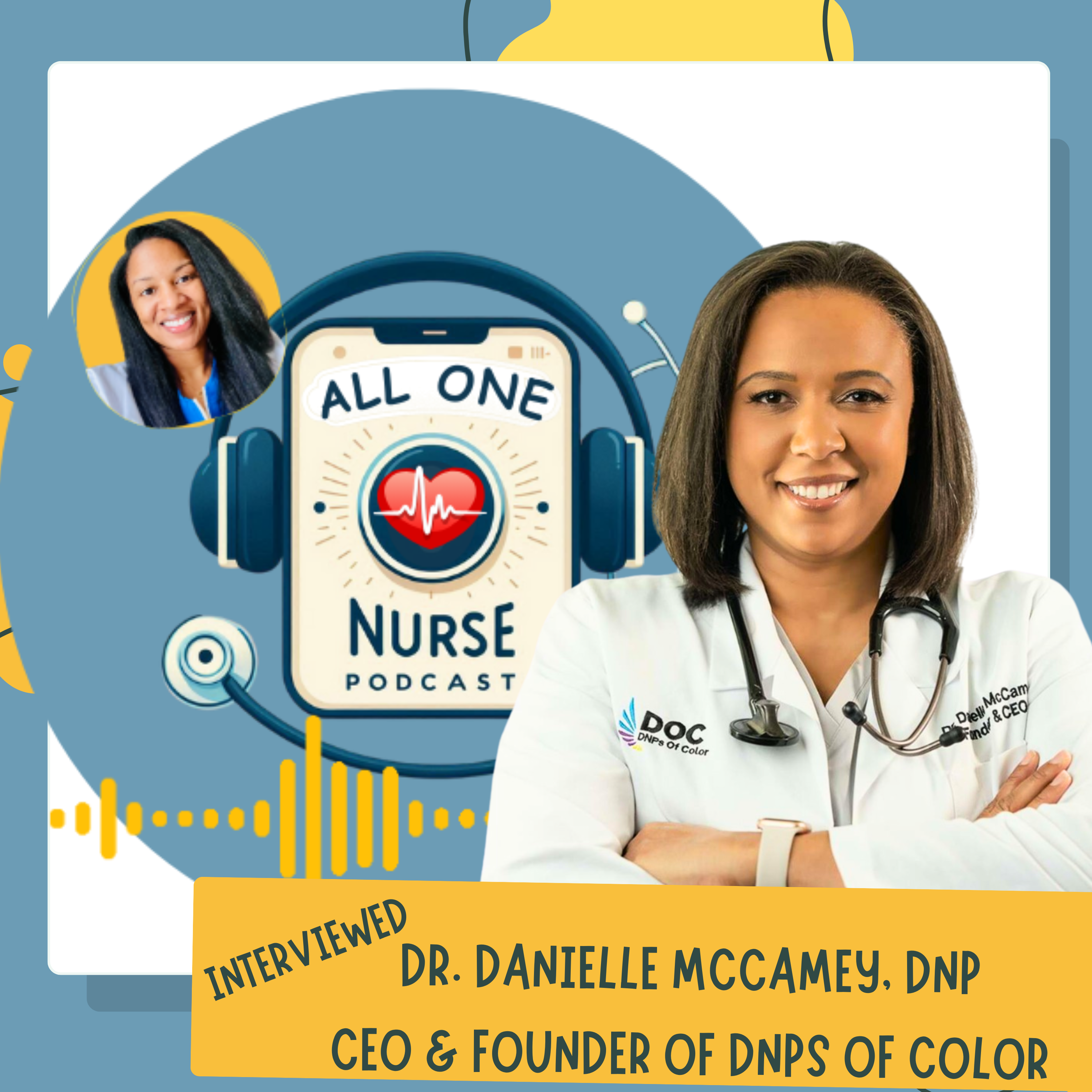
And that can often lead to making us feel uncomfortable or maybe even discouraging and even isolating. But I've also learned that they can be the very places that God grows you to, strengthens you, and impacts you in ways that you couldn't have imagined, as evidenced of myself. And that's why today's guest is such a gift. I'm your host, Chanel Tompkins. And today I have the absolute pleasure and honor of sitting down with a woman whose work has shifted the landscape of advanced nursing education and leadership. Dr. Danielle McKamey, the founder and CEO of DNPS of Color. Yes, and Dr. McKamey. She created DNPS of Color to increase diversity in doctoral nursing programs, support nursing nurses pursuing advanced degrees, and building a community where representation isn't just encouraged. It's expected, and I love it. Her mission is rooted in service and advocacy and creating spaces where none existed. And in this conversation, we're going to unpack, of course, who she is. And briefly, about her origin story, the why and the how behind DNPs of color, and the different type of mentors that you should have. And this episode is just rich and inspiring and full of those quiet moments or those quiet truths that stay with you long after the conversation is over. And so I am just elated to have her jump on the All One Nurse podcast with us.
So settle in, take a deep breath, and let this be a reminder that even when the path feels uncomfortable, you're not alone. And that you are absolutely capable of rising in spaces that weren't, or seem like they weren't built with you in mind. So let's get into it and be sure to listen in to the very end for a few updates and upcoming events that you don't want to miss, especially with the DNPs of color. Welcome, Dr. Danielle McCamey. How are you doing today?
[00:04:25] Speaker B: I'm doing great. How are you?
[00:04:27] Speaker A: I'm doing well. I am so excited to have you here on the podcast with us.
[00:04:32] Speaker B: It's such a privilege to be here. Thank you for the invitation.
[00:04:35] Speaker A: Yes, ma'. Am. Now I got to meet you for the first time in Tampa, Florida, at the Nurses Making Business Moves. Yes.
[00:04:44] Speaker B: Shout out to Sarah.
[00:04:46] Speaker A: Yes. Yes. So many wonderful connections and so much wisdom delivered to us in that room. So I am so appreciative.
[00:04:55] Speaker B: Right.
[00:04:55] Speaker A: On the All One Nurse podcast, we always start out with your nursing journey, like your origin story, because everyone has an origin story. So can you just tell us your origin story? Who are you and how did you end up in nursing?
[00:05:09] Speaker B: Well, who am I? I can think of a lot of songs that say that, but when people ask me this question, I always default to. I don't know if it's like my tagline or whatever, but I say that I build communities that create opportunities. And when I reflect on my career, I have this unique ability to identify gaps and just create opportunities, things to close the gap. And when I think on my nursing career, it was and is continuously inspired by my mom. She, back in the day, did home health nursing and dialysis nursing, so she would take me around with her. She's a single parent, so childcare was, look, baby, you coming with me to these appointments. And I got the opportunity to witness her nursing magic, which was incredibly inspiring to me. And she's always been my number one cheerleader and encourager. So when I finally came to my senses, because I wanted to be a physician at one point, and she was just. She was just watching me just count up the cost and count up the time. And I was like, yeah, I don't think that. I don't think that I want to go back to be a physician. And so she was like, yes, nursing is the best profession because of the flexibility, the versatility, you know, and the evolution that you'll get the opportunity to experience. Because nursing is just so versatile, so vast.
[00:06:34] Speaker A: Yes. I love that you say that. And thank you for sharing, because when I think about your mom, even her background in nursing home health and dialysis, those are two really tough. Tough, yes, tough. So you witnessed a lot.
[00:06:49] Speaker B: Yeah, definitely. I was like, acute care. Cause I ain't got tough.
[00:06:56] Speaker A: Yes, because you definitely got to see it on that side.
And, man. So it looked like you graduated in 2003. Right? So did you go straight for your BSN or your ADN?
[00:07:09] Speaker B: Your BSN, yeah, I went. I was a traditional BSN student. So I figured out the game secrets to college, like in my junior year, because nobody in my, you know, my mom didn't do the bachelor's route. So, you know, going to a traditional four year college was, like, new to my family.
So I had my coach put me onto some game secrets on about applying. So I went straight through.
[00:07:33] Speaker A: Yes. That's awesome. And then it looked like you went on and got your doctorate. So did you go straight through for your doctorates?
[00:07:41] Speaker B: No. So I. I never thought that I would go back to get my doctorate because I just thought I was like, what is. What is a doctorate? Like, is it going to get me then?
Then my mindset evolved, and I ended up stopped in between to get my master's. But still, when I got my master's, I never thought that I would go back to get my doctorate. And at the school that I got my doctorate, they were like, we have funding. We will offer full scholarships to folks that want to go. And I said, well, let me go ahead and put my hat in, because if I get in, who am I to deny them to pay me to go to school? That part. Yeah. So I got in and they paid. They paid for me to go to school.
[00:08:20] Speaker A: Awesome. Now, with your master's, I'm assuming you did your master's in nursing practice with acute care.
So tell me, what would you say some of your biggest challenges were coming through your BSCN or through your master's and even leading up to your dmp for those of us who are either yet to experience one or the other?
[00:08:43] Speaker B: Yeah. So the challenges, when I think about bsn, was just navigating the transition of being at a Traditional residential college. So first semester, it was the turn up, and then grades. The grades came in, and it was like, you got to turn all the way down because I was on scholarship grants that depended on bpa. And I said, my mama can't afford for me to, you know, be messing up, and she can't afford to pay my tuition, so let me tighten up. So that was like my major thing was just that transition. And then I also struggled with my cohort of colleagues. There was only four black nurses, nursing students in that. So we kind of banded together and we supported each other and moved through the process. But, no, we just recognized there was just access to resources that weren't offered to us, so we had to become our own support system. And honestly, that's been the thread throughout my. All my advanced degrees, Master's, you know, had some experiences there, and then doctorate, had major experiences there, which is why I created GMPs of color.
[00:09:44] Speaker A: Yes. Now tell us more about that. What did you experience to lead to the.
[00:09:50] Speaker B: Yeah, so it was. It was one. Me being the only black woman in my cohort, which I've been black all
[00:09:56] Speaker A: my life, but I still had hope
[00:09:57] Speaker B: that going to a doctorate program, that there would be, you know, at least somebody, another one of us. Yeah. But there was not. And I was like, okay, well, I've been to this institution for my masters, so I know what it is. But doctorate school was hard, and I struggled. And I was, you know, looking at my cohort mates that they were getting the support that they need. Like, they would express their struggles, they would get support, or they would get access to various different opportunities. And I'm like, but what? Like, I'm not getting them.
[00:10:29] Speaker A: What about me?
[00:10:30] Speaker B: Yeah. So. So then it just got to the point where, again, I. I kind of felt that quitting wasn't an option. Failing out wasn't an option. So I need to do something. So, again, putting together the community, it was initially just a Facebook group. Honestly, just selfishly for me to have people to. To talk to about my experiences and get some validation and also, like, you know, talk a little. A little something. Something on the side.
[00:10:53] Speaker A: Yeah.
[00:10:54] Speaker B: But then it just evolved into this, like, its own entity where hundreds of people across the nation that were either pursuing or had already pursued their DNPs had similar stories, and I'm like, what the heck? And then evolved into an organization that it is today.
[00:11:12] Speaker A: Oh, awesome. Now, what I'm hearing you say is that you were the only. Not the only black woman, the only person of color in your DNP program. And therefore you didn't have the resources or the support that you felt that you needed. And so when in starting just a simple Facebook group, Facebook community, you realize that, hey, I'm not the only one.
[00:11:36] Speaker B: Yep.
[00:11:37] Speaker A: And went on to found the dnps of color.
That is awesome.
Yep, that is awesome.
[00:11:45] Speaker B: It's, it's been, it's been an incredible journey.
[00:11:48] Speaker A: Yes. Now, in your role as a, as a dnp, what all does that consist of for you?
[00:11:55] Speaker B: One of the things I love about being DNP prepared is the opportunities that are available to you if you're ready and willing to articulate your value and also to be innovative to create the space if it doesn't exist. And that's kind of what was presented to me when I got my DNP degree. I no longer felt as fulfilled in my clinical nurse practitioner role because I started seeing all the systems level things, all the policy influences and then understanding like the, the literature behind a lot of the things that we were doing. And so I was like, you know, in clinical practice, full time just isn't where I've, it served my purpose. Now getting this advanced degree has offered me a different lens and also, you know, credentials to be able to sit at these, I call it like shot collar tables where, you know, I'm able to influence policies, procedures, decisions, and how do I learn to embrace that? Being DMP prepared, but also being able to articulate the value, which I think is probably like the number one thing. People always ask me, like, why dnp? And I say, why not? You know, having advanced degree is only going to add and enhance what you already have from your lived experience into your traditional educational experiences. So why not?
[00:13:15] Speaker A: I feel I'm going to tell you, I'm going to tell you. I got invited to an award ceremony, okay.
For being, because being master's prepared, you know, get to precept other, other students that's preparing to get like their master's in education, because that's my route. But I was sitting at a table at the award ceremony with a lot of the faculty, professors, and everybody was doctors prepared. And I had to reach over, like I leaned over and asked another friend, I was like, does everyone at this table have a doctorate? And she was like, yeah. I was like, oh my God. No pressure, no pressure at all.
[00:13:50] Speaker B: Just confirmation, just confirmation.
[00:13:54] Speaker A: Oh my God. And just even meeting with you here is just like
[00:14:00] Speaker B: the time gonna pass anyway, whether you in somebody's doctorate school or not.
[00:14:05] Speaker A: It is, it is.
And with interviewing so many awesome guests like yourself, it's just like, why not? Why not? Now this is a conversation. You might have to come with me to have my husband.
[00:14:16] Speaker B: But I got you.
[00:14:18] Speaker A: Why not? It sounds good.
[00:14:21] Speaker B: I got you.
[00:14:22] Speaker A: Just like, why not? And so that's something I've really been thinking about.
[00:14:26] Speaker B: Good.
[00:14:27] Speaker A: And I told Dr. Angel White, I was like, mm, I'm not there yet. And she was like, come on. And I'm just like, okay, y' all
[00:14:33] Speaker B: are giving me the process.
It's a process, you know, it has to align with where you are. And you definitely need a support system and having your family on board because there is. There will be significant demands on your time. That's just what it is. And being an adult learner is hard because you're like, I just got off work at 7pm and then now I got to read this chapter and I got to write this 10 page paper and I got to meet with my group members, like, what am I doing? You know? But it's worth it in the end.
The time is going to pass whether you're in school or not. And you get to dictate and create the value once you have the DNP degree. And that's something that I've done and help encourage others to do the same.
[00:15:12] Speaker A: Thank you. Thank you. I'm gonna write it down. Usually when you write it, you can
[00:15:16] Speaker B: kind of make it plain.
[00:15:18] Speaker A: Make it plain. That part. Now, one thing. When we talk about having support, you mentioned at the conference about having four types of mentors.
[00:15:27] Speaker B: Yeah.
[00:15:33] Speaker A: It's time for a quick nurse note, a moment to pause, reflect, and reset.
Understanding that sometimes the path to purpose doesn't look like promise. It may look like rejection. It looks like being misunderstood by the very people that you love the most.
And Joseph, he knew that feeling all too well. He was favored, gifted and full of vision. And yet, as we know the story, his brothers couldn't see this. Right? And they couldn't see what God had placed inside of him. And they stripped him of his coat. But they couldn't strip Joseph of his calling. And every pit, every prison, every lie, every moment of isolation was still part of God's plan to position Joseph for his purpose. And maybe you've felt that way too. Overlooked, underestimated, and even pushed aside in spaces where you expected support, especially in nursing. But just like Joseph, your story isn't over. The same God who was with him in the pit was with him in the palace. And he's with us right now, and he's with you right now, even in the uncomfortable spaces that stretch you. So just know that rejection doesn't cancel purpose, it refines it. And sometimes the very place that feels like confinement is the soil where God can do his best work and grow your character. So if you're in a season of just feeling lonely or uncertain, hold on, stay planted, for you are being prepared for something greater. And I can remember that. And I can remember what Steve Harvey once said. You have to choose your heart and sometimes stay implanted in the program continuing through to the end. Or staying planted on that nursing unit for that first six months to a year may be uncomfortable, you know, if there's no abuse or really risk of losing your license or anything like that. But just know that God is still growing you and he's growing your story in every chapter, even the hard ones, are leading you toward the promise that God has for you. In Genesis, chapter 50, verse 20 says it best, you intended to harm me, but God intended it for good. So take heart. Student nurse, new nurse, seasoned nurse, you are not forgotten. You are being formed. And if your spirit needs a reset, a moment to get back centered to why you chose nursing in the first place, I invite you to download the seven day all one earth devotional. It's a gentle heart reset for your heart. Seven days of scripture, reflection, prayer, and gratitude designed to take you from anxious and overwhelmed to grounded and from weary to renewed, take you from anxious and overwhelmed to grounded and because sometimes we just need to pause and remember that our calling is sacred and we're still becoming.
So take that time, refill your cup, and remember what's in the cup is for you. The overflow is for everyone else. Okay, let's get back to our conversation because this is where it gets really good.
Yes. Can you tell us more about that?
[00:19:14] Speaker B: Yeah. So mentorship is the key to success in any endeavor. And that I shout out from the rooftops everywhere I get an opportunity to say it. I say it because that was the significant turning point in my life is having mentors pour into me the game secrets so that I, you know, am able to navigate back to the four mentors. So the first mentor is your parent mentor. And this is someone that knows you very well, like a parent would, that you have a connection that you know is not like any other. And they help remind you of who you are.
They provide you with a little bit of razzle dazzle of tough love. They help gather you when you have not when you've been ungathered, but then they also love upon you when you need to be loved. And Help encourage you and help you remember your why and who you are.
The second mentor is your career strategist mentor. And this is someone, they may not have like the same level of like everyday connection, like your parent mentor, but someone that you trust with helping you understand what are some of the strategies or the best moves that you need to make for your career. Because sometimes an opportunity might be presented as an opportunity, but it's really a distraction from what you need to need to get done.
[00:20:31] Speaker A: Yes.
[00:20:31] Speaker B: And sometimes going for the higher paying job doesn't necessarily mean that's the better move. And I've experienced that as well. One, going into academia, like, listen, academia does not pay like clinical practice.
Okay? But it was a strategic move because I knew being in academia would give me a different exposure to different leaders that I needed to help expand the brand of DMPs of color.
[00:20:56] Speaker A: That's good.
[00:20:57] Speaker B: My, my, my career strategy mentor helped me to see that. Cause I kept looking at the math with the clinical practice paycheck and the math with the academic, and they was like, I know the math ain't matching, but the strategy is the network that you will gain and your network is your net worth.
The career strategist. And the third one is someone that is, I always say, like, and I know this is old school, like hashtag goals. I don't know what the youngins say nowadays, but someone that is doing transformative work that you may not have readily access to, someone that you basically virtually watch or you follow their career. It might be a celebrity, it might not be a celebrity, but it's someone that you see the energy of their impact and how that's making a ripple effect in the world. And you use some of the strategies that you see them implementing for that impact and that influence and that you adopt. And then the last one is call it a historical mentor. And these are folks that have passed on. They might be scholars, teachers, leaders, whatever. People that align with your passion and your mission in life. And their work still resonates with you. And I'm always sharing that. Right now I'm really digging into bell hooks and WB Du Bois. And it's like, you know, they passed on, but their legacy of their knowledge and expertise and scholarship lives. And it's resonating with me and where I am right now.
[00:22:24] Speaker A: Thank you so much. I'm over here writing notes. The first one you mentioned was the parenting mentor. The second was the career strategist. And I love that you said your network is your net worth, but because
[00:22:37] Speaker B: in America, it's Not about what you know, but it's about who you know, who you know. And we see that playing out in real time every day. There's something.
[00:22:46] Speaker A: And one thing I'm valuing is being in a room with those that. That has went before me or in advanced roles or where I see myself going. Going to the Nurses Making Business Move conference with Farrah. That was my opportunity to be in a room with wonderful women like yourself, Dr. Kwan, if I'm saying her name right, to just hear your insights and wisdom on what to do going forward. And it was so humbling because it wasn't just about business, but it was just like, as an individual and getting out of my own way.
[00:23:21] Speaker B: Yes.
[00:23:22] Speaker A: So it was nice.
[00:23:23] Speaker B: It was.
[00:23:23] Speaker A: And even more wonderful to have you here with me.
I'm so grateful that you even took the time.
[00:23:31] Speaker B: Absolutely. Yeah. And thanks for your flexibility because it's been. The schedule has been wild and is.
[00:23:38] Speaker A: And I was going to commend you because it's. This month has a lot going on in regards to graduations, Nurses Week.
Man, conferences like this is probably one of the busiest months of the year.
[00:23:53] Speaker B: We made it work. We made it work.
[00:23:55] Speaker A: Yes. I love it, and I'm so appreciative. Okay. Speaking of legacy.
[00:24:00] Speaker B: Yes.
[00:24:02] Speaker A: What type of legacy do you wish to leave? Especially as someone who is big on leadership and advocacy. And your one word, if you had to sum up your why for nursing was service.
[00:24:14] Speaker B: Mm. Yeah, that is. That is my why for nursing is service. But when I think about legacy, one of my mentors, I had asked her this question, and she was like, the legacy I want to leave. I want to talk about the legacy that I'm living.
[00:24:27] Speaker A: Come on.
[00:24:27] Speaker B: You know, it's the work that I'm imparting in the next generation and the charge that I have on my life to ensure that I'm walking in my. My passion and my purpose. So the legacy, when I think about legacy, is allowing my light to shine. So that gives others permission to do the same.
[00:24:46] Speaker A: Yeah.
[00:24:47] Speaker B: I just want to role model authenticity, role model, you know, not being afraid to be unapologetically who you are.
And a lot of that is also letting our light shine.
And that's so incredibly liberating because we as a people, and I know, for me, I've experienced where I've had to go into spaces to, quote, unquote, dim my shine, dim my light because it was too bright for others.
And having gone through that and, you know, being confined and now being free, it's like, I want People to see that they can be free to be. Yes, that's it.
[00:25:27] Speaker A: I love that. And that's one of my main missions here with all one nurse. Like, I end every episode with let your light shine.
Let your light shine. Yes, yes. Like, let your light shine. So what does that look like? But first, you have to know you have that light in you to even
[00:25:43] Speaker B: let it shine, or mentors will help you find that.
[00:25:46] Speaker A: Yes. And that's. And lately I've been like, who I need to really invest in a good mentor.
[00:25:52] Speaker B: Ma', am, you ain't got no mentors.
What we doing?
[00:25:56] Speaker A: So I do. But in the season that I'm moving in, like, even with the podcasting, you know how you have a good mentor but not a good career strategist. Right. And so it's like when you're talking about investing, because all of it is investment.
[00:26:07] Speaker B: Yeah.
[00:26:08] Speaker A: What do I invest in? Invest in first, you know, and so that's another conversation when it comes to the business aspect of it as an individual and so many moving, moving pieces, especially as a mom, wife. And I have a 4 and a 6 year old now. And so when we talk about going back to school, I'm in school now. I'm in his, I mean, head. Started kindergarten, right. I'm going to first grade. And when I say motherhood ain't for the week, and I, baby, I'm telling you, it's. We're. We're in school. We do school work every day. And the math is not the same.
Oh, my God.
I'm like, sometimes my husband's like, what? What are they asking? And I'm like, you know what? She should. Let's look for an example.
[00:26:50] Speaker B: Okay.
[00:26:51] Speaker A: And this is this kindergarten. Like, what are they asking? Let's look for an example.
I'm telling you, it's interesting, but I thank God that I'm able to do so much more now, even before. Before the children. So I just know it's possible. Like you said, let your light shine. And I love that you mentioned living your legacy now. I love the saying, die empty. Like, take nothing to the grave with you. So that's.
[00:27:19] Speaker B: Yeah. Now, Roberta Waite for that dean. Roberta Waite, she's the first black dean at Georgetown University School of Nursing. I'm sorry. So she gave me that gem. And I'm like, yeah, like, that's right. Yeah. Let's let the legacy now. Because when I'm dead and gone, ain't no guaranteed the legacy going to be secured or it's going to, you know, Live on. So, like, let's just rock with it now.
[00:27:42] Speaker A: Yeah, it's like who's. Who's depending on your yes?
[00:27:46] Speaker B: Right.
[00:27:46] Speaker A: Right now, who's depending on your yes?
[00:27:48] Speaker B: Oh, yes.
[00:27:49] Speaker A: And Speaking of, with DNPs of color, what all do you have coming up?
[00:27:55] Speaker B: We got a lot popping for the next few months.
We this month for Nurses Month, we have a couple of webinars going down.
In June, we have Men's Health Month. Our Dimensions in Nursing program will be hosting a symposium around men's health. And then our annual meeting will be in The D Detroit, Michigan, October 15th through the 18th. And I'm really, really excited about that because we'll be offering our clinical practice track. We'll be hosting a hackathon and storytelling sessions just to break up the monotony of conferencing. And the theme of this year's conference is Designing Our Future, Driving Innovation and Igniting Community.
And the thought process around that is like, what we got going on ain't working for us. So how can we collectively harness the wisdom that we know that's in the community to create the innovations that we need to design our own future? And so that's why we're focusing on, on the hackathon, the storytelling. And we'll be partnering with a nonprofit called the Congress of Communities, and they focus on organizing and community building and advocacy in Southwest Detroit, which is a predominantly Hispanic Latino population. So we're excited to partner with them as our community service effort, but would love to invite folks out to join us for the annual conference. One more thing about June, we host a virtual commencement. So anyone that has graduated from DNP school, we love to celebrate you. So we invite folks to sign up for that and we also invite viewers that want to come and show some love as well. So lots of great things that we're doing. You can find out on our website, dnpsofcolor.org and sign up.
[00:29:40] Speaker A: Okay, said dnpsofcolor.organd I will add all this information in the show notes below. Now with the the hackathon and the dnps of color. Now, this is a the DMPS of Color summit, am I correct?
[00:29:55] Speaker B: It's our annual conference.
[00:29:56] Speaker A: Annual conference. Now. Now, the last one y' all had was in California, am I right? Oakland.
[00:30:02] Speaker B: Yes. The them was rest and resistance, and we was channeling all that Oakland energy into the conference.
[00:30:09] Speaker A: Now, who all is invited to the annual summit?
[00:30:12] Speaker B: Anybody that sees value in what we're offering. I do know that people share how inclusive they feel when they come to our annual conference. And for me, it's been incredibly. We've been incredibly intentional about redefining what professional is what professional looks like in the conferencing space. And we want people to be comfortable. We want people to not.
[00:30:34] Speaker A: That's good.
[00:30:35] Speaker B: Feel that they gotta rock high heels or dress shoes to be considered acceptable to be. To show up in the educational environment. Because folks of color know that we have to have a certain level of versatility in certain spaces. And so we want people to, you know, highlight that versatility. If you want to come student and booted, great. If you want to come comfortable with, you know, some sneakers and some jeans, great. We value you and just showing up.
Right, that part.
[00:31:06] Speaker A: Yes, ma'. Am. Thank you so much. Now, now, before I let you go, what is one thing that you want new nurses to know as they embark on their nursing journey?
[00:31:19] Speaker B: When I think about when I was a new nurse, navigating, I wish that I gave myself more opportunities to experience different specialties in nursing, and one of them was traveling. So my advice to new nurses is don't let the fact that you're a new nurse limit your opportunities to experience the fullness of nursing. And for folks that try to limit you or say that you can't run in the opposite direction and show them. Show them that you can.
[00:31:45] Speaker A: That part. I love that. Thank you so much for sharing and thank you so much for getting on here with us today.
[00:31:52] Speaker B: Yes.
Thank you for the opportunity to share and connect with you. Really, really appreciate this opportunity.
[00:31:58] Speaker A: Yes, ma'.
[00:31:59] Speaker B: Am.
[00:31:59] Speaker A: Thank you. As we wrap up today's conversation, I hope you feel as inspired and strengthened as I do. Dr. Danielle McCamey is a living reminder that when we choose to stay the course, even in the rooms where we feel unseen or outnumbered, something powerful is being built in us if we let it. And remember, growth rarely happens in comfort. But it does happen when we keep showing up. We keep learning and keep believing that our presence matters, too. And if today's episode spoke to you, I want to encourage you to stay connected with the DNPs of color, their work, and what they're doing. They have several upcoming events, as Dr. McKamey said, opportunities and community spaces designed to support you along your journey, especially if you're pursuing advanced practice or leadership roles. Make sure you check them out and get plugged in. And before you go, if you're a new nurse or you know one, don't forget to download the free new nurse starter kit. It's a guide I created to help you move from anxious and overwhelmed to prepared, both spiritually and practically.
Because the truth is you don't know what you don't know and you shouldn't have to figure it all out alone and you don't have to. And this resource is meant to walk with you along the way and give you like, more clarity, confidence and a sense of calm that comes from being equipped. And the kit includes of course, a personal message from me, free tools and resources like a planner, nclex tips and strategies, handpicked podcast episodes that will speak directly to your early career challenges, and then blog posts that also offer some encouragement and emotional grounding, and of course how to connect with a community of other like minded nurses who are learning to become and be the best version of of their selves. And before we go, I just want to give a big thanks to Dr. Danielle McKamey and thank you for spending time with me today. If you're new to this space again, subscribe to Stay Connected and as always, share this with someone else who needs a reminder that they belong and that they matter and that they're becoming too in their nursing journey. And of course, until next time, let your light shine.