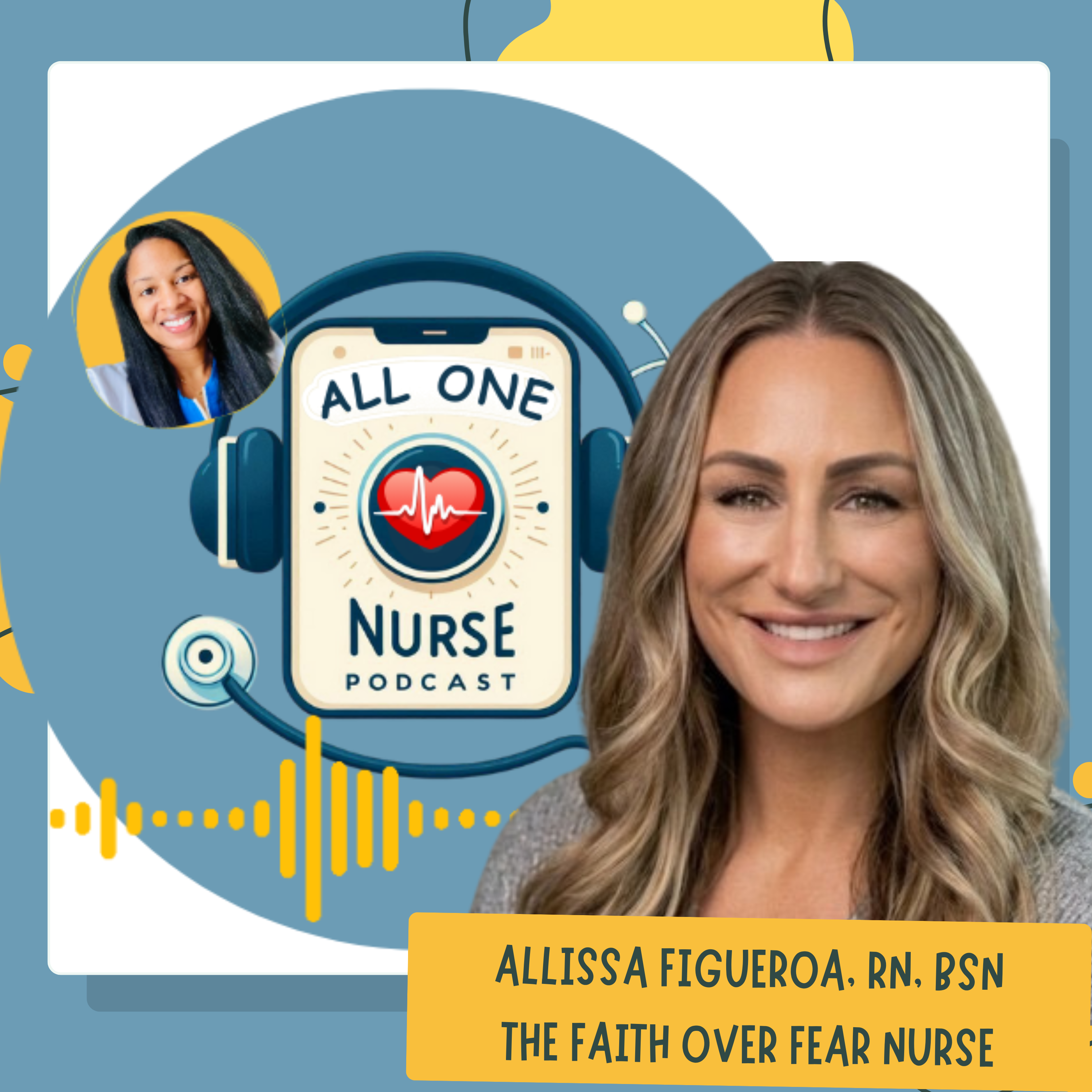
Episode Transcript
[00:00:00] Speaker A: Did you know that first year nurses experience the highest turnover of any group?
That reality is staggering, but it also tells us something important.
You are not alone and your growth matters.
Welcome to the All One Nurse Podcast, where we are bridging the gap between the stethoscope and the soul through real nursing stories and nursing conversations.
Here, our mission is simple, to get back to the human side of healthcare.
I'm your host, Nurse Chanel Tompkins, and I'm also your mentor and nurse educator. And this space was created just for you to breathe, to learn, to grow, and most importantly, feel supported no matter where you are in your nursing journey.
So take a deep breath and let's step into your next breakthrough. Hey friend. Welcome Back to the All1Nurse podcast where I'm your host, Shanell Tompkins, and I'm so glad you're here. If you've been following along with the Faith Over Fear series through the blog post, the emails and reflections, then today's episode is going to feel like the perfect continuation of this that journey we've been talking about.
Releasing fear, receiving grace, refocusing on your assignment, and most importantly, choosing faith over fear, even when the path feels uncertain. And today I'm sitting down with Alyssa Figuera, the Faith Over Fear nurse, whose story lines up so beautifully with everything we've been unpacking. Her story reminds us that sometimes faith begins where comfort ends, when the people, places, or places that we thought would hold us down don't. So what happens when the foundation you've always known suddenly shifts beneath you? Alyssa talks honestly about what it looks like to pursue freedom, trust God, and to keep showing up for yourself, even when fear tries to creep in. And listen, make sure you stay tuned all the way to the end of this episode because I have something special to share that All One Nurse is doing to continue encouraging those of you who are choosing to show up for yourselves. Now, if you're new here, don't forget to subscribe so that you don't miss another episode of encouragement, whether it's just me and you or an awesome nurse that you may have even recommended to get on here with us and share their story. Now, let's dive in to our conversation with Alyssa, because you'll definitely be surprised by what Alyssa experienced early on in her nursing journey.
[00:03:13] Speaker B: Hey Alyssa, how are you doing today?
Good.
[00:03:16] Speaker C: How are you?
[00:03:17] Speaker B: Good. Welcome to the All One Nurse podcast.
[00:03:20] Speaker C: Thank you for having me.
Yes.
[00:03:23] Speaker B: So what is it like where you're at right now?
[00:03:26] Speaker C: It is very nice. Today was 88 degrees. It's sunshine and just beautiful outside.
[00:03:32] Speaker B: Same, same. I think it's about 70s here in Memphis, so I'm just glad to have you on the show today. You know, we met in Tampa at the Nurses Making Business Moves conference and I, I just really enjoyed it. Did you enjoy it?
[00:03:50] Speaker C: Did I had, I did. I had a blast. It was my first ever conference that I've ever been to for nursing.
And it was, it was, it was a whole vibe. Like I literally was in like on cloud nine for like a whole week when I came home with just so many ideas and just so inspiring. It was, it was, it was such a good time, for sure.
[00:04:09] Speaker B: That's awesome. That was actually my first conference as well.
And I just kind of was like, what the heck, let's just go.
[00:04:17] Speaker C: Yeah. And I think we spoiled ourselves because I think Farrah went above and beyond and I don't know if we'll ever go to another one as hype, as much energy and just. It was, it was a good time.
[00:04:29] Speaker B: Yes, it was. I don't think I could put it into words on LinkedIn enough. Like I couldn't put enough in, in my own wrap up of that conference. So I'm just glad that we crossed paths and that we're here today. So welcome, welcome. And so just starting out, you know, I always start out with who are you? And I know for you, you summed up your one word for your why for nursing as freedom.
[00:04:57] Speaker C: Yes, yes, freedom.
[00:04:58] Speaker B: Tell us, tell us a little bit about your nursing journey and how did you get to that one word?
[00:05:03] Speaker C: Yeah, it took a long time for me to get to that word, but I wholeheartedly live it every day. So obviously my name is Alyssa. I'm super excited to be here.
I'm someone that has just always been naturally drawn to helping people. So nursing just felt like a really good fit for me. I originally started in the traditional space where I worked at the hospital system.
I learned my clinical skills there. I learned how to critical think in, you know, fast paced environments.
And I realized that I wanted more for my career. Right.
So very quickly into nursing, I was about a year and a half in. I moved over to the home health setting, which I absolutely loved. I was able to meet with patients on such a deeper level. Right.
And I worked there for about 10 years.
And then it was about 10 years there that it hit me that I was starting to really think about my life. And I wanted to, I wanted my life to be different. Right. I didn't want to work crazy nights, weekends, holidays, on calls all of this stuff that kind of comes with nursing.
So I started exploring different avenues and different pathways because I wanted to stay in nursing. And, like, I had a lot of people in my life, in my nursing career at that point that were either leaving nursing altogether or they. To go, you know, start different endeavors outside of nursing, or they were just moving on, right? They were going back to school and getting higher degrees. And I was at this, like, crossroads, and it was like, well, what. What do I. What does Alyssa want? Right?
And I was. I had a family and I had. I have two kids. And they were. They were younger, and they were starting to get older, and in travel, sports, and life got busy, and it was. It got to a point where I wanted to fit nursing into my life. I didn't want to fit my life into nursing anymore.
So that is where I took the road to go down the remote area of nursing.
It took me about a year to get into the role that I'm currently in as a remote nurse. It was very challenging because it is a very different area of nursing, for sure.
And then I got into the remote space. It's been the best decision that I've ever made for my career. I have that flexibility. I have that free freedom. I can travel with my kids. I'm not micromanaged. It's just been a breath of fresh air, as I tell my clients when I speak to them. And then I got my time back. I got my freedom back. And then I realized that I wanted to help other nurses that had the same vision and had the same dream get there quicker so they didn't have to, you know, try trial and error. Trial and error it for a year or two where they can, you know, jumpstart it and get to where they want to be in two to three months.
[00:07:51] Speaker B: So that's.
Yeah, that's awesome. And so you say you did home health for 10 years.
Yep. Before just going off into the remote nursing.
Correct. Okay, that's awesome. Awesome. Now with that, because I know my audience is more new nurses.
So what recommendation do you have for new nurses? And I just had this conversation with Marsha Batty, one of my previous guests, about. Cause she does remote nursing, but she's with a company.
And one thing that I am seeing with some new grads that working at the bedside, it's like, they're just like, it's not for them.
It's not for them. And so what advice do you have for them as far as other avenues of nursing? Which makes it so great that in nursing we can do so many things.
[00:08:42] Speaker C: Yeah. Yep. Yeah. I think, I think for a new grad, I think my biggest, you know, piece of advice would be that you learn the basics in nursing school. Right. You learn how to be a bedside nurse. You, you learn the clinical aspect of it. I still think that bedside is great and I will still stand on that. I think that nurses need a foundation.
So graduating from nursing school and trying to get into remote position is going to be extremely challenging because 95% of these companies are going to want you to have experience no matter where you go in the healthcare setting. You, they want you to have experience even trying to get into the bedside. They want to know where, where are you coming from? But that being said, I, I would definitely highly recommend getting some, some bedside experience even if it's a year or two. Like I personally only did a year and a half in a critical step down unit and then I pivoted away and I did the non traditional area of nursing. And there's so many non traditional areas. Right. But even if like a new nurse wanted to, you know, they, they knew that they originally they, their ultimate goal was to go remote and they were like, well, I'm just going to go into home health and get that experience so that this way my, I have my foot in the door sooner. You still need experience to get into home health because you still need to have those critical thinking skills when you're out in the field on your own and you don't have a charge nurse to walk to or another nurse to help you move a patient or God forbid, you can't insert a Foley catheter, you can't just call for help. Right? Right. So just any of those critical, you know, thinking skills, those clinical skills, it's so good to have knowledge stepping into specific spaces in the non traditional world.
[00:10:24] Speaker B: So what I'm hearing you say is get your clinical experience.
[00:10:28] Speaker C: Yes.
[00:10:29] Speaker B: Give yourself a year, maybe a year and a half of clinical experiences so that you'll be well versed and prepared for the roles outside of health, outside of direct bedside care.
[00:10:41] Speaker C: Yeah.
[00:10:41] Speaker B: Within the hospital. So, yeah, that makes a lot of sense.
[00:10:44] Speaker C: Yep. And I will say this too is I know a lot of times you as nurses, we hear when we graduate that med surg, go med surg, that's the best route to go. I don't personally agree with that and I know like a lot of people will disagree, but I think you have to sit with yourself and you have to ask yourself what do you true. All of nursing school, all of the areas that you were, you know, you did your clinicals and you observed all these different, these different spaces. What stood out to you? What did you love? Was it oncology? Was it that, the intensity of the icu? Was it the intensity of the ed? Was it more of the laid back areas? Right. You know, you have to ask yourself what you truly love and, and go that route and, and really try to get that type of experience. Because the last thing that you want to do is just get a job. Because you want to get a job because that's where you burn out. That's where you burn out. That's where you're not happy. And I see so, so many nurses do that. But also what is going, what is your long term goal? If, if as a new grad you should have goals? And that's probably a mistake that I made as a new grad. I, I just was ready to be done. Right. Because nursing school is so hard and we're just like ready to be done. We're ready to get that paycheck and we're like, whatever. I just want a job at this point. But as soon as you graduate, make goals for yourself. Write some short term, some long term goals and whatever those goals are, those, especially those long term goals, those really guide yourself towards that path.
So if you know you love oncology and you want to be in clinical trials and you want to be one of those nurses that does that, go get a job on the oncology unit.
[00:12:21] Speaker B: So, yeah, that's good. That's good. I was, I was just telling someone, a nurse that is looking at wanting to go into CRNA school because that's another big nursing role that a lot of new nurses want to go into. And if you're already in the ICU setting, start, start the conversation with CRNAs that bring patients to you from the OR.
[00:12:46] Speaker C: Absolutely.
[00:12:47] Speaker B: Like you have to make that connection. And so that you made me think of that when you're like, hey, set those goals and start moving toward, toward those things. I thought I should add that.
Definitely network in a way.
And networking. You know, sometimes you think of networking as like this cliche, like, oh, I just want to get to know you because I need something. But actually it's like you can make genuine connections that is still considered networking. So yeah, just thought I would add that now for my new nurses coming through nursing school for you, what were some of your biggest challenges and how did you overcome them?
[00:13:27] Speaker C: Girl, let me tell you now. So I did everything backwards in nursing school. As soon as they as soon as I started, they, they said the one thing. Don't get pregnant. Your girl got pregnant.
So it was challenging. My husband, who was my boyfriend at the time, was stationed away and he was in Virginia and I was in New Jersey. So it was so challenging.
But I failed a semester of just all of the things, right? Being pregnant, you know, just everything.
And that was, I will honestly tell you, Chanel, that was my wake up call, like when I failed. And the program that I was in at the time, you actually had to get on the waiting list to get back in if you had, if you had failed.
Wow. And it could have been anywhere from a year to a two year waiting list, right. And I remember like crying for weeks and it was Christmas because it was the, it was the winter semester and. And I just thought my life was over. And I thought, like, I, I convinced myself, like, well, maybe you shouldn't be a nurse, you know? You know, you probably aren't good enough then if you can't pass the schooling. And I remember just praying to God, like, please, Lord, make this make sense for me. Like, open up this doorway for me. Please give me one more chance. And I promise, like, I will make this happen. And sure enough. It's crazy. I got a call the very next day from the dean and she said, we have one spot open for you to re. Enroll. Do you want it? And I said, thousand percent.
So I took it. And I remember going back with this mindset that nothing was going to stop me. Nothing.
Yes. So I literally barreled through the next like two. I think I had like two semesters left and graduated and.
And then it was like boards, right? And then it's like you get so freaked out about boards. And I for sure thought, well, I failed school, so I'm definitely going to fail the boards. And I didn't. I passed on my first try. So, yeah, nursing school is, is a roller coaster for nurses. And so many nurses are at that point, right? There's road. Sometimes life throws you roadblocks. And whether it's you have kids and you're trying to go through nursing school or you're going through a divorce or you lose a parent, or there's an illness that gets involved in there somewhere. There's so many different circumstances that could come into play, but it's like you have to. And that's kind of why I. My name of my, my program and my business and my life is faith over fear nurse? Because I had to rely so much on my faith to pull me through a Lot of really dark spots as a young nurse, even as a young nursing student. And I think that so many more nurses need to hear that, like, rely on your faith to push through. Especially now with all the, all this stuff in healthcare just kind of flipping upside down and healthcare just not being what it used to be.
Fifteen years ago when, you know, I graduated with, you know, I think Covid changed that for everybody. And a lot of nurses are afraid to, you know, pursue that path now because they just don't know what it's going to look like for them. So definitely have a lot of faith to pull yourself through nursing school because it is 1000% worth it. You will be employable everywhere and anywhere you can build a business with it. There's so much that you can do with that. Those letters behind your name that. So that's definitely my advice for those new nurses.
[00:16:49] Speaker B: Oh, that's awesome. Thank you for sharing with you. Having basically being a single mom, even though you, you were in a relationship, but as far as availability, like you were it as the parent being in Jersey, how did you navigate that in nursing school?
[00:17:08] Speaker C: It was tough. I moved. I was, I was born and raised, I was raised by my grandparents who ultimately didn't approve of my pregnancy, right. Because I wasn't marri very old school Catholics.
So I was pretty much put out on the street. I moved in with an aunt who was also a nurse who was basically my mentor growing up. Right. She was the one that made me want to become a nurse. So I, I literally moved in with her and I had to study around her schedule. Like when she was home, she would watch the baby and I would study. My husband at the time would come and take him for like a week just so I can take specific, you know, exams and things like that. It was really, really challenging. It was very challenging. I would study when he slept. I would, you know, for school I took, I winded up switching to the night program so that this way I could leave him with my aunt during the night so I could go to school. It was, it was lots and lots of roadblocks and challenges, for sure.
[00:18:10] Speaker B: Yeah, but you succeeded.
You succeeded. And that's why I wanted to ask because I know as a single, as a single teenage mom myself going into school, that this is all I got. Like I got to get this degree. And so that's why I wanted to ask because then I had a toddler, you had a newborn. So it's like, how did you navigate so that others can actually hear that, hey, they're not alone when they happen to be the one that, oh, I have kids and I'm trying to pursue this nursing degree.
Do what you got to do. Like you said, like your mind was made up when that opportunity came. Like, hey, this is going. I'm going to get this degree right.
And you did that by the grace of God. So thank you for sharing that. Absolutely, yes.
[00:19:05] Speaker A: Now, before we continue this impactful conversation with Alyssa, let's take a moment for a faith intermission note where we get to pause, breathe, and center our hearts around this wonderful revelation. Walk by faith, not by sight.
Because faith doesn't always look like confidence.
[00:19:29] Speaker B: Let's just be honest.
[00:19:30] Speaker A: Sometimes it looks like trembling obedience. It's choosing to move forward when the path isn't clear, trusting that God hand is steady even when your steps aren't. And when Alyssa shared her story, it reminds me that walking by faith isn't about seeing the outcome.
It's about believing that God is already in it. You may not see the full picture, but you can trust the painter. Now, I want you to meditate on this scripture as an anchor throughout whatever your journey is. Your work shifts, your preparation for your exams, exit exam for your nursing program, or maybe even regarding nclex.
Around this time of this episode, I want you to meditate on the second Corinthians 5, 7 reminds us, for we walk by faith and not by sight. And James, he reminds us in James, chapter 2, verse 17, that faith without works is dead. So that means we have to keep preparing, keep moving forward, even when you can't see exactly what is going to happen or you can't see clearly or maybe even at all. For faith is truly learning how to navigate blindly, how to navigate without vision, right? Trusting God's vision for our life and trusting that God is going to provide everything and everyone needed along the way, whether that's a mentor, a coach, or opportunities.
And so now let me ask you, where is God asking you to take a step without proof, to trust his promise more than your plan or more than you wanting to control what's around the corner? Take this pause to breathe, release the fear. And remember, faith is not the absence of uncertainty. It's the decision to keep walking. Anyway. Okay, let's get back to our conversation with Alyssa because this is where it gets interesting and where we learn more about the faith over fear nurse and what she does.
[00:22:03] Speaker B: Now as we get into patient perspective. Because I'm always about getting back to the human side of healthcare, just jumping right into it with home health first and Foremost, I take my hat off to you.
We don't have to dive. We don't have to dive deep into it because I've heard some stories about home health. Like, you're going into their environment.
How would your patients describe you and how did, how did you navigate home health? Like, how.
[00:22:35] Speaker C: So I definitely understand what you're saying, and I get that a lot. People like you're home health, what you do that. I would say that it came natural to me. I've always had, like, a heart for people that are less fortunate. Right. Like, I think I, I think, I think I wear my heart on my sleeve for sure. And I really understand struggle and poverty and all of that. And that is exactly what home health is. Right? You're gonna go into these big, beautiful mansions, but you're, you're rarely going into that. You're gonna go into really poor environments, even sometimes hotel rooms, people living in hotel rooms. But the thing that really, that I loved about it so much was it was, it was so humbling for me to see so many different people, you know, because in the hospital system, you work with them for two, three days, and it's very clinical driven. It's passing meds, it's doing wound care, you know, giving treatments.
It's very, very clinical. You know, you, you get a little bit of connection with a patient, and for the most part, they're very hesitant to connect with you because you're in the lab in the white, you're in the lab coat, right? You're the nurse that is, you know, there to, to give all the bad news. But in the home health setting, it's very different. When you step into their environment and you build that trust and you build that rapport with them, you're almost like their, their, their daughter. I've had so many connections and relationships with patients that I've talked to for years. Like, a patient of mine that I took care of forever just passed away last year. And I mean, she would, he would call me, she would call my husband. She would be like, can you come over and check my attic? Because she couldn't get upstairs. You know, she was in a wheelchair. Like, you just build such great rapport. And I think you have to have a heart to do home health because you're going to deal with a lot of really, really sad situations. You know, people that can't afford medications and they don't, or people that, that aren't eating right, they're not eating because they can't afford food or especially when it's the holidays, you're going to see someone like right before Thanksgiving. And, and you're like, so what are your Thanksgiving plans? And they're like, oh, nothing. I, I, I don't, my, my son doesn't talk to me. My daughter left me, disowned me. I don't have no money for any food. And it, it just, it gets you, right? It, it gets to your heartstrings. So it molded me as a person. It molded me in my faith. Gosh, I could go on forever. So there's such an ugly side of home health because you're going into some, you know, maybe some dirty homes or some infested homes or, but you're, but you're ultimately, you're really turning into a different person and you're super, super humble and grateful for what the Lord has blessed you with. And I think all I wanted to do was help these people.
So. Yeah. Yeah.
[00:25:26] Speaker B: And you did it for 10 years.
[00:25:28] Speaker C: For 10 years. I would still be there till, still to this day if, if they didn't stop denying my pto.
[00:25:34] Speaker B: I understood you can't get to freedom with no pto. I'm, yeah.
[00:25:40] Speaker C: And I would say this for some new nurses that are following, you know, your podcast, it's actually a really good place for nurses to build a lot of clinical skills because like in the hospital system you have very specific specialties, right? Like you have cardiac, you have neuro, you have ed.
But in home health, when they all go home, they go to home health. So you're seeing every single thing from cardiology to oncology to hospice to mental health, just everything. So it's really a good place for a nurse that doesn't mind going into patients homes to really build those clinical skills. And I know like the company that I worked for, they did hire new grads.
So it's definitely something to look into if that interests them. And the flexibility is great. You make your own schedule. You're not, you don't work 12? No. Home health nurses work 12.
So
[00:26:37] Speaker B: how far did you travel?
[00:26:39] Speaker C: I was just local. I did two zip codes that were right next to my house. So like, I'd say 20 minutes one way, 20 minutes the other.
I saw six patients a day. Some of them were very quick, you know, just education, like mostly just disease management education.
And then other ones would be like maybe wound care or blood work or things like that.
[00:27:00] Speaker B: Thank you for sharing that. Yeah, I'm learning something.
That's good.
Yes, yes. Now just jumping right into your expertise and your current role. Tell Us a little bit about what you do now and faith over fear. Yeah.
[00:27:19] Speaker C: So I am currently a remote case manager. So I work from home. I've been with my company for seven years. This new company, I've been with them for seven years. Well, July, June will be seven years. And I am also a field case manager. So it's very similar to what I do at home health. I go to patients houses and I see them once a year but there's no hands on care so I don't have to wear scrubs, I can go in regular clothes. Again, very flexible. I make my own schedule and I am pretty much making sure that all gaps in care are closed. Everything that they need, they have. DME equipment, follow up providers, medications, transportation to medical appointments. I am pretty much their nurse liaison that is helping them get these things. I work for the Medicaid population which again is our low income population, which I was already used to that working with home health, again just super rewarding because these people truly need, they need help. So that gave me the flexibility and the freedom that I was really, really wanting. And then once I got my time back I was like, I hit again, a pivotal part in my nursing journey. I think we hit these pivotal points a lot, right? And I'm almost 6, I'm 17 years in. 16, 17 years in.
And I was at a crossroads where it's like, well, what do I do now? Do I go back and get an advanced degree? Do I, what do I, what do I want to do? Right? Because I want to grow. I, I'm, I'm always, I always want to grow. Like I always want to make myself better, you know, each year. So I did, I went back, I finished my bachelor's because I originally only had my adn. I finished my bachelor's and it's didn't really do anything for me. I didn't make any more money with my bachelor's where I'm at. And I just was like, I want, I want to start a business, but I don't know where to start.
And it's funny because I was actually following a nurse that was at the Nurses making business news conference last year and the light bulb just went off and it was like, start your own business.
And this is my expertise. I've been doing it for so many years.
Why not help nurses understand what else is out there for them in healthcare, in nursing. I started Faith Over Fear nurse about three and a half years ago and it's been the best thing that I ever did because I'm just thriving, my family's thriving. Just I don't have to worry about a lot of things that I used to worry, like finances are not a worry anymore. And I just wish that so many more nurses knew that. There's so much opportunity, right. You don't have to pick up a second shift, you don't have to work overtime, you don't have to get a second job. It's like you got those letters behind your name, girl, use them, use them. We all have an expertise. Whether you're an ed nurse or you know, wherever you're coming from, you have an expertise and somebody wants your knowledge and there's a problem that you can solve for for them for sure.
[00:30:14] Speaker B: So with Faith over, if you're a nurse, it's more like.
Is it more like coaching?
[00:30:20] Speaker C: Yeah. So it's a coaching program, it's one to one coaching where. Well, it's actually, it's a, it's a suite of different products. But my number thing is my high ticketing coaching. It's one to one coaching where I literally help them with everything from the very beginning of what do they want their life to look like, that path and what one of these roles that are out there is going to fit that lifestyle. Because there's so many different ones in the, in the remote world. I mean you have everything from the payer side, the insurance world all the way over to the biotech side and pharmaceutical sales and medical devices. Like there's just so much. So it's like what do you truly, I always ask my clients, they say what do you love about nursing and what do you want to keep moving forward? For me personally, I loved that patient interaction. I did it for so many years. It's what made me who I am as a nurse and I wanted to keep that. So that is a huge part of my program is we really, I get to know my nurses. Like I want to know their story, I want to know what they've been through, where they want to go and what excites them to stay in nursing.
And then I help them with everything, their resume, their LinkedIn, getting in touch with the hidden job market, optimizing their LinkedIn branding, their skillset, their interviewing, salary negotiations, just everything.
Yeah.
[00:31:40] Speaker B: So you, you really like go along, you walk alongside them but it's like you're not leading them, but it's like, hey, you do your assessment and you get up under the table and see, okay, let them tell you what their goals are, what their ideas are, where they've been, where they see themselves going and then it's like, okay, let me guide you.
And you're definitely there along the way, like practically there.
[00:32:10] Speaker C: Yep.
[00:32:10] Speaker B: Yeah, that's awesome.
[00:32:12] Speaker C: I think it's, I think that's important, especially in the remote space, because when you're going from clinical to corporate, it's a very different world. Right.
And nurses are so clinically driven in our keywords, in our actions, in policies, procedures and everything. Just extremely clinically driven.
So when you step into that corporate world, it can be really difficult to switch your mindset to it. It can be really difficult to articulate your skill set coming from the bedside and understanding what this leadership is looking for. So I walk with them hand in hand every step of the way from that moment when they're like, hey, remote sounds interesting, but I have no idea where to start or where I fit. And I'm like, girl, I got you. Let's go. And we rock out for four months. Some of my clients stay on a little bit longer if they're like almost there and they haven't gotten the job yet, but they're getting interviews and, and yeah, I just, I just pretty much walk with them every step of the way. And I think that, think that's what has made me so successful is because it's not a course.
I think it's really challenging when something is so foreign to just buy a course and kind of put yourself through the course and be like, okay, I get it. Right? It's so great to have a mentor to handhold to get you to where you want to be.
[00:33:27] Speaker B: Yeah, I think that is especially with someone who has been there and actually is doing it. And so that's awesome that you're able to guide them and something that you're well versed in and well experienced. And so I really thank you for even getting on here to even share your experience as well.
Now, is there anything coming up? Because you mentioned, since you mentioned that faith over fear nurse involves more than just coaching. Is there anything else you would like to share with us?
[00:34:03] Speaker C: Yeah, so I, I do have, I do have a suite of products. So it's not just coaching because I get, I get it. Coaching can be expensive. It's not for everybody, but some people still want resources. So I do have what's called my scrubs to Screens starter system. And it is a like mini course tutorial where you get some knowledge in there and you get my. I build custom GPTs so they get my custom built GPTs that they can plug and play and it's literally like a clone of me. I've put everything inside of it. So it's almost like you're getting a coach, but you're getting an AI digital coach of me. So that's an option. You get the resume resources, you get a video, a walkthrough tutorial video. So those things are all available for that nurse that's like, listen, I'm, I'm fresh. I'm barely making ends meet. I can't afford a coach.
They. That's an option for them that's extremely low ticketing.
[00:35:02] Speaker B: Gotcha. Gotcha.
[00:35:04] Speaker C: Yeah.
[00:35:04] Speaker B: And so for those who don't know what high ticket and low ticket means, you can correct me if I'm wrong, but if you think about high ticket, you just think about it costing more.
And then low ticket means that it's more. It may be more affordable for those who are more on a budget. Not saying budget is bad because we all need to the budget our finances. Yep, I'm working on that. But low ticket will be more.
It may be more within your budget. Yeah, if your budget is limited. If you're limited already.
[00:35:36] Speaker C: Yeah, but high. Another thing with like high ticketing, I wouldn't necessarily, you know, put a dollar sign to it. With high ticketing, you know, you're getting a complete transformation, and that is what people truly pay for. They don't want another template. Right. They don't want another course. They want a true transformation. They want to know that when they put that money down, that they going to be where they want to be at the end of it. They want to, they want their life to change and they want somebody there to help them and have that knowledge. So that's, you're. You're pretty much paying for that transformation for sure.
[00:36:10] Speaker B: Thank you for saying it like that. And that's good, because when you're ready, like, even for myself, going into the podcasting space, even the nurses making money, not making money, even the nurses making business moves conference, it's like, okay, I'm investing in me, I'm investing in my growth. And you cannot put a dollar amount on that.
[00:36:32] Speaker C: Nope.
[00:36:34] Speaker B: If what I need is in that room, I am going to pay for access into that room to get what I need to take me to the next level or the next season that I see myself going into. And it did exactly that. And so that's why I'm glad you said it like that, because that helps. It's not just about the dollar amount. It's about the value. It's about the transformation that you're getting. And a lot of times it.
What I do love is when. And this is me learning as an entrepreneur. Right? Like, I've made all one nurse an llc. And now I'm learning as a nurse, and we can take this conversation a whole nother route.
But as a nurse, I'm so used to, like you said, like, clinically, Clinically, I, I am used to taking care of individuals and making things better. And we don't usually whip out a bill and say, oh, I did XYZ for you. This is how much it costs.
[00:37:32] Speaker C: Right.
[00:37:32] Speaker B: I'm just used to my employer paying me bi weekly. So now as an entrepreneur, I'm trying to get out of this mindset of Chanel, you don't have to give everything away.
Like, a business is not a business if it doesn't profit or it cannot sustain. And it's not even about selling, like, just selling things. Selling things. But the value that you bring in my own personal growth over the last two years and investing in programs myself, I learned that when it comes with, let's say, the value, the price that's on it, everyone that's in that room wants to be in that room, and they're there for what's in that room. Like, you're not gonna see a person, like, if it's free, oh, I might go, I might not go, you know, or I'm gonna get in there and I'm gonna complain about, like, it's none of that. Like, we're in there. Notepads ready, all on screen. Okay. What you got?
Right. And we're all able to have those conversations depending on what type of program it is. Like, for me, it was like more of a, like a group setting.
But it was so impactful and it was so worth it for me and for the other people that also saw.
Also wanted access to what that program provided. So I'm glad you explained it like that too.
[00:38:56] Speaker C: Yeah, absolutely.
[00:38:58] Speaker B: So how can our listeners connect with you?
[00:39:03] Speaker C: Yeah, so I am everywhere on Instagram. I'm on Instagram. That's. That's my number one platform. But I am also on LinkedIn, which is obviously a very professional platform.
I'm on TikTok, just starting there. So it's a little tick tock's a little different, but.
But they can connect with me either way. I have a website, it's faithoverfearnurse.com I am on, like I said, Instagram, LinkedIn. I. You can send me a DM. I. I love getting questions too. And I get so Many, you know, questions from nurses that are like, well, I've reached out to other remote nurses and they won't answer me or they make me want to. They, they're making me have to pay for something. And I'm just, I'm not built that way. Like, and, and I, and I like, kind of like what you were saying earlier. You want to give, you want to give free info, but you also, like, you got to be profitable too. Right. But I feel like in business it's so important. People invest in you. They don't invest in your product, they invest in you. And if you are genuinely connecting with people and you're there to guide them because that's what these nurses want, like for you too, with working with new nurses. Right. You're there to guide them. And if they feel comfortable with you and they feel like they've asked you questions and you've answered them and you're genuine and that's where the sale comes from. It's not about you having the best systems and the best, you know, resume.
It's about, it's about who you are. People are going to invest in you. So I love that when people reach out to me and just ask me questions via DMs or things like that, you're never going to get a ghost, a DM from me. I'm going to message you back and I'm going to give you the answers and I'm not going to push my program on you. I'm going to give you the resources that are available and when you're ready, I'm here. And that's just kind of like, that's how it is, right?
[00:40:58] Speaker B: Yes. That's so awesome. So awesome. And I can't even remember what all we talked about, but I can remember having a really good conversation with you. Even at the conference, we were talking about batching content.
[00:41:09] Speaker C: Yes.
[00:41:10] Speaker B: Yeah.
[00:41:11] Speaker C: And making life easier. Because content is a lot of work, right? It's a lot.
[00:41:17] Speaker B: We need a whole nother person for social media.
[00:41:19] Speaker C: Yeah.
[00:41:19] Speaker B: A whole, whole employee for social media. I said that's a whole nother job.
But it's doable. It's doable. I think for me, it's hard with my 9 to 5. Like, I still have the, like physically get up and go to my nine to five.
[00:41:35] Speaker C: Yeah, yeah.
[00:41:36] Speaker B: And everything else.
[00:41:38] Speaker C: And you have kids and, you know, you're balancing life and husbands and just everything. Right. So it's hard and I think as an entrepreneur for like anyone that is listening and decides at some point to Go down the entrepreneur route. You fail your way every day. Every day is failure for me. Every day I fail at something, and it's okay. And, like, it took me. It took me, like, a good, solid two years to get to a point of saying it's okay to fail in entrepreneurship every day. Because. What does that mean? That means you learn something new every day because you're like, I'm not doing that again.
[00:42:11] Speaker B: Yeah.
So that's so good. They kind of sound like new nurses. I mean, just go. It's like, every shift, what is it gonna be like? You can't go in there with that mindset. But it's something. You're like, I'm not gonna. You know, you're not gonna know something, and you just hope.
Like, I think for most of us, it's the emergency situation starting out. Like, just don't let it be my patient. Don't let it be my patient.
[00:42:37] Speaker C: Don't code.
[00:42:37] Speaker B: Please don't code, man. Or the doctor asks you to grab something, and you're looking like, what's that? Like, can you tell me, please? I can remember doing that as a new nurse. I was working nights, and the patient had a uti. And so I called the resident, called the doctor, and he was a pretty new doctor, and I told him that the patient had a uti, and he said, oh. He said, what do you suggest? And he named some antibiotics. And I just put it on hold. And I was like, miss, what should I say? She was like, tell him this. And so I got back on the phone, I said, well, miss, so and so recommended this. And he was like, okay, let's do that. And I was like, dang, I need to learn something.
[00:43:17] Speaker C: Those questions used to get me. I would hate when they would do that. And they're like, what do you recommend? Or why do you think this is? And I'm like. And I sometimes. Because mine was a resident teaching hospital, too, and I think sometimes they truly don't know what to do. And they want your.
[00:43:30] Speaker B: Right.
[00:43:30] Speaker C: They want your idea, or they're just trying to test you because they know you're like, a newer nurse, and they're like, let me mess with her.
[00:43:37] Speaker B: Yes. You know, he was actually really kind, and I think he was just like, newer. He was a new MD and he was leaning on his nurses. But I'm like, I'm not the one to lean on because I don't know anything, Doc. I'm just saying.
But I had my support person right by me, so it worked out. But I thank you so much, Alyssa, for getting on here today.
[00:43:59] Speaker C: Thank you for having me. It was a pleasure meeting you at the conference. It was a pleasure talking with you today. I love, love sharing stuff for new nurses because it's just so. It's part of the reason why I built this, because I want nurses to stay in nursing. Right? I don't want them to. So, yeah, we need good nurses. We need nurses at the bedside, and we need nurses at home. And, you know, we need nurses to come into nursing and love it.
[00:44:24] Speaker B: Yes, yes. And I love how there's room. There's just room for everyone.
They talk about the nursing shortage, but it's like, how can we keep nurses as nurses? Because whether you're at the bedside or remote nursing or somewhere else as a nurse, you're still impacting patient care somehow, whether it's directly or indirectly. And so I just really appreciate the nursing profession itself. And for those of us who have decided to, hey, stay in it, as well as find our freedom as well, what freedom may look like for us. And so thank you so much. And so I will definitely be sure to include any links for you as my listener to connect with Alyssa down in the podcast description below.
So thank you, Alyssa.
[00:45:20] Speaker C: Thank you, Chanel.
[00:45:21] Speaker A: Thank you for joining me today. If this episode connected with you, especially after walking through the Faith Over Fear series in Lyssa's story, be sure to share it with someone.
And I want you to know I see you, I'm praying for you, and I'm rooting for you. And I told you to stay to the very until the very end of this episode just to tell you that I'm giving away a $100 digital gift card to encourage someone who is truly showing up for themselves in this season in your nursing journey. And of course, it is you.
So all you have to do to enter is tag two Friends, three things. Tag two friends on the Faith Over Fear all one Nurse giveaway graphic on any social media platform under all one Nurse Social media page. And two, subscribe to the podcast, which you're already here, so click that subscribe button.
And three, complete the entry form that's located in the show notes and it's going to be in the link in the bio across the social media as well. I will pick a random person on May 12. So the giveaway runs through today, May 1. May 1 through May 9, midnight until 11:59pm and I will announce the winner on May 12 as we wrap up Nurses Week. So in addition to that, Happy Nurses Week, I hope that you celebrate and you get all the gifts given to us during this time. And I hope they include students as well because you are entering this profession and you're working hard before you even get here. Now, don't forget to follow me on social media. Check out how to connect with Alyssa down in the show notes below as well as all things all one nurse and sign up for the giveaway. Complete all the things now. Until next time, keep showing up, choosing faith over fear and letting your light shine.
[00:47:35] Speaker B: Bye.