[00:00:00] Speaker A: Did you know that first year nurses experience the highest turnover of any group?
That reality is staggering, but it also tells us something important.
You are not alone and your growth matters.
Welcome to the All One Nurse Podcast, where we are bridging the gap between the stethoscope and the soul through real nursing stories and nursing conversations.
Here, our mission is simple. To get back to the human side of healthcare.
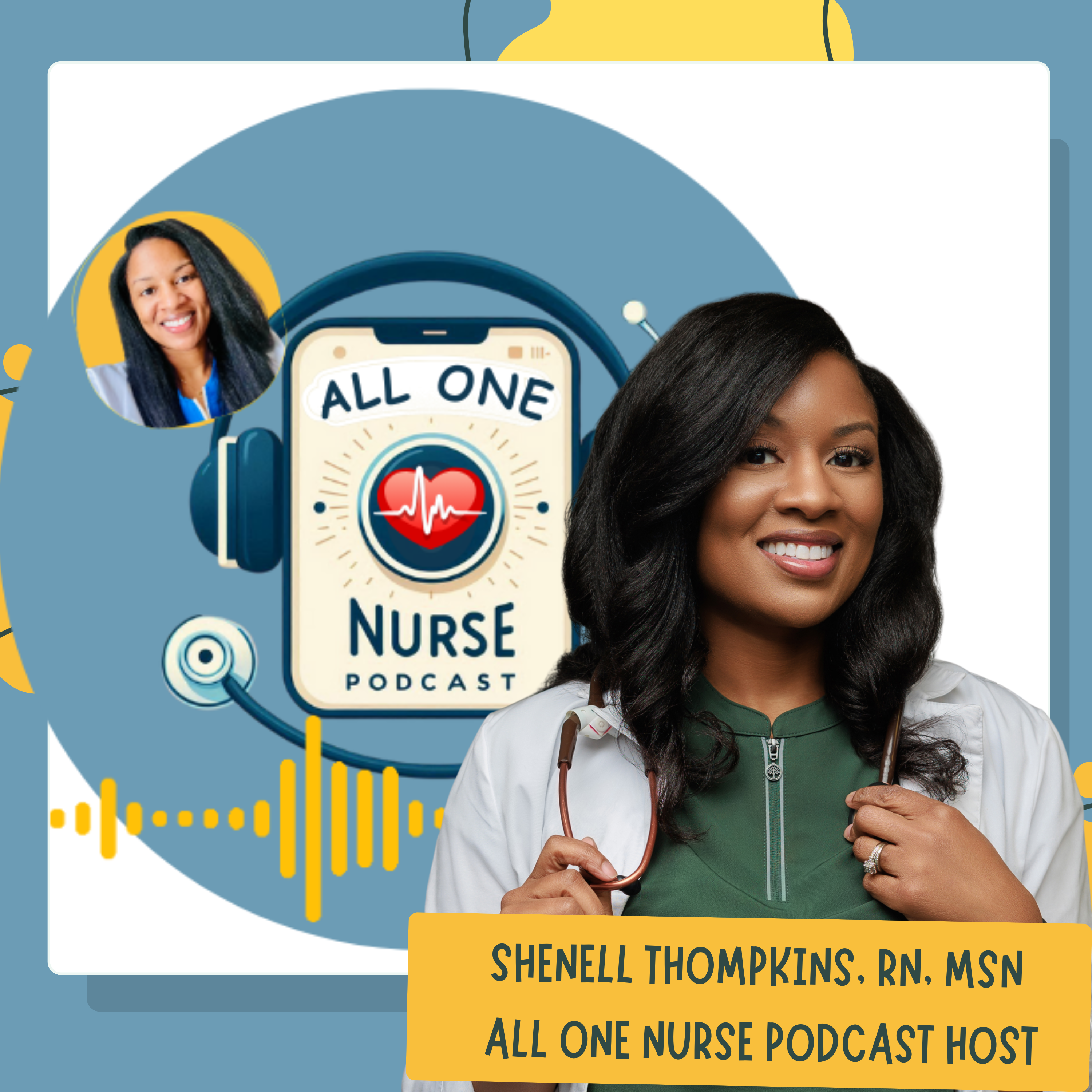
I'm your host, Nurse Chanel Tompkins, and I'm also your mentor and nurse educator. And this space was created just for you to breathe, to learn, to grow, and most importantly, feel supported no matter where you are in your nursing journey.
So take a deep breath and let's step into your next breakthrough.
[00:01:02] Speaker B: Hey there. Welcome Back to the All1Nurse podcast where I'm your host, Nurse Chanel Tompkins, and I am so glad that you are here with me today.
I hope that you had a wonderful Easter weekend with your family and with your friends.
Or maybe you celebrated Easter with patience. And guess what? I'm sure you get extra points in heaven. Okay? And speaking of, if you got the opportunity to listen to my previous episode with Marsha Batty the bossy nurse and all of her wonderful takeaways about remote nursing and let me know if you decided to make a fresh start or rededicate your life to Christ as I mentioned in the previous episode, so that I can celebrate with you and just let you know that I am rooting for you, especially if you have questions or concerns about what the next steps should be. Definitely reach out to me. You can DM me on social media or you can email
[email protected] and that's chanelwaneurse.com now. Welcome to this episode of the All One Nurse podcast. I'm excited because this topic is something that is so near and dear to me and that is providing safe patient care. And I'm just not talking about the medications. I'm just not talking about checking off all the tasks or completing your orders and the work list and all that. No, I am talking about basic patient care, basic hygiene, and now let's talk about it. To give you some context, I help facilitate critical care class at my organization and I also have a background in cvicu and I've worked there for about five years, going on five years. And when I say I loved it, I love it. And so I titled this episode if it was you non negotiable in basic Nursing. Because you have to ask yourself this question if it was you laying in that ICU bed With a breathing tube pushed down your throat. You have these soft wrist restraints tied around your wrist. You're unable to move and change positions. You're unable to get this uncomfortable tube out of your mouth. And you're unable to talk and tell the nurse that's caring for you how you actually feel, how you need to be repositioned, or what pain you may begin.
So if it was you laying in that bed looking up with a gown on and nothing but a gown come on and listening to all these monitors, knowing that you're somewhere out other than your home with strange voices, if it was you, how would you want to be cared for? And so that's what I'm going to talk about today. If it was you, how would you want to be cared for? And I just want to break down like address just really two things. One, safe patient care in the icu. Yes, let's talk about it. And two, let's talk about really just some scriptures to help get you grounded and anchor you as well as anchor your, anchor you as you take care of patients in their most vulnerable time. I can't get my words out and some practical ways and steps to successfully care for your patient. Now, if you are a new nurse or an aspiring nurse, I encourage you to also look down in the description below so that you can get a hold to the new nurse starter kit that I curated just for you to help you with building your confidence, finding some clarity and knowing that you're not alone. Through some handpicked blog posts and some hand picked podcast episodes as well as some updated freebies as well, all within that all oneurse new nurse starter kit. So be sure to check that out through the link in the descriptions.
And so diving right into number one safe patient care in the ICU setting. So you have to understand that yes, everyone, I don't want to say everyone, but some of the most sought after units for new nurses are lnd, nicu, EDIE and icu. If that's you, go ahead and raise your hand right now. Go ahead and raise your hand now. I can't speak to NICU and I cannot speak to ED or lnd. Let me get that straight. But when it comes to icu, one thing that I believe drives a lot of new nurses to the ICU is the nurse to patient ratio, which is typically one to two. And if your patients, if a nurse has to do a one to one ratio, then another nurse may have to do a one to three patient ratio. Okay? But one thing that you must consider is not the patient ratio, but the patient acuity level. These patients are also the sickest patients. And so it's more than just not having a lot of patience, if I'm saying that correctly. It's not just about having less patience. It's also about being more in tune and being present and aware of your patients. Even beyond titrating drips, beyond meeting these ICU protocols and checking off tasks and workflows, beyond emergently intubating the patient, beyond emergently putting in devices to help the patient in whatever way, it's beyond all those things. It always bulls. Always think of all those things being part of a bigger picture that is basically a portrait of your patient. So we can do all these things in which a lot of the things that we do are actually band aids, and we have to correct whatever the insult is for that patient, because Levo doesn't heal anybody. But if they needed Levofed, which is a vasoactive drug because the patient is hypovolemic, meaning that they need volume, then the goal is to really provide the volume and making sure that we're providing the right volume so that we can stabilize the actual blood pressure. Because we're correcting the insult or the issue. But we can talk about that another day. In doing all these ICU things, you have to remember that the patient is also depending on you to do the one thing that matters to them, which is their basic care needs. Brushing their teeth, washing their face, providing them with a bed bath because they're unable to do those things for themselves. Turning them, making sure they're comfortable, like they are truly dependent on you. So as a new nurse, yes, you're learning how to do what it is that you're expected to do safely. But always be mindful to check out or look over your patient. Assess your patient, not only for documentation purposes and not only for getting a baseline, because that baseline is very important, but also for your patient. Are they comfortable? Are the pillows positioned correctly? And you would think, oh, well, Chanel, I don't have time for that.
Please make time for it, because what if it was you? And like I mentioned to a class recently, I guarantee you, all the things that you're saying you don't have time for. If you're there, if you're visiting someone that you love or you happen to be in that position, guess what? You gonna have time today, Right? Right. So I really just wanna stress the importance of providing basic hygiene care. And another good example that I provide, I use, is we can provide these wonderful drugs for instance chemo. You can provide this expensive chemo treating the patient's cancer. But if we fail to provide oral care, perineal care, and the patient gets pneumonia, then what good have we done for the patient? We could treat the cancer. What if they had a good prognosis with the cancer to treat it, make it through the, you know, already have an immunosuppressed system. But what good is it treating the cancer if they're going to die from pneumonia from sepsis? So we have to look at the patient and everything that matters for that patient in addition to your role and what you are expected to do in your role. But just know that just because it says basic care needs or basic hygiene, basic hygiene is a vital to safe patient care. Now there are some scriptures that I wanted to leave you with to help anchor you when you're taking care of patients who are at their most vulnerable state. And my first scripture is Galatians 3, verse 23, which states whatever you do, work at it with all your heart as working for the Lord. I used to tell clinical students that all the time, whatever you do, work at it with all your heart, as if working for the Lord. My next scripture is Proverbs 4, 7. Wisdom is the principal thing. Therefore get wisdom. So yes, continue to want to know. Continue to do things safely by increasing your knowledge. And this may include studying at home, especially as a new nurse. If guess what, if I worked at the bedside and they brought out a new device that we were required to use at the bedside with patients, then guess what? That would require me to study and become well informed about that new product, right? And so you can always be going from novice to expert when it comes to healthcare because healthcare is constantly evolving, because technology is constantly evolving.
You're seeing a little bit more of AI in your charting systems. If not, it may be coming soon. The same artificial intelligence is here to stay and we just don't know how much it's going to affect us. But it is here right now. Philippians 4:13 I can do all things through Christ who strengthens me. That was actually one of my motivation Monday Scriptures recently. And I love that scripture. But just know that these verses, they help remind us that safe patient care is stewardship. Long story short, you are in a position to be a good steward of what you have obtained a license to do, which is to take care of patients. So and all you're getting get understanding and get wisdom.
And so to go a little bit further, I believe it says that to to fear the Lord is Wisdom and to shun evil is understanding. And that actually goes into your workflow.
Hey, I'm going to work as if I'm working unto the Lord. Therefore, I am going to take care of my patient the best way that I know how. In addition to learning my role in the ICU or whatever, bedside, whatever you do as a new grad or wherever you're at, even in clinicals, I want to do the right thing by the patient. But in all you're doing, be sure to connect with your patient, Check in with your patient and make sure your patient is actually comfortable. Make sure you are aware of how the patient is actually doing and all you're doing. Okay. And all that just to say that you're. That as you learn to, as you're building your confidence and building your nursing skills and your workflow, the patient is at the center of everything that you do. And it's not about the task and checking off a list, right? And just now with that, may God give you the grace even when it feels like you're carrying a weight because you will have some bad days. Sometimes when you. Sometimes for me, when I walk around the units, when I'm rounding, sometimes it makes me emotional because I'm not actually caring for the patient. But I get to see those nurses who are in it and they don't realize just how blessed we are to be on one side of the badge providing care instead of being on the other side needing the care to be provided to us. So practically, what does safe patient care look like in the icu? You like Chanel, I hear you, Chanel. You stay preaching to us, but give me some practical ways to provide safe patient care in the icu. So one thing that I mentioned earlier was baseline. Knowing your, your patient's baseline, that means having your stethoscope and truly doing a head to toe assessment on your patient and having that baseline. Now you can go from I got a baseline on my.
Now I can anticipate complications that might go on before it happens. And so in addition to that, not only do I need to know my patient's head to toe assessment, but I also need to know what's in the chart. What's my patient's most recent labs, recent diagnostic test, what was the results? How are things trending?
Right? Is the electrolytes going up or down? Now I can anticipate my patient's vitals, Are they trending up or down? The plan of care based on the different providers who are consulted, what are the most recent notes by them and what do they anticipate? And are they talking to each other? Right. Because some person, one of them may be planning a procedure and the other one don't know anything about it. And it's like, wait a minute now, did you know so and so plan on doing this? Because as the nurse, you are the stop sign for that patient. You are the advocate for that patient. You are the middleman for your patient. Okay? And then with that, that just means that you have to learn how to communicate clearly with your team. And that is the intensivist, the resident, the advanced nurse provider who may be on call arounding for another doctor. And then your respiratory therapist, because there's a team, your physical therapist, speech therapist, everybody that's helping to help take care of your patient is part of your team, that patient's patient care team. And so learn how to communicate clearly with them and being sure to be able to connect the dots, if that makes sense. And of course, you have to advocate fiercely for your patient. Nobody should put a central line in your patient and not want to do an X ray if that is a required state standard for a central line placement at the bedside. Again, we're not playing chiefs and Indians. We are playing safe patient care. Your license, that patient's life, they both matter. But that patient's life, it holds a lot more value. Let's just be honest, okay? Now another thing that you can do is slow down, slow down when everything around you just seems to be speeding up. Like, honestly. Take a step back, take a deep breath and give yourself a moment and try to think through. Okay, I need to give these medications, I need to assess my patient again. I need to do a breathing trial, I need to do sedation vacation. And this where you have to, you may have to.
What am I trying to say? Partner with your respiratory therapist. So it's just so much that you may have to do. But just know that caring in itself is holistic. It's holistic. Okay? And then know that as a new nurse, you don't have to know everything to be safe. I don't know everything. And if I can, and I'll tell nurses all the time, if I come back to work at the bedside with you, I'm probably going to have just as many questions as you as a new nurse, because I want to be safe too. And things change. They create new protocols, they remove old protocols. We got new providers, you got old providers who have retired. I mean, it's just things change. So you always want to be in the loop. And how do you stay in the loop? You ask questions. You want to know. You be intentional about it. So be sure to ask questions as well. And know that you don't have to know everything. Everything. The nurse, we always say, the nurse who says that they got this, they know this. This. The. That's the day you become the most dangerous nurse. Because healthcare is always evolving. Always. And with that, always remain teachable. What I have found is that when they're looking at candidates, new nurses, new employees, are they trainable in the icu? Especially in the icu, if I try to teach them something, will they listen? Will they retain it? Do they want to know? So be that nurse who is teachable, inattentive. Have your notebook with you, have your stethoscope with you. Get up when your preceptor gets up. If something's going on with another patient and another nurse that's not assigned, that you're not assigned to, go ahead and go in there and ask them, what can I do to help? Or can you help me understand what is happening right now? Or you may have to wait till afterwards, because if they're in the thick of an emergency, they don't have time to explain, right? They may just say, wait right here, or just hold this, but absorb the whole scene so that you can go back and ask questions. Why did you do this? I noticed that y' all did this. Can you help me understand why we did this instead of this? So it helps you process that moment, right? It helps you process that moment, and it helps you become more grounded as well.
Now, I think this is a good moment to include a faith intermission note. And the title of this note is Work as unto the Lord. Work on it as unto the Lord. So let's pause right here. You're not just clocking in. You're not just completing tasks.
You are not just trying to survive another shift as you're going out into the icu, working as a new nurse or whatever position that you've decided to work in, especially at the bedside, just know that as that new nurse, as that aspiring nurse, you are working unto the Lord coming through that nursing program. It's busy. It's tedious. It's. Oh, my God, I am so over this. You're still working unto the Lord, and let's that be your grounding factor. You are working unto the Lord, and that means for you, work well, not rushed, not frantic. And you want to do it more so by being smart and effective. I've told a mentee before, don't Occupy space in your head with negative energy, negative thoughts. That takes up the anxiety in the worrying or the complaining. It takes up mental space that you could be actually using to have a positive experience with studying and retaining information or showing up for clinicals and being able to ask the questions that you need to ask appropriately with your clinical professor, clinical instructor, or with the nurse or the patient, or doing your care plans. And so just remember that you're working unto the Lord in all that you're doing. You work with the patient at the center, not the task list like we talked about earlier.
And you want to work with grace even when the unit is chaotic, right? Because you may walk into some chaos, you may be dealing with some chaos on the floor. And just know that you work with strength even when you feel stretched. God has you. You can do all things through him who strengthens you. Remember that. And so I want you to walk in peace knowing that God has you.
As we wrap up this episode, if this episode resonated with you in any way, I really want to invite you to join the All One Nurse Community which is a private Facebook group group All One Nurse Community and upon being approved you will see some devotionals. I do a devotion every Monday based off my motivational Monday scripture and just know that you can also head over to All One Nurse Link tree because I have a mentorship program. I haven't assigned a date yet, but if you are interested you can sign up to be added to a wait list to find out more about the mentorship program that is meant for new nurses and aspiring nurses to help provide you with nursing support. Basically from a faith rooted perspective as well as some practical ways and some practical tools to help you along your nursing journey. Okay? And before you go, please please please please I ask a review. Leave a 5 star review because your review helps more nurses find this safe rooted space and join again the All One Nurse Community because it's private and it's supportive and designed to and designed to pour into you spiritually, professionally and emotionally. And you don't have to walk this journey alone. So until next time, but remember to keep your patients at the center of your care and let your light shine. Okay, bye.