Episode Transcript
[00:00:00] Speaker A: Did you know that first year nurses experience the highest turnover of any group?
That reality is staggering, but it also tells us something important.
You are not alone, and your growth matters.
Welcome to the All One Nurse Podcast, where we are bridging the gap between the stethoscope and the soul through real nursing stories and nursing conversations.
Here, our mission is simple. To get back to the human side of healthcare.
I'm your host, nurse Chanel Tompkins, and I'm also your mentor and nurse educator. And this space was created just for you to breathe, to learn, to grow, and most importantly, feel supported no matter where you are in your nursing journey.
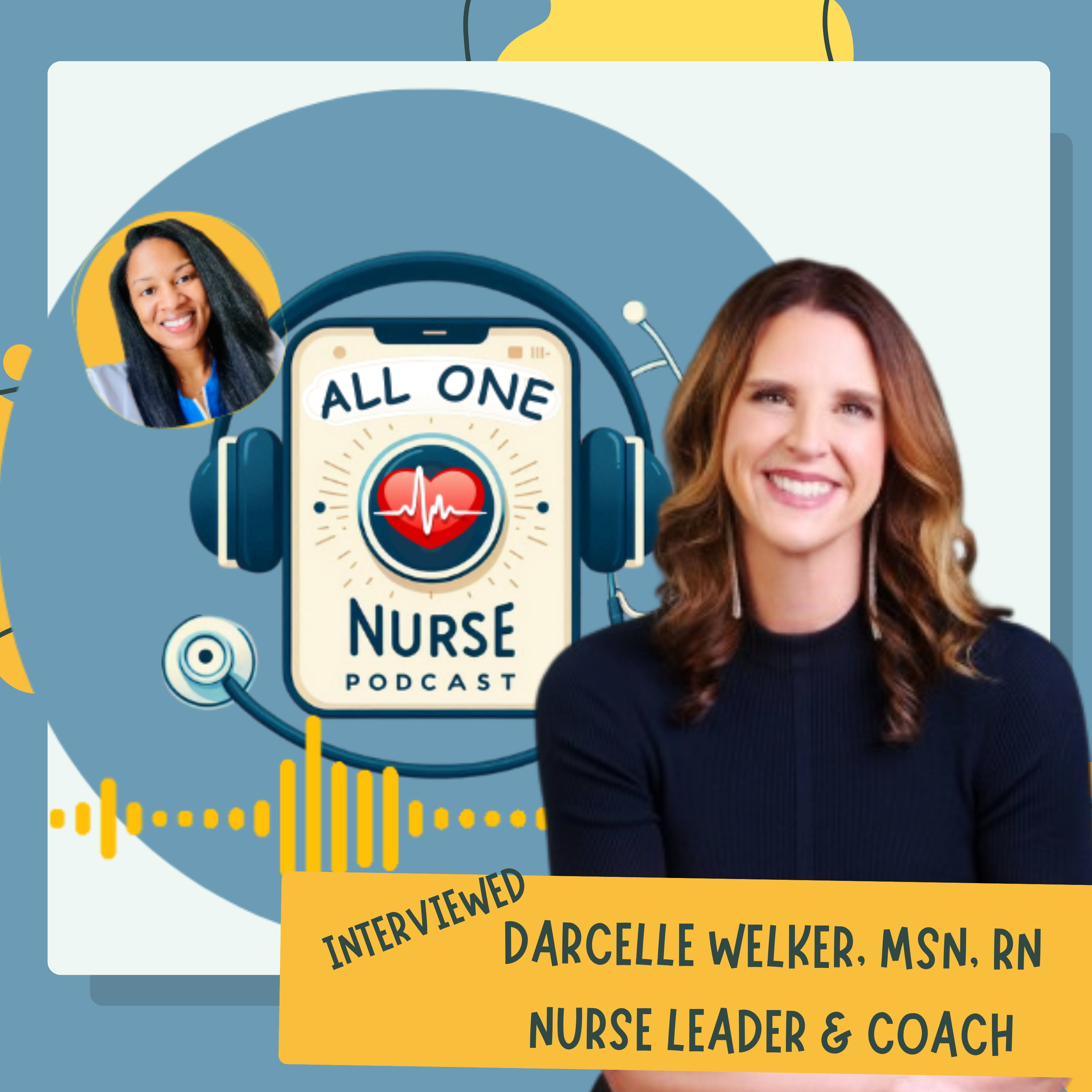
So take a deep breath and let's step into your next breakthrough. Welcome back to the All One Nurse Podcast, where I'm your host, Nurse Chanel Tompkins, and I am so glad that you are here with me today on this episode, I have a wonderful guest, Ms. Darcelle Welker. She's a nurse director and a nurse coach who has been nursing for over 35 years, almost as long as I've been alive. But in our conversation, we talk about burnout, boundaries, leadership, and so much more. As if you are not already a subscriber, go ahead and click that subscribe button so that you don't miss another episode. And all that I ask is that you share this episode with someone who could also use Ms. Darcelle's words of wisdom and guidance.
So go ahead and grab your water, your favorite warm drink, and no matter where you're tuning in from, may you open your heart to receive.
That's a wonderful conversation. Let's dive in. Welcome, Mrs. Darcelle. How are you doing?
[00:02:04] Speaker B: I'm doing well, Chanel. Thanks for having me.
[00:02:07] Speaker A: Yes, ma'.
[00:02:07] Speaker B: Am.
[00:02:07] Speaker A: It's so awesome to have you here on the All One Nurse Podcast.
[00:02:11] Speaker B: Yay.
[00:02:12] Speaker A: Yes, ma'. Am. So tell us a little bit about you and what drew you into nursing.
[00:02:18] Speaker B: All right. Yeah, I think I knew from a young age, maybe middle school, school, junior high school, that I wanted to work in a hospital.
I didn't necessarily know nurse yet, but I was fascinated with all the equipment that I would see in a hospital room or the doctor's office, and I thought, I want to be the one using that equipment.
So, yeah, it was. It was. Once I decided I never looked back, really.
[00:02:49] Speaker A: Now, as for myself and other guests, did you start to take any classes that prepared you for, like, medical field or healthcare in high school?
[00:02:59] Speaker B: Yeah. So I did get my cna and I worked the summer between, I believe, my junior and senior Year.
[00:03:09] Speaker A: Wow.
[00:03:10] Speaker B: Yeah. I worked in a nursing home, and I worked 3 to 11, so I got to put all of the lovely residents to bed and give them their back rubs. That was back in the day when we did back rubs. I don't know if they do them anymore.
[00:03:25] Speaker A: I don't.
[00:03:25] Speaker B: But it was wonderful. And, yeah, I did that before nursing school, and then I went right in. I did a BSN track.
[00:03:35] Speaker A: Okay.
[00:03:36] Speaker B: Right. Right out of high school and just. Yeah. Yeah.
[00:03:40] Speaker A: Awesome. Now with that, what were some of your challenges? Because I love for new nurses to hear that we may have had some of the same challenges coming through the BSN program or as a new nurse, what would you say some of the challenges were?
[00:03:54] Speaker B: Oh, gosh. Well, this was a long time ago. Right. So we didn't even have computers, if anybody can even believe that. I think I wrote my papers on a typewriter.
[00:04:04] Speaker A: Oh, wow.
[00:04:06] Speaker B: And this was really back in the day, too. Just funny story. Like, we didn't have a lot of the simulation, any of that, so we practiced on each other. Yeah.
So that was always kind of. Kind of crazy time. You know, we put IVs in each other. We practically put NG tubes down each other.
[00:04:25] Speaker A: I've heard of that. It was.
[00:04:26] Speaker B: It was a little scary. But, you know, we got comfortable with taking care of other humans. Right. Because we were actually doing it in school. But I think it was challenging, for sure. You know, I remember just being scared to death on my first day in clinical. My instructor grabbed me, and we were at, like, the va. Oh, wow. And she grabs me, and this. This was. She was a smoker, and she always had coffee spilled down her. Her white, you know, nursing uniform, and you get your papers back, and they always smelled like cigarettes. Anyway, she grabbed me, and she's like, darcelle, we're taking out a Foley. I'm like, what?
That was like, my first day of clinical. Like, I was scared to death. And we just went in and. And. And did it, and it was. It was unbelievable. And lifelong friends, you know, still friends with several of the. The folks I went to school with.
So, yeah, it was fun. So hard, but fun.
[00:05:21] Speaker A: So what's so funny is I think with that, as I'm hearing you say that y' all did a lot of your skills on one another, I think that I would say you can tell me if I'm wrong, but that make you really compassionate towards. Towards patients because you actually know what it feels like to have an NG tube by inexperienced person. You know, when you're doing your skills check off to put an NG tube down like that. I couldn't imagine practicing NG tube insertion.
[00:05:51] Speaker B: We didn't go, like, all the way down, but, you know, it was really good shutting over that. Yeah, yeah, yeah, yeah, yeah. I know. And you're for it. You really learned to trust your classmates.
[00:06:02] Speaker A: Yes. Yes. You would have had me at the measuring. I'm. I'm good. Just show me, you know, how to measure. We good? But we did. In my program, we did do the IV starts on one another. We just had to do one, thankfully, and it was in the hand, so. But now, like you said, thanks to advanced technology simulation. I just remember in Covid, the nursing students had to do a lot of their simulation online, and it's like, could you even imagine that? And so the challenges that we've seen throughout the years, like, just from going from not having mannequins to, like, now we have mannequins. Even having mannequins that can birth babies. I'm just saying.
[00:06:39] Speaker B: I know.
[00:06:40] Speaker A: It's amazing.
[00:06:41] Speaker B: It's unreal, isn't it?
[00:06:42] Speaker A: Yes.
Crazy. But thank you for sharing.
[00:06:46] Speaker B: Yeah, you're welcome.
[00:06:47] Speaker A: Now, what all did you do? Come coming out of nursing school because you have over 35 years of experience.
[00:06:54] Speaker B: Yeah.
[00:06:55] Speaker A: Yeah.
[00:06:55] Speaker B: And you look great. Thank you, thank you, thank you. I thought I wanted to work in the emergency room, and I met with a recruiter at a hospital, and after talking with her, she said, darcelle, she said, I want to put you on the oncology unit. And I didn't even know what that was. I didn't know, really. This was even before I had graduated from nursing school. I worked as a. Like, a tech, a nurse tech or CNA on that floor as well. And no one in my family had cancer. I never knew anyone with cancer.
That was a blessing, right? Yes. So I said, okay, what the heck, I'll try it. And I fell in love with oncology and the patients.
[00:07:36] Speaker A: Yeah.
[00:07:38] Speaker B: So I did that. And this is a funny story, too. I remember thinking, so I. I'm there for three years, and there were these older nurses that were there, and there were some hard ones. Right. Like, there was one nurse, her name was Eunice, and, man, I know the name. If you didn't know your stuff, like, Eunice was hard on you. But what I've learned, really, all throughout my career is everything is relationships. Right.
You know, relationships with your patients, relationships with your manager, relationships with your peers. Like, everything is built on that. And I don't remember where I was going with this story, but. So Anyway, I started on the oncology unit.
[00:08:17] Speaker A: Yes.
[00:08:17] Speaker B: Loved it. But I saw these nurses that had been there for, like, 30 years, and they were crabby. They were so crabby. And I thought, oh, my gosh, I don't want to be a crabby nurse when I grow up. Yeah. So I decided right then and there that I would always find the positive. And. And I have. I always look for the positive. So I ended up travel nursing after three years, and that was way back in the day. It wasn't a cool thing. Right. To do, but I learned a lot. And then after about. I think I did three assignments or about a year and a half, I moved to Florida and found an oncology cancer center. And that is where I have been for 34 years.
[00:09:01] Speaker A: Oh, wow.
[00:09:03] Speaker B: So I'm not a crabby nurse. I. Yeah. Thanks. Thank you. It is. It has flown by. So I started out, I worked bone marrow transplant. I worked night shift. I did that for eight years and got very burned out.
[00:09:15] Speaker A: Eight years on night.
[00:09:17] Speaker B: Eight.
[00:09:17] Speaker A: How did you. Yeah, like that alone. We just need tips on how did you survive, because, you know, every new nurse, majority, 90%, are going on night shift. Coming out of orientation.
[00:09:28] Speaker B: Yeah. You know, I think a blessing was I didn't have kids, and I, I wasn't married. I was, you know, pretty young, and I really flipped. I mean, I slept all day.
[00:09:41] Speaker A: Wow.
[00:09:42] Speaker B: And not all day, but, you know, I slept. I, I, I could not flip shifts, you know, from days to night. I just, I'm not. I have to have my sleep. So I really did. I just really.
[00:09:55] Speaker A: You are a night owl.
[00:09:56] Speaker B: Became. I really flipped my hours. But it was hard, Hard to have a relationship. Hard to meet people.
[00:10:05] Speaker A: That is so true.
So true. I did it for two years, and it was, it. I did have a son, and so it was nice to sleep while he was at school.
But I did get. Have to work, like, mostly Thursday through. I think I worked Thursday, Friday, Saturday, or it was, yeah, Thursday, Friday, Saturday, or Friday, Saturday, Sunday, because it just, it worked out better for families having family support during that time. But it was hard, and I gained a lot of weight. I gained a lot of weight in nursing school. Let me put that out there. And then I realized I started smoking in nursing school.
No, you did not.
[00:10:42] Speaker B: I made dumb mistakes in my life.
[00:10:45] Speaker A: Oh, my God. Now, one thing I did realize while we're there is that I saw a lot of respiratory therapists that smoked when I first started. And I'm like, y' all are respiratory. Why? Why are y' all I was like, no, no.
And so, yeah. That is crazy.
[00:11:03] Speaker B: Yeah. But on the trance, on the bone marrow transplant floor, I got very burned out. And I remember thinking something just clicked. I was going into work, and I have this feeling that, like, I don't even care about my patients. Like, that. Those words were, like, in my head.
[00:11:22] Speaker A: Yeah.
Before we continue, I want to pause for a faith intermission note. And today, I want you to focus on having joy in the middle. Because in nursing and in life, relationships are everything.
The way we show up for one another, the way that we choose kindness, stay connected. Even when life gets loud, that's when God really does his best work, because he reminds us that the joy of the Lord is our strength. And so no matter what we're facing, joy sometimes isn't loud or traumatic, is found in the quiet moments where we choose to be present.
So wherever you're listening in from, whether it's from your car, your break room, your kitchen, wherever you are, take a breath and let your shoulders drop and let your mind settle. Because God is here in the middle of your day, in the middle, middle of your journey, and in the middle of your becoming. And know that joy isn't just something that we chase, is something that we notice, and that presence isn't something that we earn. It is something that we allow.
And relationships aren't perfect, but they're purposeful.
[00:12:44] Speaker B: Right.
[00:12:45] Speaker A: And as you listen to the rest of this conversation, I pray that you feel reminded that you are not walking alone and that God is guiding you, strengthening you, and restoring you right here and right now. So let's dive right back into it.
[00:13:10] Speaker B: And I'm like, it can't be this way. Like, these people are going through hell. They need a nurse that's engaged and compassionate and present. And I had to work through that. Right. And I did. But I. You know, I ended up switching really into a different position, and I went to outpatient and still in oncology. But it was the shift that I needed to. To take care, to be able to educate and talk and form the relationships with these patients that weren't so, so, so ill. Like, it was, you know, very difficult to work that long in transplant, and we didn't have good drugs back then. I think Zofran had just came out like, oh, wow. It was. It was. You know, things were just different back then, and people, you know, they died a lot, and so. So switching to outpatient helped my psyche. Took me a while to get back to being a daytime person, but I did that for a long Time. But I loved it. I loved educating the patients.
[00:14:14] Speaker A: That's awesome. And then do you feel like you saw more of. Like you didn't put yourself in a position to see poor outcomes? Do you feel like you saw. Got to help them? Like, it felt more fulfilling?
[00:14:24] Speaker B: Yeah, yeah. We still did have poor outcomes, because, like I said, it was oncology patients still. But you also saw all the thrivers and survivors and everything that came along with it. And you got to know these patients. I did that for, like, 18 years. So I got to know them because they would come back.
Yeah. As family. Yeah. And then I hopped into management, which, if you would have told me, Darcelle is going to be a manager, I would have laughed at you.
[00:14:53] Speaker A: Really? Now, did you do manager, management and outpatient?
[00:14:57] Speaker B: I did.
[00:14:57] Speaker A: You did?
[00:14:58] Speaker B: I did, yeah. In the same clinic where I worked.
So I went from peer to manager.
[00:15:05] Speaker A: How was that for nurses who are interested in administrative. In the. In the administrative strat?
[00:15:11] Speaker B: Yeah. Well, here's what guided me to that. It was really another nurse friend, but I had a manager that was really ineffective, and I kept thinking I could do better than her. Well, she ended up leaving, and one of my friends called me, and they said, darcelle, you should do it. You should apply for that job. And I was like, what?
[00:15:30] Speaker A: She's like, yeah, yeah, do it.
[00:15:32] Speaker B: Do it. So I did, and there were, like, five candidates. And really, I got the position.
So it was. You know, I think you get a lot of advice from people saying, don't become a manager where you were the peer. Right. Because it makes it more difficult. But honestly, it didn't. I think I knew that group. They were all very professional. They were all very supportive of me.
[00:15:57] Speaker A: That's awesome.
[00:15:59] Speaker B: And we built a great team.
And I did that for 13 years.
[00:16:03] Speaker A: Management for 13 years.
[00:16:06] Speaker B: Yeah. And then two years ago, I became a director.
[00:16:09] Speaker A: Oh, my God. Well, congratulations for.
[00:16:12] Speaker B: Thank you. Yeah, thank you.
[00:16:14] Speaker A: And you look so well. So is. You look so good. This is how I'll be.
[00:16:19] Speaker B: I was just gonna share. I'll be 60 in August.
[00:16:22] Speaker A: Oh, my God. 60, where I just.
[00:16:25] Speaker B: You get old to say it, but
[00:16:27] Speaker A: I don't feel it. I give you so much hope. You've been nursing longer, almost longer than I've been alive. You give me hope because you look great. And I was just having this conversation earlier. I had a representative come or a vendor come to the hospital, and as a specialist, sometimes we have to walk around with them, especially if they get our areas. And she was just like, you know, quite A few people. You've been here for a while. And I have. I've been at my hospital organization now for about a little bit over 10 years and kind of floated around. And I'm very social because I feel like if I'm going to be at work all day, I don't want to be mean and just miserable. That is a long time to be somewhere to not be happy. And in that, you create a lot of relationships. Right. And I told her, I believe nursing preserves us. Like, you don't have time to do anything else but eat, sleep, and be a nurse. Literally.
Like, I think. I don't know if it's the scrubs or what, but I've seen nurses that, like, you have done nursing for a long time and look so good. And I'm like, how. Where I got something to look forward to. Like, keep preserving me.
[00:17:32] Speaker B: Yeah, it is physical a lot. Yeah, bedside nursing is definitely physical.
[00:17:37] Speaker A: Yes. Well, congratulations on the director role. So you definitely in. In leadership, but in addition to that, you do so much more. So tell us a little bit about your business as a coach.
[00:17:51] Speaker B: So everything, you know, kind of just happens for a reason. Right. I believe God puts things in front of you. So during COVID or right after Covid, I was watching a physician talk about what they do in their wellness department and how he coaches physicians around stress and burnout and. Yeah, and I'm. I'm thinking, well, who's doing that for the nurses? Right? So I got to talking with our wellness department, and I'm like, do we have this service? Like, you know, nurses need a coach. Coaching isn't therapy. It's not mentorship where you just give advice. You know, that's more of a mentorship. But it's really. It's just provides a sacred space for nurses, nurse leaders, to really work on themselves without judgment. And we're all smart. Nurses are smart and resourceful and whole. And it's. It's just a beautiful thing, but it's. There's not a lot of literature out there on it yet. Right. And. And I think. I think it's coming. I think I'm having conversations with my CNO about really the importance of coaching.
[00:19:02] Speaker A: I know that you've also created a model that you go by. Tell us a little bit about that.
[00:19:07] Speaker B: Yeah, well, my tagline is coaching the heart of health care.
So. Yeah. Yeah. So I coach one on one. And it's, you know, aside from my director of nursing role. So we really. We kind of dive deep into health and engagement, alignment, resilience, and then transformation.
[00:19:26] Speaker A: Yes.
[00:19:27] Speaker B: So, yeah, it's just an honor to be able to pour into someone and really help them feel empowered. And everyone has that within themselves. But, you know, we get so caught up in the stress and the family and the work.
[00:19:44] Speaker A: Yes.
[00:19:44] Speaker B: You sometimes forget you have an inner critic too, in your mind that's kind of telling you you don't know what you're doing.
Like, all the things, we all have them. But I say we also have an inner ally. Right. You have an ally that it's in there.
[00:20:03] Speaker A: Yeah.
[00:20:03] Speaker B: So I like to do a lot of work on that. Just like working on the inner critic and kind of calming that, you know, that voice that you might have and bringing out that ally. And really, I love it.
[00:20:16] Speaker A: Yeah, I love it.
[00:20:18] Speaker B: It's exciting.
[00:20:18] Speaker A: I was on TikTok and a young lady had made a post about being a nursing student and how it seems like everything just is so hard and, you know, relationships aren't really what they should be. Because if you're not. If you're not in nursing school with someone, if you've never been in nursing school, like, and you're the only person that's pursuing nursing in your circle, your family with family dynamics, like, they do not understand what that looks like. They don't understand why you have to dedicate this much time to this. And so that's. I was just telling her, you know, the enemy comes to steal, kill and destroy, but Jesus came so that we may have life and have it more abundantly. And so I was telling her in the comments, what does abundance look like for you? Because we can get so focused on all the things that's going wrong. But like you said, sometimes we have to take a step back. And like you said, don't listen to the bad. Listen to the other one that's going to tell you all the good things that are true, but you just can't. You don't hear that voice. You hear the other voice. I think I probably butchered it a little bit, but no, I think I love it.
[00:21:27] Speaker B: Sometimes the inner critic is louder than your inner ally. So.
[00:21:32] Speaker A: Yes, yes.
[00:21:33] Speaker B: Yeah, you have to. You have to work on getting the ally to really come out.
[00:21:39] Speaker A: I love with your method that is like transformation, because you think about something that transforms, you don't change back. It's like a caterpillar becoming a butterfly. It's no going back to the caterpillar. Caterpillar, because now you have the capacity to truly move forward. So that's. I got chills. I love it.
[00:21:58] Speaker B: Yeah. I mean, your whole life is like that, right? And you, you start one place and you continually grow, change, pivot, land somewhere else maybe, but you're constantly moving forward and, and being a better version of yourself.
[00:22:13] Speaker A: Yes, yes. If we, if we allow ourselves to be. Yes, I always say that. So as. As a nurse coach, can you just give us an example of a client that you've had that just their burnout? Like, what did that look like? What are the telltale signs of that?
[00:22:31] Speaker B: Yeah, I think similar to what I said when I was driving into work that day, and I just had that thought, you know, I don't really care about my patients. Like, no, you really have to notice what you're feeling, what you're thinking. It could come in, you know, that was a loud voice. So maybe, you know, someone else doesn't have that loud of a voice, but finding that, you know, just exhaustion all the time, even on your days off, vacations, even sometimes. Or long periods of time off, you know, maybe don't revive you as much.
Just the joy sort of just disappears or you're. You're ruminating on work. I'm big on boundaries too, and making sure that work stays at work.
[00:23:15] Speaker A: That's good.
[00:23:16] Speaker B: And it's really hard sometimes, especially for nurse managers that I coach. They. They go home and they're still working, you know, like, turn off your email.
I don't expect. I even had to tell my managers because she was sending me emails on the weekend. I'm like, what are you doing? I don't want you working on the weekend. Like, you have kids, don't log on. And it's really hard for her. But we're working on it. Yeah, we're working on it. So I think, I think we have a hard time turning off. I think I hear that a lot in clients. That's good.
[00:23:49] Speaker A: That's good. I'm glad you mentioned that because I know managers, that they're like, I don't have time at work. So I go over this at home. I'm like, no, no. How can we help you get to where. Look, how can we. Like, I'm gonna help them do their job, but what can we do differently that when you're off, you're off. When God talks about acknowledging the Sabbath and truly taking a rest day.
[00:24:12] Speaker B: Rest.
[00:24:13] Speaker A: I've been very intentional lately about, about Saturdays being my time. Yes. I may do a little. A couple of things, like in the morning, but past, like 10am I have to turn it off. I have to walk away from it. And it's no longer about anything work related. It is about family, it is about home life, it is about, okay, enjoying the fruits of my labor. What good is it to work hard and you buy nice things or you have nice things, but you're not really even enjoying it. And then you never take a moment to just sit down and enjoy what you actually have before you.
[00:24:51] Speaker B: Yeah. Someone told me the other day, or I'm not sure where I heard it, but it was a good quote. It's be where your feet are.
And I thought, I like that because it's so easy to be everywhere else. Yep. And I thought that's really simple and grounding and be present. Be where you are. And I think we can all work on that. Yeah.
[00:25:15] Speaker A: Yes. I love that I was talking to some mentees about being present because like you said, we are, we driving to work, but our, our minds are a million or a thousand miles away thinking about every other thing. And whether you're at work, you're thinking about things at home, if you're at home, you're thinking about things at work. And it's like, no, let's be more intentional about being present. That's good. So what I, what I'm hearing is rest and be present. I gotta take notes.
[00:25:42] Speaker B: Yes.
[00:25:43] Speaker A: I'm gonna note that.
[00:25:43] Speaker B: Be where your feet are.
[00:25:45] Speaker A: Be where your feet are. I love that. Thank you for sharing. Now, Ms. Darcelle, I love that you were very transparent about just that self awareness of not caring how your patients feel or just understanding like, hey, I shouldn't have these thoughts at this time. When you were working nights on the bone transplant. Bone marrow transplant unit.
[00:26:06] Speaker B: Yeah.
[00:26:07] Speaker A: And so with that, what do you wish every new nurse understood about the emotional and spiritual weight of caring for people? Because they don't know what they don't know.
[00:26:17] Speaker B: Yeah. Yeah. You know, my advice is there's going to be good days, there's going to be really good days, there's going to be bad days. It just stink. And, but, but that's in every job. I mean, go ask, you know, whatever, a lawyer, whoever. I think that's just the nature of life. Right. So don't give up. Be where your feet are and trust. Right. Trust in your, yourself, trust in your knowledge, even though you don't know, ask tons of questions, know that you can pivot. Right. If, if you find that oncology isn't your thing and you want to go help deliver babies, you can do that. Right. The world is completely open to all sorts of places for nurses.
[00:27:03] Speaker A: Yes.
[00:27:04] Speaker B: Business owners Gosh. I mean, it's endless, right?
[00:27:07] Speaker A: Yes, ma'. Am.
[00:27:08] Speaker B: So I think just my mom always would say this too shall pass.
She had good wisdom into her 90s even.
But, you know, you have the power within you to make a change, even if it's a small change. I think it's easy sometimes, you know, we just blame everybody else and blame and blame. And there could be some truth to some of that, that processes need revision or implementation. But. But, you know, it does lie within you to kind of speak up for yourself and call on your inner ally if you need some courage.
[00:27:46] Speaker A: Yes. Yes.
[00:27:47] Speaker B: Yeah.
[00:27:48] Speaker A: That's awesome. So I love that you said that, and it was a couple of things that you said with leading. I always tell new nurses, or just individuals in general, you lead by your own right. Like lead yourself. Well, regardless of what your position is, what your title is, you have to lead yourself as an individual.
[00:28:08] Speaker B: I think, too. The other thing I'll add is somebody else said to me, you are what you eat and who you hang out with. So I think, as a new nurse, right, finding your tribe, find the positive tribe. You know, don't find the mean girl tribe and don't buy. Don't be the nurse that bullies the other. You know, just find the positive people, the lifter uppers. And. And. And if you're kind of not that, then strive to be that.
[00:28:34] Speaker A: I think that's awesome. It's like you've been in my. Have you followed me all day today? Mrs. Darcelle, I promise, it's like. No, it's like I had these conversations earlier.
That is. Yeah, that's true. And you know, nobody. Nobody should be mean to anyone.
And there's no gatekeeping when you're taking care of patients. There's no reason to be mean. The patient is totally dependent on all of us to take care of them. Because. Because the patient doesn't want to be there most of the time.
[00:29:05] Speaker B: Exactly.
[00:29:05] Speaker A: Hear me. Most of the time, they do not want to be there.
[00:29:09] Speaker B: Put yourself in their shoes. Or I always said, you know, I think I'm having a bad day, but then I think I could be that cancer patient on this table or chair or bed.
That could be my mom, that could be my brother, that could be my husband. You know, you have to flip the
[00:29:27] Speaker A: perspective because it can always be worse. Yeah.
[00:29:31] Speaker B: Yes.
[00:29:31] Speaker A: And I think for me, even on my worst day, and it's some days, you know, especially working at the bedside, I always say those supply rooms have caught many tears, and it's still catching Tears, I'm just saying. But even in the midst of that, I just tell myself I get to clock out and go home. Lord's willing, I am going home today. That patient may not leave here. So give me what I need this day, this shift, and then if it's really hard, this patient, this patient. Yeah. And you're like, jesus, be a fence, be a whole house, be the whole unit. I just need, I need you. And it's. Sometimes you just gotta walk away.
Just gotta walk away. But, hey, I'll be right back. And for me, I guess for me to prevent burnout per se, on the units, I was just telling the intern some of the things that I did to keep myself up during my 12 hour shift at the bedside. And that was to actually have breakfast before I got to work, have a cup of coffee after I got bedside report, and while I'm checking the chart. But I also communicated that with my patients and their families so that they'll know. Like, oh, there she goes, she's already at the desk, you know, doing nothing. But they would know. And if they would, could have coffee, hey, I would bring them a cup too. But then I would have me like a snack right around 10, once I got done with my first set of rounds. And then I told her, I said, and girl, and I could work through lunchtime. I can make sure people got fed and I will even check blood sugars, you know, as long as I know people are going to follow up and then come to 2:30. Okay, I'm going to lunch. We're not talking about work at lunch.
[00:31:03] Speaker B: Love it.
[00:31:04] Speaker A: Yes. And as a matter of fact, I'm able to report off to whoever's, you know, watching my patients while I'm gone. Hey, if Dr. So and so comes by, tell them I need this for this patient. But I am setting myself up for success. Now, does it always work out that way? Did it always work out that way? No, of course not. But most of the time I had a routine, I had a strategy, but I had everybody else in mind. And one thing I told her when I worked through the noon time with meal time is that I would encourage other nurses to go to lunch. And so it's like, I want you to be your best self. Because when I go to lunch, I don't want y' all to have to bother me. And I always tell the patients, go ahead and take you a nap. Eat, take a nap. Like I would set when I say 2 o' clock was nap time or I would tell them what I'M going to do once I got back to the unit. It's like, in certain things, if they request it early in the morning, I was like, look, we do baths and dressing changes after lunch or at lunchtime. And they'd be like, okay, okay. Unless it just, you know, really needed it.
[00:32:05] Speaker B: Yeah.
[00:32:05] Speaker A: But I said one thing. Like you said, communication is the biggest thing. The biggest thing. And so that, that helped me out a lot, you know, as I became more experienced, of course. But it came with.
[00:32:17] Speaker B: Yeah, I love that you, you know, food is foundational, snacks are found. You've got to have your sleep, your hydration.
[00:32:24] Speaker A: Yeah.
[00:32:25] Speaker B: Good nutrition and movement, which, you guys, you know, getting a lot at the bedside, you know, that is a lot of movement. But if, if you're like me and you are in a ton of meetings, sometimes I get up between meetings and do jumping jacks in my office or. Yeah, you know, just something. I got to get up and move.
[00:32:43] Speaker A: It's really.
[00:32:44] Speaker B: It's not good to sit for so long. But that's, you know, one other just tidbit, you know, I think managers, sometimes new nurses can be afraid of managers and, you know, just realize they're. They're human, too. They're probably slammed and burned out, you know, like. Like the nurses are.
But just coming back to relationship is really.
Is really key.
[00:33:09] Speaker A: That's good. One thing you were saying about the new nurses not wanting to talk to man, leadership or management. What is your advice being a leader yourself now, director, what is your advice for nurses who are wanting to pivot but don't know how to approach you? To say, hey, I'm applying for so and so?
[00:33:31] Speaker B: Yeah, I think just go for it. Right.
If you don't say it, you know, go. Or what I did, I think as before I became a manager, I went and talked to not my manager because she was on her way out the door, but I went and talked to another manager and was like, hey, it was somebody I knew, you know, like, what do you think of this? I'm thinking about doing it, and that was a big help. So if you don't feel comfortable going to your manager, maybe there's someone else, another manager that you could kind of bounce things off of. But managers love it when people come up and say they're interested in a leadership role. They want to hear what your dreams are. Yeah. So. And like I said, you never know. I did not ever strive to be one. It just so happened. And I had a little nudge. Yes. And it was fulfilling. And I built a Great team.
[00:34:25] Speaker A: Awesome, awesome. Thank you. That helped because I'm like, I can tell people like, hey, just ask, do this, do that. But it's something else when they hear it from the horse's mat.
[00:34:36] Speaker B: It happened to me this week. Chanel, a nurse from another department zoomed me and she said, hey, I'm thinking about applying for this position, yada, yada, over here. What do you think? And I'm like, yes, go for it. You've got this and this and this. And so we'll see.
[00:34:52] Speaker A: But yeah, that's so awesome.
[00:34:54] Speaker B: Love it.
[00:34:54] Speaker A: Awesome. So could you let us know how could we connect with you?
[00:34:59] Speaker B: Oh, yeah. Great, great, great. I'm on Facebook and Instagram. It's Darcelle Welker. Coach can find me there. I'm also on LinkedIn and then also on Facebook. I do have a Facebook community that I'm just getting started. I think I don't have a lot of folks in that group yet, but if, you know, friend me on Facebook and then we'll get you in the group. It's Burnout to Breakthrough and just a great place. Yeah. Community for nurses and leaders if they want to join the community and. And share tips and positivity and encouragement.
[00:35:36] Speaker A: Burnout to Breakthrough.
Okay, I love that. And I can't speak to the leadership role as far as management, but just as a staff development specialist, I'm a leader. I lead from the educational side. But like I always say, you have to keep your cup full and the overflow is for everyone else. We know that nursing, regardless of what you do, you're. You're giving a lot of.
I can only imagine being a director, you carry the torch in a different way. I commend you for that. But also, I will add all of your information down in the show notes below so that our listeners can readily find your Facebook group.
[00:36:18] Speaker B: To Breakthrough.
[00:36:19] Speaker A: Burnout to Breakthrough. And you have a website, too.
[00:36:23] Speaker B: Yes. Darcelle welker coaching.
[00:36:25] Speaker A: Yes. Darcelwalkercoaching.com and we will definitely have to meet again. You have shared.
[00:36:33] Speaker B: Yeah, I would love to definitely reconnect and stay in touch and.
[00:36:37] Speaker A: Yes, ma'.
[00:36:38] Speaker B: Am.
[00:36:38] Speaker A: Thank you so much, and thank you for joining us here on the podcast today.
[00:36:43] Speaker B: Thank you, Chanel. I appreciate it.
[00:36:45] Speaker A: Yes, ma'. Am.
[00:36:46] Speaker B: It was great.
[00:36:47] Speaker A: Today's conversation with Ms. Darcelle reminds us that nursing is just more than a profession, that it is truly a calling that requires our hearts to be fully in it, and it requires boundaries as well as intentional growth, which I am all for, especially in this season of my Life. And if you've felt, seen, encouraged or challenged by anything that Darcelle shared today, I want you to take a moment to reflect on what your inner ally ally is trying to tell you. And remember that transformation doesn't just happen overnight, but it does happen when we choose to move forward with purpose. So make sure that you follow the podcast, share this episode with the nurse who need it, and leave a review so that nurses can find this space of faith, truth and community.
And be sure to connect with Ms. Darcelle, especially on her Burnout to Breakthrough Facebook page on LinkedIn or through her website, which I will add all her links in the show notes below.
And I just personally want to say thank you for being here and for showing up for yourself. So just like I told my mentees on our Thursday night meetup, go ahead and pat yourself on the back because you don't realize, you know, sometimes we have a hard time sitting down and being present. Like Ms. Darcelle said, be where your feet are and truly look at everything that you have going on that's going well and truly, moving with a heart of gratitude and having joy and in the middle, right? So I pray that this blesses you and all I ask is that you bless someone else with this conversation with Ms. Darcel. And until next time, let your light shine. We are all one nurse. See you in the next episode.