Episode Transcript
[00:00:00] Speaker A: Hope for the best, but prepare for the worst.
[00:00:02] Speaker B: Did you know that first year nurses experience the highest turnover of any group?
That reality is staggering, but it also tells us something important.
You are not alone and your growth matters.
Welcome to the All One Nurse Podcast where we are bridging the gap between the stethoscope and the soul through real nursing stories and nursing conversations.
Here, our mission is simple to get back to the human side of healthcare.
I'm your host, Nurse Chanel Tompkins and I'm also your mentor and nurse educator. And this space was created just for you to breathe, to learn, to grow, and most importantly, feel supported no matter where you are in your nursing journey.
So take a deep breath and let's step into your next breakthrough. Happy Thanksgiving All One Nurse Family.
As we gather with gratitude this season, I want to thank you for being a part of this growing community. One of the reasons I love this platform is that we get the opportunity to sit down with some incredible people, most of them nurses. And we learn from there to learn from their lived experiences, gain practical insight, and hear advice that can help you navigate nursing in your own journey in healthcare and beyond.
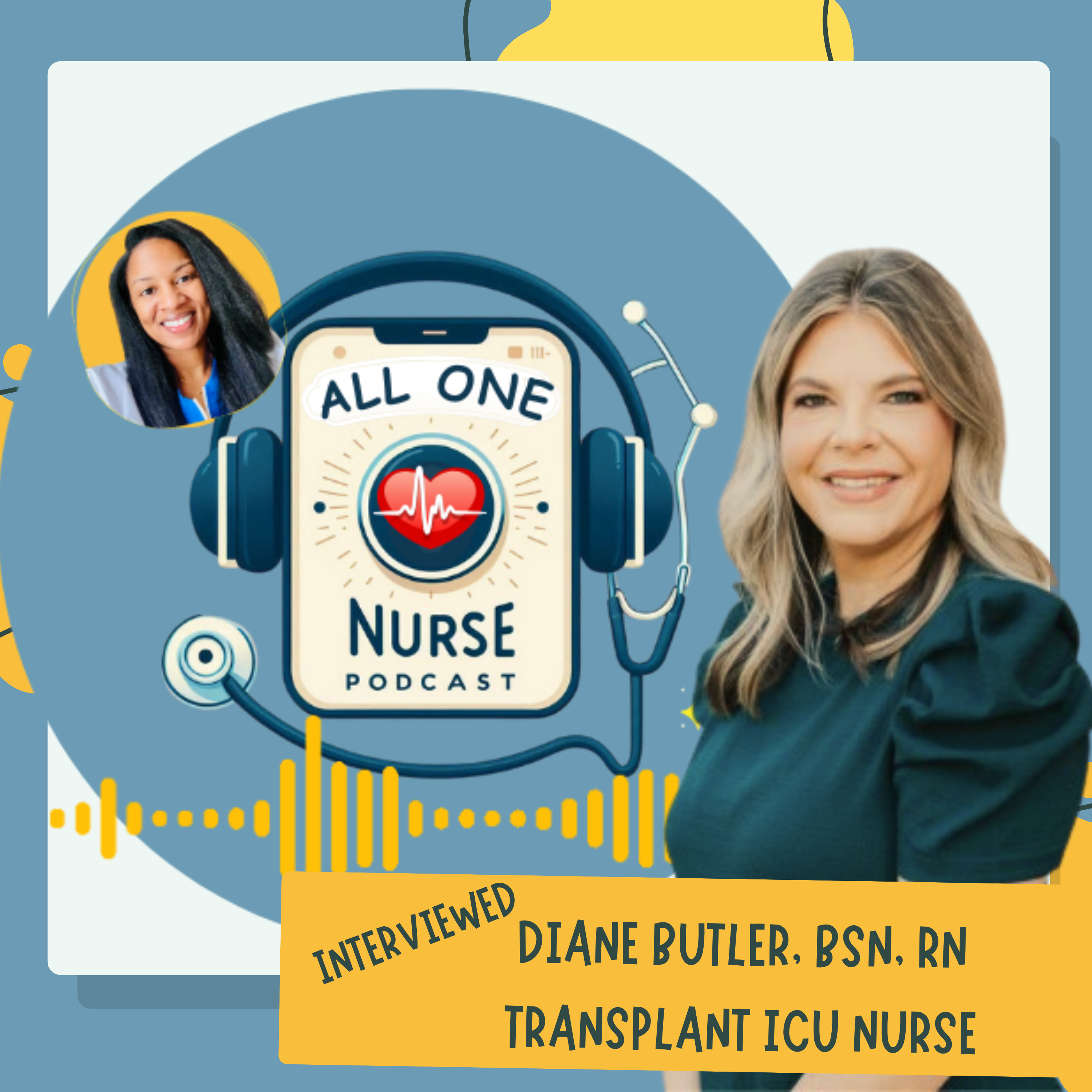
This week's conversation features Diane Butler, a transplant, ICU and ECMO nurse whose passion for critical care, patient advocacy and continuous learning shines throughout this conversation. And Diane shares how she cares for heart transplant patients, families through uncertainty and finding healthy ways to stay grounded while working in a high acurity environment.
Her perspective is both inspiring and honest.
And don't miss what's coming up next. I'll be joined by Dr. Devin Owens, PhD, my other Devin, you know I had my ebony and my ivory, so this is my ebony.
And if you haven't checked out Devin Patterson, the ER nurse who co founded Surtracker, then I advise you to go back and check that one out too.
But Dr. Devin Owens, Ph.D. is an accomplished leader in academia whose focus has been on diversity, equity and inclusion. And most importantly, she's a breast cancer survivor and she is still walking this journey.
And she brings her remarkable transparency, resilience and wisdom to the All Oners platform to us. And her story is one that you don't want to miss.
And finally, if you're feeling stuck, discouraged, overwhelmed and unsure of your next step, be sure to go back and listen to our previous solo episodes.
Those episodes were created specifically to encourage you, challenge you, and equip you with practical and mindset shifts to help you move forward.
Okay, thank you for being here. Happy Thanksgiving. And as always, remember, you're not alone. We're Growing personally and professionally together.
So let's dive in with Ms. Diane Butler.
Hi, Diane. Welcome to the All Nurse podcast. How are you?
[00:03:56] Speaker A: Yay. I'm doing well. How are you?
[00:03:59] Speaker B: I'm doing good, thank you. Thank you.
So getting right into it. Tell our listeners. Who are you?
[00:04:07] Speaker A: Yes, I am Diane Butler. I've been a nurse almost for 10 years and I started out straight into an ICU, straight out of school and nursing school from University of Memphis and I went straight to a device heavy transplant icu.
So
[00:04:24] Speaker B: yes,
[00:04:25] Speaker A: yep.
[00:04:26] Speaker B: Now going
[00:04:26] Speaker A: back
[00:04:27] Speaker B: to your now, what brought you into nursing? What were you like? I just knew I wanted to be a nurse. Tell us more about that.
[00:04:35] Speaker A: So kind. Pretty much, yeah. So my mom is a nurse and so I grew up going with her to. She worked in a doctor's office for a long, a long while. And so I would go with her for that and then kind of see her do that. And then she went and got her bsn and she also worked at a hospital and so I got to see her through all those phases and it just really inspired me to.
To be like her.
[00:05:01] Speaker B: Awesome. Awesome. Now, do you have any sisters that are nurses as well?
[00:05:05] Speaker A: Don't. My cousin is also a nurse in East Tennessee, so that's kind of cool. But it's just my mom and I.
[00:05:12] Speaker B: Awesome, awesome. Now when we talk about nursing and going straight into an equipment heavy unit and like you said, icu, a lot of new nurses, they may not know about icu transplant icu.
So tell us a little bit about your experience starting out in transplant. And actually, what is that for the nurse that's wondering? Oh, I just thought there was one ICU or just cvi.
[00:05:39] Speaker A: Sure. Yeah. So it's really interesting. My mom, she kept telling me, she said, you should go tour transplant icu. And I was like, I don't know. Like when I studied it in nursing school, it really didn't spark my interest. I was maybe interested just in general ICU or even the er. My friend was interning and he said, I'll take you around.
And so I got to see some of the devices they use and I was thinking to myself, wow, this is exactly what I'm looking for.
So my thoughts changed and I interviewed. I knew immediately that's what I wanted to do and so stayed with it ever since. But it, it's very interesting. I really wasn't sure and didn't realize how intense it was and high acuity it was. So it was perfect for me for sure.
[00:06:31] Speaker B: So you say perfect for you because Being a new nurse, what qualities would you say a nurse would have, a person would have to have coming into that type of environment?
[00:06:40] Speaker A: So I found a lot of growth in myself, even still today when I work in that unit, because you have to have a lot of critical, quick, quick thinking, and it's something that you constantly study, which I actually enjoyed because I felt constantly challenged, and I'm not stagnant in that unit at all, which is really nice. And so I was able to experience a lot of autonomy as well as a nurse. The doctors kind of give you the parameters and expectations and training, and then you are to utilize that, and they expect that for their patients, which was. Is really nice. It was a very tight relationship and still is. So I enjoyed that part of it, too. Yeah.
[00:07:28] Speaker B: Now, I do love. Thank you for sharing that insight.
And one thing that I love that you mentioned is the continuous learning. Like, the learning is a continuum. Like, you're always studying to learn what you're doing in that type of environment. And I always want to point that out, because sometimes I think nurses graduate nursing school, and they're like, I got my license. I got this. And it's like, wait a minute. You have to continue to learn. The learning has not stopped, regardless of where you start in your nursing profession. So I love that you pointed that out, especially in the transplant ic. Now, for those who may be wondering, okay, Chanel, what type of transplants are we talking about? Could you explain what you have experience with?
[00:08:16] Speaker A: Yeah, yeah. So I have pretty much all my experience with heart transplants. We still have some residual lungs that we take care of as well, but majority is heart. And the really cool thing about the experience I've been able to have in this particular icu, and really, I feel like it's. It's like this across the country for the majority as well, is these patients require a certain amount of monitoring and labs and a team behind them. And so they have to stick with that team pretty much for the rest of their life, unless they move. But the same kind of team is also there in that other part of the country.
And so if they were to go to a hospital who doesn't have experience in heart transplants, they wouldn't know what labs to draw to keep them on their regimen of medications.
So I always see those transplants or the mechanical devices like LVAds, because if they have a head bleed, we know how to monitor them in their labs. So it's been really, I hate to say great for me, because it is a very unfortunate Circumstance that they are there. But I have been able to expand my knowledge because whatever etiology they are dealing with, because of their original diagnosis of heart failure, mechanical device or transplant, they still come to us. So they can have a head bleed, they can have GI issues, they can have bone issues, and we're still going to take care of them. So I've been able to still dip into neuro, dip into gi, dip into ortho, gyn, you know, wherever, whatever. We need to take care of that patient. So that I've really kind of gotten lucky in that regards to not just stick solely with cardiology. So that's been cool.
[00:10:02] Speaker B: Yes, that is awesome. You know, I worked at cvicu, but a lot of our patients. All right, you know, of course we have to deal with comorbidities and their reason, you know, the things that come with them having the heart issues. But it's interesting that you point out that, hey, regardless of what's going on with that patient, especially a patient who has been a heart transplant recipient, hey, they're. They're a lifetime patient with
[00:10:25] Speaker C: us pretty much if they're. If they stay within our location. Right.
So that's awesome. And
[00:10:32] Speaker A: exactly. You kind of opened
[00:10:34] Speaker C: up the caveat with my next question of how do you support patients and families
[00:10:39] Speaker B: through,
[00:10:40] Speaker C: like, uncertainty of waiting on a heart
[00:10:42] Speaker A: transplant?
[00:10:43] Speaker C: How do you. How do you support patients who may
[00:10:47] Speaker B: be
[00:10:47] Speaker C: waiting on a heart transplant? Because
[00:10:49] Speaker B: there's
[00:10:49] Speaker C: a lot of hope and probably, and I'm assuming sometimes
[00:10:52] Speaker B: loss and joy that's all wrapped up in one sometimes with your. With the population of patients that you serve.
So what. Can you give us some insight on that?
[00:11:03] Speaker A: Yeah. Yeah. So this is a very interesting dynamic that I deal with or experience with on these families and patients, because a lot of them, the majority of them have been dealing with heart failure for a while.
They've experienced the decline. And so they know that they're at the end of the row, end of options. And so it's kind of a Hail Mary and they decide that they want to go this route or not. And so they felt the. I can't walk very far. I'm on a bunch of meds. I'm getting an AICD because I'm at risk for this. I had to get disability.
So that is a lot on them. And so they also don't live near this hospital usually, you know, because it is a rare treatment option or rare surgical option for just every hospital. There's not a ton at every single location that you're going to go to. So we get patients from all over, and a lot of hospitals around the country do. So they're going to not have their family with them all the time, or, you know, it is expensive for their family to come visit. And so that's very hard. So we try to learn what that patient interests are, what makes them in a better mood, how to serve them, how to take their mind off things. We learn their family members and learn what their family members are going through. So that. That is a big deal.
That is really hard. And then we also, we also prepare them for what a hard recovery might look like, where it doesn't go as they expected, or a plan B or plan C.
Those are hard talks, but a lot of them would rather you be open with them than keep it from them. And sometimes health care providers don't always. They forget to communicate as openly as the patient would want them to. And so that's where it's really important. A lot of times it's the nursing staff, but our ancillary is also great because they can fill in as well. But, you know, we, we sit down and have these conversations, what it's going to look like. We try to prepare them for what hard work in the recovery status is. Is like, and try to remind them of the goal. But we also tell the family, one of my favorite sayings is, hope for the best, but prepare for the worst.
And so that's what we try to always, always keep going for.
[00:13:35] Speaker B: That's good. That's good.
Very insightful. And I know when you say a team.
[00:13:41] Speaker A: Yeah, yeah.
[00:13:43] Speaker B: I know that working in the ICU can be intense in general, and you can have some intense shifts. And so I have to ask, how do you stay emotionally grounded?
And what is some of your ways to offload what you experience or have to carry during your shift, especially with your patients and family?
Before we continue, I would like to take a moment to reflect as Diane shares her experiences caring for patients and families through some of their most vulnerable times.
In moments, we're reminded that nursing is more than tasks and responsibilities.
It's a calling to serve, encourage, and remember. Remain faithful even when the work is hard.
And our scripture to reflect on comes from Galatians 6, 9. Let us not become weary in doing good, for in the proper time, we will reap a harvest if we do not give up. Dear Nurse, whether you're showing up for your patience, supporting a struggling colleague, caring for your family or siblings, simply trying to make it through another shift, God sees your faithfulness, the compassion you give the sacrifices you make and the seeds you plant each day, know that they matter.
Your work has purpose and your presence makes a difference. So let's get back to the conversation.
[00:15:19] Speaker A: Yeah, that is hard. And it's something that, you know, I think we all deal with. I think that I found throughout my nursing journey.
It's looked different throughout the years. So some of that is either I like to really sit on my back porch or front porch and just sit there and read or just sit there with my dog or hang out, maybe eat dinner outside. That's just. It's fresh air.
Especially if you're night shift or if you've been inside all day not looking out a window. It's just nice to get some sunshine or fresh air and it feels like you can breathe a little bit sometimes. It's a couple years ago was working out. I like to cook, so that's kind of like I'll have all the ingredients on the countertop. So when I get home or on my days off, I just get. Get going. And that goes directly from chaos at work to just immediately doing my own thing.
[00:16:17] Speaker B: Yeah.
[00:16:18] Speaker A: And it's kind of a nice bridge into dinner, you know, and to change, like, it really forces me to change that momentum. I think I like to travel, and so that kind of like forces me to remove.
I will say I used to really stay up on how my friends were doing at work, and I had to stop doing that. I had to stop doing that. And I think that's very important because you have to have a boundary for yourself and for your friends at work.
Because if I'm at work and I'm trying and I've got my friend that's off asking me how things are going, I can't do my job. And her job is to have a day off also.
[00:16:57] Speaker B: Yeah.
[00:16:58] Speaker A: And so that. That was a big deal. And that was hard to learn because it's just the. It was the culture of the unit. It was just something we all did. We all wanted to check on our people.
[00:17:10] Speaker B: Yeah.
[00:17:11] Speaker A: And you just can't do that.
And so just finding something that in this chapter of my life or of the nurse's life, you can do if it's blasting the music or if it's quiet time. But forcing yourself to respect yourself, to have those days off and to have an outlet is important.
[00:17:32] Speaker B: I love it. So what I'm hearing you say is create ways to disconnect. And for you, it was through, for one, getting fresh air and just being present with self outside as well as cooking, which we gotta come back to. Because for one, I love food.
Just
[00:17:50] Speaker A: say that.
But
[00:17:52] Speaker B: that prepping and being prepared to just, hey, soon as I get home, it's time to do what I can control. Do something that I love and that I do in full control of. Yeah,
[00:18:02] Speaker A: exactly. I think that's
[00:18:03] Speaker B: awesome.
That's awesome. And another thing I heard you say was when you're off beyond.
[00:18:08] Speaker A: Because I almost feel like, yes, yes. Because you have all this energy after work or you're just. I wouldn't say energy stimulation.
So if I could take that residual stimulation and put it into cooking or put it into arts and crafts, whatever it was, then I don't keep that stimulation and transition on my family, you know, and so that was a way to flow that somewhere else.
So that was, that was nice. That was cool to learn.
[00:18:39] Speaker B: Yeah, that's good. I remember and I spoke about it here on the podcast, how at one point I would just be all in at work and I was like, and I, I will that correction.
I've always been like that. But with patient care, it's like, you can be the housekeeper, you can be the, you're the, the assistant. You are. You
[00:19:01] Speaker A: secretary. Yep.
[00:19:03] Speaker B: Man, you are everything.
You wear many hats. And then when I got home, I would be so frustrated because I'm like, y' all can clean up, you can feed yourselves. Why is
[00:19:15] Speaker A: the
[00:19:15] Speaker B: house like this? And so it's like I would dump frustration out on them, but had a
[00:19:22] Speaker A: good
[00:19:22] Speaker B: attitude all day at work as a, you know, just caring and
[00:19:26] Speaker A: doing
[00:19:26] Speaker B: what I'm supposed to do for someone who is vulnerable and sick. And I had to learn that that wasn't fair to my family.
So I love that you mentioned that, that you created space to, to really put that, that residual energy and stimulation into something else, like cooking. And I'm sure your family enjoyed it because they got a meal. So that is awesome.
And thank you for sharing that.
Yes. Now, let's see now, I got two thought provoking questions for you. One not so deep, but what do you wish more people understood about the nurses behind transplant care?
[00:20:10] Speaker A: Hmm. I think that there are a lot of expectations and it is hard for them to gather their thoughts with all these expectations. And it's hard. There's. I feel like there's a lot of protective mechanisms built into us because the heart is the center of all these organs. Right. And so we wanna make sure we're perfusing this organ and this organ and this organ. And there's so many hemodynamic numbers.
Um, and Then the, with the transplant heart failure mechanical device team, it's, it's literally like a team of providers. So there's just a chosen few for each specialty.
Gotcha. So they know us very well and so they, they, like I said earlier, they set their expectations and parameters and they expect that.
And because I do feel like a lot of those nurses are so strong and great nurses, they kind of over fulfill. So these physicians are spoiled and so they, they are used to us just, you know.
[00:21:17] Speaker B: Yeah.
[00:21:18] Speaker A: And so it, it's just a lot to manage. And so I think people just have grace with, with that because they're managing a lot of times crt, they're managing the lvad, the L, the left side device. And then a lot of times there's a right sided device. So they're also managing that and they're managing, helping manage the vent or the airway and then they're managing, like I said, the hemodynamics, the medications.
There's a lot of family members and there's not a ton of times where family is not present because of the nature of our unit. And so that can be a lot sometimes. And so there's just a lot of hats, uh, and then the doctors want to call and get updates a lot, you know, and so it's just a lot sometimes. I remember when it was a good number of years ago, I, I was just running around like crazy getting labs and, and giving blood and, and whatever the case may be. I was doing true like heavy critical care care and spent all shift saving this person's life or trying to. And I remember at the end of the day the family member said I, I really like nurse who put chapstick on my cousin's lips. And I was like, I have been running around, I didn't eat lunch. I've been doing all these things and that's which, I mean they were happy and I was happy for them that you know.
[00:22:43] Speaker B: Yeah.
[00:22:43] Speaker A: And, and you know, it's just part of it. Like they don't realize. Yeah. So just have, you know, grace because everyone is just running around because this central organ needs so much attention for all the other organs, you know.
[00:22:58] Speaker B: Yes.
[00:22:58] Speaker A: And you know, I'm sure every nursing specialty feels similar feelings, but it's. Oh
[00:23:06] Speaker B: yeah,
[00:23:06] Speaker A: it can be a lot. Just because of all the devices that you can attach to this one organ that's having issues.
[00:23:13] Speaker B: Yeah,
[00:23:14] Speaker A: it can be a lot sometimes. And we still have health streams that are due
[00:23:18] Speaker B: and your certifications. You gotta make sure your bls, your acls Pals if you need that, I'm telling you.
[00:23:25] Speaker A: That's right.
[00:23:25] Speaker B: So much, so much.
[00:23:27] Speaker A: That's right.
[00:23:28] Speaker B: That was good.
Yes, ma'. Am. I really wanted to dive into what ECMO is because I know that a lot of patients or a lot of families do not know until someone needs it.
So could
[00:23:44] Speaker A: you kind
[00:23:44] Speaker B: of explain what that is and who and what type of patients you generally serve or why people may need it outside of your traditional heart failure
[00:23:53] Speaker A: patients?
For sure. So ECMO is extracorporeal membrane oxygenation, which is a lot of long words. It says basically a patient may need heart and or lung help that no longer can be treated with a ventilator or drips or machines. It's, it's basically the biggest Hail Mary there is.
It's very, very cool. And so it takes blood out of the body and it can oxygenate it, it can remove carbon dioxide and it can also pump the blood for the body or for the heart to the around the body and then it returns it.
So patients, for example, lung patients that may need it would be extreme asthmatics, pneumonia, ARDs, pulmonary embolism. And that's just not to a certain demographic that is a 23 year old who started birth control or a 25 year old who is on testosterone, an 18 year old who had an asthma attack that it just status asthmaticus. So this is all over the spectrum. And then heart, heart issues, it doesn't could be an an mi, it could be a surgery that didn't go as well as they wanted it to. It could also be a medication overdose. And so the blood, yeah, the blood pressure is too low and so we can support it with that device until that medication gets out of their system.
So it is all over the spectrum and it can be short term or a little bit longer term and it can be bridged to different, I guess, goals of care. So it's a pretty cool option for last resorts. So it's pretty
[00:25:39] Speaker B: cool.
Gotcha. Now one thing you mentioned was postpartum patients. So it could be young moms too, right,
[00:25:48] Speaker A: that
[00:25:48] Speaker B: experience heart failure due to pregnancy?
[00:25:51] Speaker A: Yes, postpartum cardiomyopathy is one.
And then also we've had some mothers who have high pulmonary hypertension.
And so even as they're pregnant, we'll watch them through that.
[00:26:05] Speaker B: Gotcha.
[00:26:06] Speaker A: And sometimes treat them through that. So that's, it's pretty interesting. And that's where you get to experience and learn about different areas of nursing that you're not normally exposed to.
[00:26:17] Speaker B: Got. Yeah, that's awesome. Thank
[00:26:20] Speaker A: you.
[00:26:20] Speaker B: So much for sharing that I know. You know, again, nobody knows about it until they actually need it
[00:26:27] Speaker A: or if they work
[00:26:28] Speaker B: in that environment. So I think this is,
[00:26:31] Speaker A: yes,
[00:26:31] Speaker B: very awesome that you got an opportunity to get on here and really
[00:26:35] Speaker A: share
[00:26:36] Speaker B: about transplant icu.
[00:26:39] Speaker A: Yes. I
[00:26:39] Speaker B: think that'll help new nurses feel better prepared as well.
[00:26:44] Speaker A: So a lot of the nurses that are newer to the unit to heart failure or to devices or, or whatever the case may be, I have to remind them that these patients, we didn't just pick them up off the street. So to say we didn't find this healthy patient and say, let me offer you a last resort. These are patients who have struggled for years and they felt bad and worse and worse and worse. And we're offering them an option to hopefully give them a couple more good years with their family.
And a lot of, I would say most of them are very well aware of that. The patients, they have come to that realization and they know that this is terminal heart failure. As far as heart failure goes, this is terminal. And I would just like to be given a couple more years if possible.
And so when I have to say those nurses, because they just come out of nursing school and I, I found myself having this mindset too is you come out of nursing school wanting to save lives, wanting to treat, wanting to make better because that's what we're trained to do. And then with heart failure there is not getting better.
You know, we can tune up, we can optimize.
[00:27:59] Speaker B: Yeah.
[00:27:59] Speaker A: And we can make them feel temporarily a little bit better, but we're not going to cure their heart failure. So what can we do to make their lives a little bit better? And so I have to remind them, these nurses that we're not here to, to just turn this heart failure around. We're here to give them the best of this diagnosis. We can,
[00:28:19] Speaker B: that's good.
[00:28:20] Speaker A: And so that, that's hard to remember sometimes because it's only natural as a nurse, you know, but not all aspects of nursing are like that.
[00:28:30] Speaker B: Right.
[00:28:30] Speaker A: So it's, it's, it's a different way of thinking for sure.
[00:28:34] Speaker B: That's good. You made me.
So it's like don't be mindful not to give individuals false hope even though we're hopeful that hey, with
[00:28:43] Speaker A: the,
[00:28:44] Speaker B: because treatment has come so far, like there is so much, so many advances in treating heart failure and thankfully the device system, like you said, the lvad and of course
[00:28:55] Speaker A: you have
[00:28:56] Speaker B: the, the, well do we call them RVADs. I know you have
[00:28:59] Speaker A: the
[00:28:59] Speaker B: right sided but
[00:29:00] Speaker A: yeah,
[00:29:01] Speaker B: we see LVAD more so than, you know, I
[00:29:03] Speaker A: don't.
[00:29:04] Speaker B: We see people walking around more with lvad, so. So you can still have a.
A good life
[00:29:10] Speaker A: for
[00:29:11] Speaker B: what. For what you are dealing with. And like you said, just be mindful of. We're not trying to. We're not going to get back to what was before.
[00:29:22] Speaker A: I found myself at first so disappointed because I wanted certain things, certain markings for them, and then I had to realize that that wasn't appropriate for their diagnosis or for what stage of heart failure they were in. And they were happy with getting up and going to see their granddaughters play.
[00:29:40] Speaker B: Yeah.
[00:29:41] Speaker A: You know, or they were happy with being able to see their son graduate high school. And so I had to realize, like, that was appropriate, and that was the care that they were expecting and that they needed, and they got them five years from that, and. And they could walk without feeling short of breath constantly. So then I had to realize those were my wins, and so that helped me a lot.
[00:30:04] Speaker B: That's good. That's good. And I know, you know, of course, we're talking about a certain group of patients, not just all transplant patients. Of course. Course,
[00:30:13] Speaker A: yes. Correct. Or
[00:30:14] Speaker B: heart failure patients. So thank you for sharing that. I think that has helped out a whole lot. I'm sure I'm gonna think of more questions just even after publishing this episode, this conversation, but I really thank you, Diane, for
[00:30:28] Speaker A: getting on
[00:30:28] Speaker B: here and just really giving us some good insights. I mean, I've helped. I've floated to.
I have floated to the transplant unit, but I was only worthy enough to, like, standing in the doorway with an ECMO patient. I'm like, I'm just here. What's up? You good? You know, or carry that?
[00:30:48] Speaker A: And that's appreciated.
[00:30:49] Speaker B: I'm telling you. Thank you. Thank you. Or I walk with the wheelchair. You know, I'm like, hey, I'm a whole licensed nurse, but, you know, I'm just gonna stay behind y' all with this wheelchair.
[00:31:00] Speaker A: Yeah.
[00:31:01] Speaker B: But I do appreciate you sharing.
[00:31:04] Speaker A: Yeah. Thank you.
[00:31:05] Speaker B: A little bit about. Or a lot about what I transplant ICU is like and what care for those patients are like. So thank you.
[00:31:15] Speaker A: Thank
[00:31:16] Speaker B: you.
[00:31:16] Speaker A: Thank you so much. I appreciate it.
[00:31:19] Speaker B: So how could my listeners connect with you?
[00:31:22] Speaker A: Yes, I am pretty active on LinkedIn. I feel like.
[00:31:26] Speaker B: Okay.
[00:31:26] Speaker A: And so I share a lot of research on LinkedIn and some recent activities that I've been doing and kind of ways to. To help increase knowledge and care options for these patients in this community.
And, you know, we got to get these people up, mobilizing. I'm very active in that, so I'm very passionate about that. So I'm on LinkedIn. Diane Butler,
[00:31:54] Speaker B: thank you so much. So what I hear is you're like, you're an advocate, actually.
[00:31:59] Speaker A: Yeah, I, I, I feel strongly about that for sure.
[00:32:04] Speaker B: Yes. But, Diane, thank you so much for getting on here with us today.
This has been awesome.
[00:32:11] Speaker A: Yeah, you're welcome. Thank you for having me.
[00:32:13] Speaker B: Wow.
Thank you, Diane, for being on this show with us.
And thank you for joining us for this episode of All One Nurse with Diane Butler.
If Diane's story encouraged you, challenged you, or, or helped you see nursing from a different perspective, be sure to share this episode with a fellow nurse, student, nurse, or healthcare professional who could benefit from it. And don't forget to subscribe, follow and leave a review so more nurses can find this community and know that they're not walking this journey alone either.
And make sure you come back for our upcoming conversation with Dr. Devin Owens, PhD, a leader in academia, advocate for diversity and equity, and breast cancer survivor who courageously shares her journey with transparency, faith, and resilience. And shout out to our winner from the giveaway in the survey. It's still not too late to take this survey. I will put it in the link below.
But the giveaway has been given away and the date has passed. But happy Thanksgiving. And I hope that this Thanksgiving is one that is especially grounding for you and that you do what is best for you, especially if you're in school and you know that you cannot be everywhere at the same time. And you have to stay focused on this is one sacrifice out of many that you may be willing to make so that you can get to a better place for yourself and for your family.
You don't have to feel bad about that. We've all been there as nurses. So until next time, let your light shine.
Bye.