Episode Transcript
[00:00:00] Speaker A: Did you know that first year nurses experience the highest turnover of any group?
That reality is staggering, but it also tells us something important.
You are not alone, and your growth matters.
Welcome to the All One Nurse Podcast, where we are bridging the gap between the stethoscope and the soul through real nursing stories and nursing conversations.
Here, our mission is simple, to get back to the human side of healthcare.
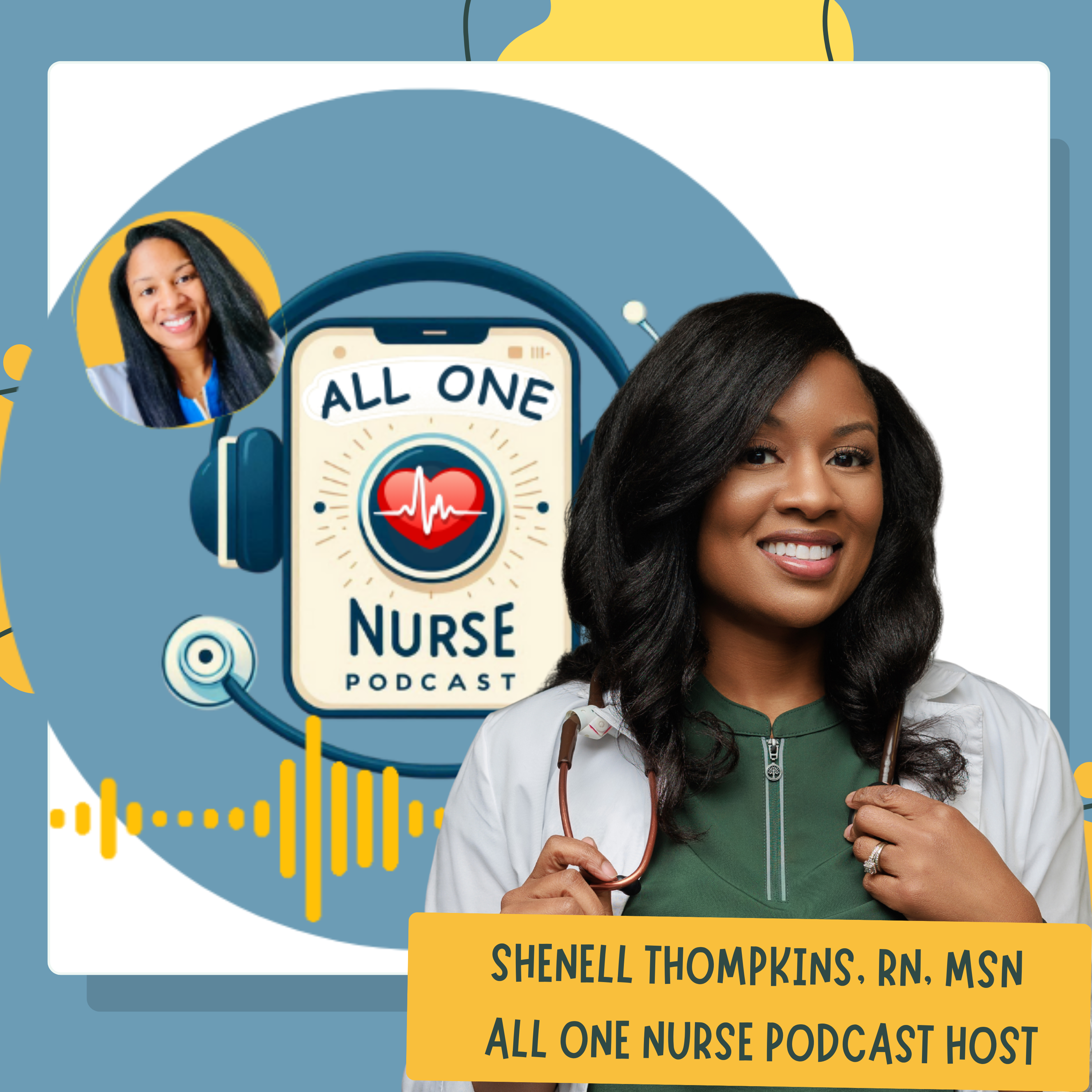
I'm your host, nurse Chanel Tompkins, and I'm also your mentor and nurse educator. And this space was created just for you to breathe, to learn, to grow, and most importantly, feel supported no matter where you are in your nursing journey.
So take a deep breath and let's step into your next breakthrough.
[00:01:02] Speaker B: Hey, friend. Welcome back to the All One Nurse Podcast. I'm your host, Chanel Tompkins, and I'm so glad that you're here with me today. Last week, we got to unpack customer service in a way that makes your day better, but also enriches the patient's experience.
And this episode is going to be focused on empowerment.
But before we dive in, I want to address some important things for the month of September, which is Sepsis Awareness Month.
Wash our hands, follow sterile technique, and keep our patients clean. Give them a bath, clean their rooms. Right. I always say cleanliness is next to godliness. I know that's not a scripture, but I believe it. And not only Sepsis Awareness Month, but you have September 10th, which is World Suicide Prevention Day.
And I wrote a blog as a guide for new nurses on suicide awareness and the importance of connecting with your patient.
And you can find that blog on the All1Nurse website, all1.nurse.com.
and then we also have today the date of this published episode, 9 11.
And if you're old enough, you can think back to what you were doing on that day with that tragic event.
So I want us to take a moment to reflect and think on Even Scripture, Romans 12:15, which states, Rejoice with others when they rejoice and mourn with others when they mourn. And this reminds us to empathize with others during their struggles and their challenges or their losses. And of course, celebrate when it's time to celebrate.
And so I hope that this moment gives you the ability the to reflect and to empathize and also lead with gratitude. Gratitude for life and the opportunity to be a healthcare provider, to be a nurse and push forward. Getting right into our topic, Empowerment. Empowerment. But first, let's define it before we talk about what it is for you as a new nurse and for patients. Webster's dictionary defines empowerment as the process of gaining freedom, authority, confidence to control one's life, and making independent choices and claiming one's rights. I'm going to repeat that. Empowerment is the process of gaining freedom, authority and confidence to control one's life, make independent choices, and claim one's rights.
So what does this mean for new nurses?
What does this mean for you? It's giving you the autonomy, clinical confidence, and personal voice to make critical decisions, advocate for your patients, and practice safely without fear.
And for someone who may be transitioning from student to a working professional, empowerment closes that loophole between learning the rules and confidently providing safe patient care as you grow.
Now let's unpack empowerment versus disempowerment. As a new nurse, what are some things that you may be dealing with? Empowerment is feeling confident to speak up to providers or seasoned nurses. If a patient condition changes or order seems unsafe versus disempowerment is staying silent because you don't want to appear to be incompetent. And then you continue to prepare medication and you have no idea what you're doing. No, we know you're in training and be empowered to directly challenge a team member to protect patient safety, to protect your boundary versus staying quiet during a mistake or letting someone talk to you in a way that you're like, they're kind of mean.
Say something. I always say, say something to them in private, and then if they continue with the action, say something to them with a witness.
And if they continue to perform this negative action, then go to your leadership.
And you know what? They're not going to be surprised because they know that you have tried to rectify the situation and most times is rectified in that personal conversation or with a witness. If we skip those steps, then we're really not getting the opportunity to process things from a genuine perspective.
I don't need management to tell you that, hey, I'm grown.
You don't have to like me. But I would love for you to have some respect for me because I respect you as an adult and we're all here to work together and provide safe patient care. Now, I should leave you with some better scripts, but you get the gist of it, right? I also want you to feel empowered to request extra preceptorship or resources to build your skills versus suffering in silence and risking burnout or quitting the profession altogether. It happens.
You limit yourself to one unit. Remember, if you're working at an organization, a hospital, they have more units than the one that you're on experiencing these difficulties and when you've addressed things and felt empowered to be consistent in who you are and don't shy away from showing respect and giving what you expect that good teamwork, respect, kindness, saying things in love and in truth, I'd rather for you to be kind to me than to be nice to me. Because people can be nice and still talk about you behind your back versus someone who is genuinely kind. They will not just tell you things or smile in your face to make you feel good. They're also going to tell you something that you may not like, but it's meant to help you and not harm you. As a staff development specialist, I guide new nurses, particularly in the icu and one thing that I've learned is the importance of self belief and you don't know what you don't know. You look back in hindsight and it's just like the statement I wish I knew then what I know now.
As you're transitioning, my goal is to provide you with that guidance, encouragement and insight from others who have experienced what you're going through, like myself. And awesome guest speakers that I get here on the so you can identify some of these areas as you're actually experiencing them on the unit or preparing to take nclex or retaking nclex, whatever it is that you have faced or going to face.
Because I want you to be successful. I believe in you.
If you're here, that means that you have a heart for what you're doing or what you want to do. You're the person I want to speak to. You are the person that when I I'm in a hospital bed or on a stretcher, I look up and I see you.
I know that I'm going to be okay because your heart is in it and there's a community of people who care just like you do and still trying to find your way just like you are.
And that is the All One Nurse community on Facebook. It is a group. It is private.
It is something that I pray over because I want the right people to be in the right space so that you get what you need as well as creating a safe space for you to not feel ashamed or judged.
There is no gatekeeping and reciprocity is expected.
I may not need advice on how to take the nclex, but guess what? Someone in the community is getting ready to do something that you may have just done.
Therefore you can share your tips, your advice, your experience so that they can chew the meat and spit out the bones to be successful in passing that nursing class or nclex or making it through a difficult nursing orientation on a unit, the Iowa nurse community is growing and I look forward to the engagement. Be sure to create a post telling us who you are, where you're at in your nursing journey, and what are you expecting from the community. Now, let's talk quickly about empowerment for patients.
Story time during nursing orientation. As I round, I love to process patient care with my new nurses. In one conversation, a young patient is in the critical care setting with DKA and I'm talking to my new nurse some of their goals for the patient for the day and what does this look like? And so of course the new nurse gives me, oh well, you know, educating them, making sure that they know X, Y, Z, this, that and the other. And I'm like, okay, I hear you, but what about empowerment? What about empowering the patient to want to own their care in a way that prevents them from being back in the ICU setting with dka, depending on what brought them in in their lifestyle? But how do you empower them to want to take care of themselves, to want to do things on their own before they even get to discharge? Yes, we educate, but how do we empower them? I learned three questions that I've always done, but it's nice to just hear it in a setting that I'm listening in on. And the three questions were asking the patient, what questions do you have for me? What are you most anxious about and what are your goals for today? We can put the patient first in our minds, but are we truly putting the patient? Do the patient know they come first and how do we prevent them from having or experiencing a lot of the conditions that are preventable? How do we do that?
So I encourage you to look beyond your patient's diagnosis, education, all the tasks, plan of care, in orders, and truly connect with your patient. And instead of solely focusing on the treatment, just, you know, let's empower the patient to self manage and prevent future crisis. And with the new nurse, it was very enlightening to see their reaction or their realization of the profound impact of empowering patients. And one thing about growth and empowerment, I empower my through personal growth things, whether it is through a conference, through YouTube videos like whatever that may be. I recently was sitting on a call with Chris Ballas and he said that a ounce of prevention is better than a pound of cure. And I thought, wow, good stuff.
Now I want you to stay encouraged and I'm going to give you Scripture, Proverbs, 3 verse 5:6. Trust in the Lord with all your heart and lean not on your own understanding and in all your ways, acknowledge him and he will direct your path. As we wrap up this episode, I hope I said something that resonates with you.
And as we get into our next episode, we'll welcome Dr. Ameca Akinay, if I'm saying it correctly, a Wound in Ostomy, nurse practitioner who supports patients beyond the hospital setting, and I cannot wait to share her journey and insights and advice for you
[00:14:15] Speaker A: now.
[00:14:15] Speaker B: Until then, you have a to do list.
Join our community, empower your patients, be empowered yourself, and click that subscribe button if you haven't already. And of course, let your light shine.
Until next time.
Bye.