Episode Transcript
[00:00:00] Speaker A: Did you know that first year nurses experience the highest turnover of any group?
That reality is staggering, but it also tells us something important.
You are not alone and your growth matters.
Welcome to the All One Nurse Podcast, where we are bridging the gap between the stethoscope and the soul through real nursing stories and nursing conversations.
Here, our mission is simple, to get back to the human side of healthcare.
I'm your host, Nurse Chanel Tompkins, and I'm also your mentor and nurse educator. And this space was created just for you to breathe, to learn, to grow, and most importantly, feel supported no matter where you are in your nursing journey.
So take a deep breath and let's step into your next breakthrough. Welcome back to the All Winners Podcast, where faith meets purpose. I'm your host, Shanell Tompkins, and guess what?
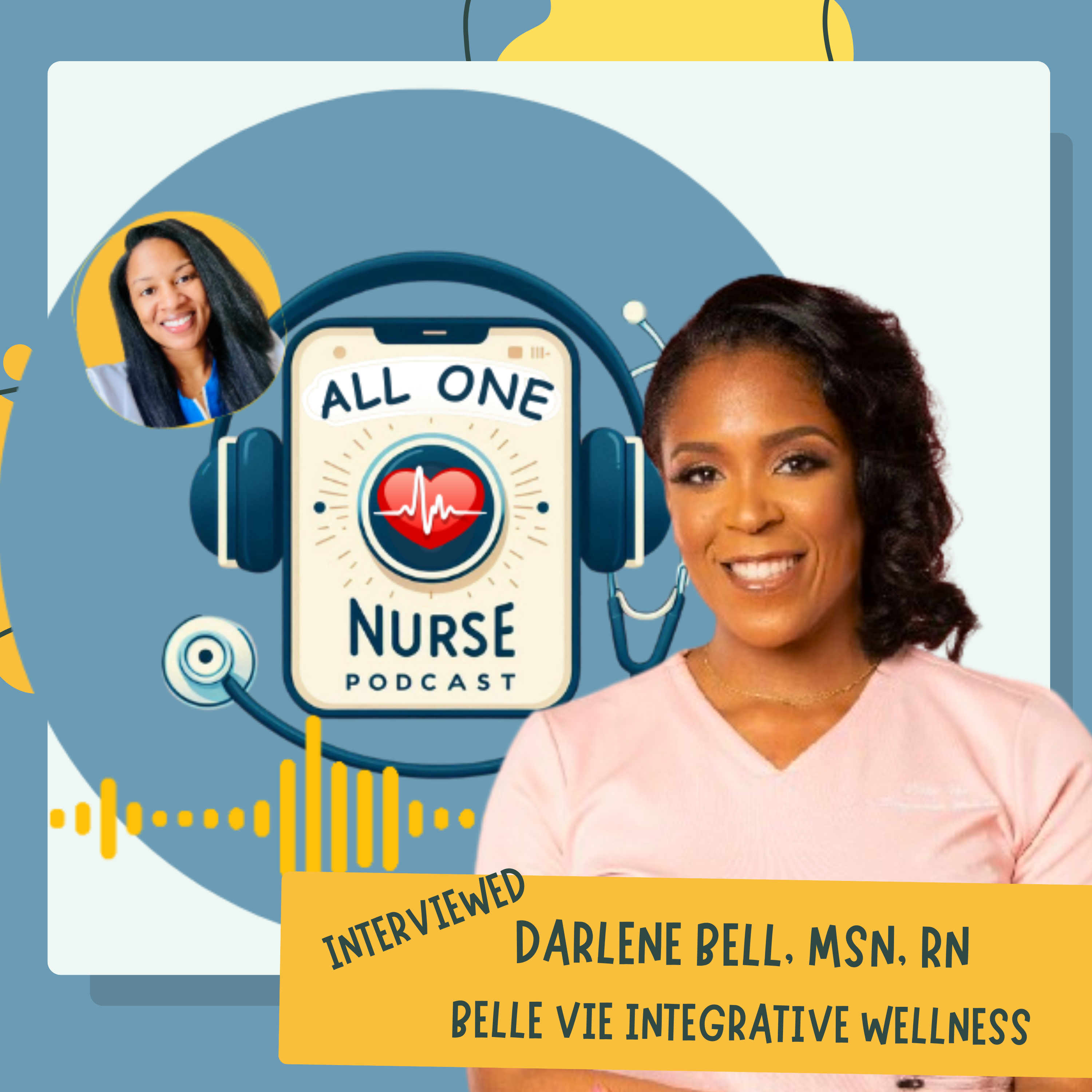
We're entering season five, Season five of the All Winners Podcast and I'm grateful to be pouring into awesome and individuals like yourself. But listen, you're in for a blessing because I get to sit down with Darlene Bell, an OR nurse and founder of Belle V Integrative Wellness, and she's just not confined to nurses, but also all healthcare workers. And I think that says a lot. Her story is one of resilience, reinvention, and God's general reminders that everything truly comes full circle, literally. From stepping into nursing unexpectedly to thriving in the operating room to navigating workplace toxicity. Raise your hand if you've been there. And of course, surviving the COVID shutdown as a single mother. And Darlene has lived the journey that many nurses don't talk about out loud. And she's opening up with her honesty, her wisdom, and practical tools that will strengthen every new nurse, aspiring nurse and healthcare worker listening in. So go ahead and grab your coffee, your favorite drink, your notebook, and of course, your heart, because this conversation will meet you right where you are.
And if you have not as a new nurse or a new nursing student who has graduated or you're transitioning, be sure to check out some of the previous bonus episodes over the summer so that you will learn how to navigate studying for nclex, encouragement if you failed nclex as well, and some tips and strategies on how to transition from student to to the actual nurse and some things to expect in the workplace. So check those out and don't forget to subscribe so that you don't miss another episode of this awesome space, this awesome platform. And let's get right into our conversation with Ms. Darlene. Welcome, Ms. Darlene. How are you doing today?
[00:03:30] Speaker B: I am doing great. I'm, like, in such a great mood because I am finally in. In a place where I'm just tying up a lot of loose ends and in the middle of transitioning from one chapter to the next. And what the next chapter looks like, I'm not quite sure. Okay. And for the first time in my life, I actually feel really excited about that.
[00:03:57] Speaker A: Yeah. Excited. I'm excited to have you here because we're here to learn about the previous chapter as we continue to move forward into what God has for you. So welcome. Welcome to the podcast.
[00:04:10] Speaker B: Thank you so much. Thank you for having me. You know, I told you off, you know, outside of the interview, but definitely very honored and flattered to be invited to be a guest on the podcast.
[00:04:22] Speaker A: So thank you. Yes, ma'. Am. So, you know, getting right to it. We always start with your origin story. So who is Ms. Darlene Bell and why nursing?
[00:04:33] Speaker B: Not non. Nursing, darling.
[00:04:36] Speaker A: Why nursing.
[00:04:38] Speaker B: Okay, so the why nursing? I don't have the typical story that I was, you know, five years old and I wanted to be a nurse. I never planned to be a nurse. I actually had gone to throughout high school. I was taking a lot of sciences and things like that that, you know, the teachers said that I was good at, and I'm kind of like, oh, yeah, whatever. But I actually was taking business classes. I took marketing class classes. And back then, again, it's gonna make me sound old, but there were typewriters. So I took what was called a keyboarding class and learned how to type on a typewriter because I just had envisioned myself in a corporate area. And a lot of the reason why I thought that was because I have an older sister, and she was always like that business chick, like, that boss chick. And her and I were very close, and she was my idol, so I figured I would follow along in her footsteps. But once I hit my senior year of high school, I needed to fill up my schedule, and I took a nursing class. It was a nursing 101. And it just talked about, like, the basics of nursing. And the teacher came over to me and said, hey, you're. You're doing very well in this class. And she asked me about my sciences, and I did pretty well in my sciences. She said, would you consider becoming a nurse?
My mother had been a CNA for, like, my entire life. And then I had a couple of physicians in a family, so people who were in healthcare that I saw.
And again, I kind of was just like, yeah, sure, why not? And then my senior year, I applied to nursing programs and then started a nursing program. And as challenging as a nursing program was, I never for. Never once did I think, like, maybe this isn't for me. I just continued and it felt right. And I pushed, and then I became a nurse. And what's funny is everything comes full circle because eventually look at me now, entering the entrepreneur space and want in and working on building my business. So, yeah, it all. Everything always aligns. So here we are.
[00:06:39] Speaker A: It's like you went full circle from initially wanting to do business to landing in nursing. Yeah.
To now getting back into the entrepreneurial business part of things. Now you gotta tell us, what all did you do during your nursing career? What was that like, your background?
[00:07:02] Speaker B: My nursing career. I knew that when I came out, I. Well, I didn't know, but I was debating. I said I wanted to work in the operating room, labor and delivery or ICU. Those were my three choices. And so I graduated in 2001. And so during that time, you know, there was what they would always say, oh, the nursing shortage and la da da. And so they were more willing back then to actually place you in the specialties that you have interest in. And so when we entered our practicum stage, I had given. I gave them my three choices. And so they placed me in the or.
And so I went for my clinicals in the or. And I'm watching and I'm thinking, oh, my gosh, this is so cool. And then one of the nurses turned to me and says, and we work Monday through Friday. And I said, that's it. I'm gonna be an OR nurse.
And so I was like, I'm going into. I'm going into the or. And so having the practicum for a full semester is what helped me, because when I graduated, I was on a mission. I said, I'm going straight to the or. And people kept saying, no one does that. You need to do med surg. And that's the only way. And I said, well, I'm going to apply. The worst people could say is no, and then I'll do the med surg way. But guess what? I got into the or, and it's. I've always been an OR nurse.
So my career in the operating room has consisted of going through a variety of specialties. I've always been open to learning. I look at myself as a lifelong learner. So anytime that, you know, any opportunity that arose, I always try, tried to take advantage of it. I became certified in my, you know, in the or. So I have my cnor certification.
I also went and got my license in aesthetics.
[00:08:50] Speaker A: Wow.
[00:08:50] Speaker B: And then, yeah. And I, I, I told myself, I said I would love to be a spa owner one day. That's something that I would like to do later on in life, maybe like during retirement or something, nurture people in a different way. And then eventually, like, I just actually graduated in May and I got my master's in in management and organizational leadership with the hopes of merging that with my business. Which goes on to say that during the COVID and the shutdown, being a single mother at the time, one income, what am I going to do? Went online, found nurse coaching, and then through that, specialized into stress management based on my own personal experience as well as professional and gathering all the tools and resources. And that's where I established Bellevue Integrated Wellness and developed the stress management coaching business.
So that's where I finally had gone through different niches of who I help and this person and that person. And finally where Bellevue Integrative Wellness goes, the direction and the audience is emotionally exhausted nurses and healthcare workers. And I help them manage their stress so that they actually stay in the profession that they loved when they entered.
So that's like, that's like the short version of my nursing career.
[00:10:10] Speaker A: I love it. So you're not just confined to nurses?
[00:10:13] Speaker B: No.
[00:10:14] Speaker A: That's awesome.
[00:10:15] Speaker B: No, it's like everyone else within the organization because although nurses are, you know, the core of who I help, we have members of our team that also help support us who also feel, you know, whenever we're not well, they're also not well either. Like, we can all feel that in the workspace and we need each other. So it can't necessarily be one particular group of us that's getting the help that they need and then everyone else is suffering. So I say nurses and healthcare workers.
[00:10:44] Speaker A: That's awesome. I was just listening to a conversation with, like you said, we're. When you go into, when you work in an organization, you have the interdisciplinary team that consists of other healthcare workers, whether it's case management, social worker, pharmacy, respiratory therapy, the physicians. And Lord knows there's different physicians that come because of being consulted on, on patients as well. But I was just listening to a pharmacist or a pharmacy tech talk about working.
Typically they work seven days on and seven off, but they have recently been very short staffed. And so I'm pretty sure that could be very depressing and overwhelming. So that was awesome that you mentioned healthcare workers in addition to nurses.
[00:11:33] Speaker B: Totally. And you know, you're working all those Hours.
That's a huge part of the emotional exhaustion. And if you're working so much you're tired, how can we really guarantee that our thought process is really clear to be able to take care of our patients the way that we're supposed to?
[00:11:50] Speaker A: Yes.
And we have a lot of it is, I say, you know, we talk about a lot of the short, like the stop signs in place or those safety checks that we have.
But even then, we're only human.
[00:12:04] Speaker B: Correct.
[00:12:05] Speaker A: We're only human. So we do have to make time to help get the rest that we need so that we don't make those human errors that we are prone to make when we're exhausted or running on autopilot. So I'm glad that you mentioned that.
[00:12:19] Speaker B: It's so true, because you mentioned those safety checklists, and they are in place, and majority of the time they do work. But if you think about. Right, if you have your entire team and everyone is feeling the same way, there are situations where people will check off the box and things have actually been missed. They've been missed. Why? Because everyone's feeling the brunt of, you know, the stress and stress in the workplace.
[00:12:47] Speaker A: Yes. Now you're speaking of safety with working in the or. What is that like? Especially for a new nurse that may be interested in the operating room setting.
[00:12:59] Speaker B: The or, the OR setting is very. It's a controlled setting where we prepare. We have the opportunity to prepare for the next day. And this is not including.
[00:13:16] Speaker A: Before we continue, I want to pause for a faith intermission note. Nurses and nursing students carry so much the weight of our patients, our families, our workplace, and sometimes the silent battles that no one sees but Scripture reminds us.
Come to me, all who are weary and burdened, and I will give you rest.
Rest is obedience. I'm going say it again. Rest is obedience. And as you listen to Darlene's story, I pray that you hear the invitation to breathe, to release, and to remember that God has already equipped you with everything that you need for this season and that you are truly not walking alone and that you are covered by his grace and his mercy, and that you are called.
And of course, you are becoming. I'm still becoming. Ms. Darlene is still becoming. So let's get back to our awesome conversation, because Darlene is just getting started,
[00:14:33] Speaker B: Of course, like, emergency traumas and things like that. But when we have elective cases, you can actually look the day before. You can see the name of the patient, how old they are, their medical history, surgical history, all the information that you need plus the procedure that's being done.
So knowing the procedure that's being done, that means that there's a room that's selected, there's a time that's selected.
There is what we call a preference sheet. And that preference sheet will list everything that that specific surgeon will do, what their preferences are, their glove sizes, their, you know, the gowns, how many do you need? So it's very controlled in that sense, where a preference card, as long as it's updated as for every single assignment and that the nurse that's assigned to that is up updates it.
Then a new nurse can go in and look to see, okay, Dr. Smith is doing a right total hip. He wears a size 8 glove. He doesn't want to hear music.
You know, they put down every single detail.
These are the instruments that are needed. And so it's our responsibility the day before to look to see what instruments are needed to make sure that they are actually there. That if there are any implants that are necessary, that the reps and the companies are contacted so everyone's on the same page so that things can go very smoothly.
So it's very controlled. At the same time, it can be a very intense environment, depending on what type of surgery is being done, depending on the surgeon that is running the room.
So coming in as a new nurse, it can be very intimidating, I'm sure, just like any other specialty, right. When you're new. So whenever I encounter nurses that are new to the operating room space, I always tell them from the beginning to be open to learning and to understand that whatever they already know makes them a valuable part of the team.
So you're not coming in and like, you're not an idiot, as much as people may make you feel as such, because the operating room environment can be very territorial. You usually will have people who have an assignment, and that's. That's their usual assignment, which is what's different from the floor. You know, you can have your patient come in, your patient might be there for, you know, X amount of days, and they go home and you get a different patient. Whereas in the operating room, yes, you have different patients, but the procedure may be the same. And that's what you do majority of your time as your elected specialty. And so because of that, there's that territorial, like, this is my room.
Yes.
So I always tell them, you are, you are a valuable member of the team because of what you already know. But with that, with that being said, you need to be open to getting new information because of the Fact that the operating room is very different and that you won't know everything.
And the day that you think you know everything, that means that you need to find something else to do because, you know, you can't always know everything. And there's always opportunity to. To grow and to learn more.
[00:17:46] Speaker A: Yes. And speaking of that, I just saw a 18 wheeler, and it was a medical company, and it was the name of this robotic surgery. I guess it was an. A surgery assistant robot.
[00:17:58] Speaker B: Yeah, yeah. Probably da Vinci.
[00:18:01] Speaker A: I think it was called Hugo, but I've heard of da Vinci, too.
[00:18:05] Speaker B: Oh, okay.
[00:18:06] Speaker A: Yes.
[00:18:07] Speaker B: And the technology.
There's so much new technology coming through.
[00:18:11] Speaker A: Yes. I was like, that is crazy. You know, I'm so nosy. Well, I.
Let. Let me take that back. I am observant.
[00:18:20] Speaker B: That's.
[00:18:20] Speaker A: I am observant.
[00:18:21] Speaker B: It's a better way to put it.
[00:18:23] Speaker A: That's what I tell them at work.
[00:18:24] Speaker B: I'm observant.
[00:18:26] Speaker A: That's it.
[00:18:26] Speaker B: But, you know, with all the time that I've spent. So this is my 25th year of being a nurse, and like, all the time that I've spent in the operating room and working in different places, like, I've worked, I've. I've, you know, I've gone through being a travel nurse. Like, I've done. I've gone to different places, and I've had overall very good experience in the workplace of meeting people who were able to see me in a way that I hadn't seen myself yet, you know, being like a newer nurse. So I always find that I try to give that back whenever I see whether it's new staff or a new nurse.
And then coupled with what happened with COVID that's what made me decide to become a nurse coach. Like, when I read about it and I was thinking like, oh, I feel like I do this anyway.
[00:19:13] Speaker A: Yeah.
[00:19:15] Speaker B: And then that's what, like, brought me down that avenue to start Bellevue Integrative Wellness and being a workplace wellness consultant so that when people come in the workplace that they're not, you know, feeling like, I hate this and I want to leave nursing because we need. We need us.
[00:19:31] Speaker A: Yes, we do. And I love that. Now, was there a moment. I know you mentioned being a single parent.
[00:19:38] Speaker B: Yes.
[00:19:39] Speaker A: Coming. Coming through Covid. Because if we all can go back during COVID some of the places that got hit the worst with Low Census, because there was no procedures, no operations going on was those procedural areas in OR areas. And so was there a specific moment for you that it was like, okay, I'm just going to start. I want to help someone else.
[00:20:03] Speaker B: Yeah. So during that time, I was not working at a hospital. I was working at an independent surgical center, privately owned group of physicians.
So when the world shut down, you know, we did all elective cases. We were shut down. Wow. And I'm like, wait, hold up. Wait, what? And so no one really had a true answer. So when we're asking, so what's going to happen? And they kept saying, like, we're not really sure. But thankfully, it was a really good group that I worked for because even though we shut down, they told us, they said, you know, we will pay you. I think it was like, Instead of a 40 hour work week, like, they paid us 30.
And then they allowed us to keep our health benefits and things like that.
Yes. It was like nothing but God. And then we worked. They were like, they. They ended up getting an okay to allow us to work one day per week for X amount of time. I think it was like, for three months. Gotcha. But so that was a real huge saving grace, especially considering, you know, seeing a mom and running on a single income. I was kind of like, well, what? What do I do? Because this is my sole income.
And so I'm the kind of person where I might spend a day crying and. And just woe is me. And the next day I'm up, like, all right, like, how are we gonna make this work?
And so, yeah, I was on my phone, I was up. I couldn't sleep, which is rare. Cause I sleep. Like, I mean, I always say I'm like dead to the world.
Couldn't sleep. Yes, Gone. But I was up, and I'm kind of like, what am I gonna do? And I went on Google and that's how I found coaching. And it was inca the school.
And I said, you know what? I'll try that. And then see what happens.
And then decided to start my business so that I could see if I could develop some revenue. Like. And I said, why not continue on as a nurse, but helping people in a different way. Instead of these patients, it's other nurses.
[00:22:02] Speaker A: Awesome. Awesome. And now we talked about.
And this may have been before we started the recording, but just transitioning. So just getting right into what you're doing now. The Bellevue. Am I saying it right? Bellevue.
[00:22:17] Speaker B: Bellevue.
[00:22:18] Speaker A: Belle. V. I'm so country.
I see the V. I. E. Actually,
[00:22:22] Speaker B: a lot of people do say that. I say Bellevue. They do. It means beautiful life, by the way. It means beautiful life in French. My parents are from Haiti, and I don't speak French, so, no. But my last name is Belle, so I put a little spin on the last name.
I love it.
[00:22:40] Speaker A: Bellevue. And look. Bellevue. To give you some context, we do have a Baptist church named Bellevue Baptist here in the Memphis area.
But it is definitely not spelled the way your company is spelled.
Silly me.
[00:22:59] Speaker B: It's okay.
[00:23:00] Speaker A: Country me.
[00:23:02] Speaker B: That's all right.
[00:23:03] Speaker A: So tell us a little bit about Bellevue.
[00:23:07] Speaker B: Bellevue. Integrative Wellness is my baby. I started it in 2000.
So, yeah, this is year number five. And it started out with me doing one on ones, and I just wanted to help everyone. Like, I said all women, and then it was like, okay, well, that's not gonna work. Yeah.
And then it was like, I think it went from all women, and then it went to driven women.
And then I'm like, no. And someone had told me way in the beginning, oh, you're going to be helping nurses. And I'm like, I am not going to be helping nurses. Like, why would I know? Like, I'm supposed to help professional women and da, da, da. At some point, I honestly can't remember how I ended up transitioning. You know, how I ended up somewhere where I was unhappy in the workplace and very stressed out. And that was something that I was not accustomed to. And it wasn't that I was unhappy because of the.
Because of the work. It was because I was working in a very toxic environment.
And that experience completely showed me a different side of myself because I was accustomed to being in a workplace and being able to, you know, I'm like, ah, I get along with majority everybody, but in this place, it was kind of like, oh, me against the world.
And I knew that with all the experience that I had had, that there was no way. I'm like, there's no way I'm going to get chased out of a place based on other people.
So how am I going to make this work?
And so I took it upon myself to create my own experience. And it was really nothing but, God, I ended up joining committees. I joined number one, starting with the employee Wellness Committee, because I said, well, I'm not well at work, so. So I'm gonna hang out with people who are trying to help other people be well at work. Right. And so I was already a nurse coach, and I'm like, well, I need this 9 to 5, so how am I gonna make it work? And so it started with me wanting to get pulled out of the department for meetings. And I actually, like, enjoyed these meetings. And, you know, the initiatives that they put out and I volunteered to share myself and share my experience. And so I start blogging for the hospital, helping them do a lot of the workshops that they would do. I put on holiday workshops, manage stress. Before the holidays, I started helping out with the new nurse graduates. And so when they were going through their orientation, I would do stress, I do stress management workshops for them. So I got very involved and shaped my own experience to make it better. And through that, meeting other staff members, whether they were nurses or other healthcare workers throughout the organization who, who are also struggling from workplace toxicity and helping them out. And that's what helped me shift to saying, you know what, how about coaching in the, in the workplace and looking to, to become that change agent and helping to make the workplace environment better than what it is. And that's what also led me to. I knew I always wanted to get my master's. I wasn't like, do I want to be a nurse practitioner or do I? And then organizational leadership made sense to me because I want to be that person that walks into a hospital organization and to be able to make it a healthy workplace for everyone.
[00:26:32] Speaker A: Yes. And it, and it truly aligns with the wellness side of it. Setting yourself up to be in a position to help address those type of issues.
Workplace toxicity, workplace bullying.
[00:26:48] Speaker B: Oh yes, it's very real, very real. And experiencing it myself. And then with, especially when people are new employees or new grads and that hesitancy to be assertive and to establish those boundaries, I like to be able to provide some guidance like some scripts, prompts, to be able to get that confidence. Yeah.
[00:27:13] Speaker A: Yes. Now tell us more about how. Because my listener is predominantly new nurses.
[00:27:21] Speaker B: Hey, new nurses. Welcome.
[00:27:24] Speaker A: And aspiring nurses. What are some, some tools that they, some practical tools that they can take with them just right now as they go into the workplace.
[00:27:33] Speaker B: Yeah. So this is what I always love to tell them again, which I mentioned before.
So when we, when we go through transitions, right. We close this door and we're moving on to the next, we tend to forget what we learned in the last room. Right. We enter this new room and we're just kind of like, you feel a little small cuz everyone else has been there for a while and you're like, so when you feel that feeling of that like, I'm not really sure. Take that as a signal as, instead of I don't really know what I'm doing and I'm unsure if. Take that as a signal as welcome, you're here and now you're learning something new. Take it as an invitation and not as something that's going to make you shrink. Don't shrink.
So whatever you learned in the last room, those are all tools that you have in your backpack that are actually going to help you. And the fact that you've gone through nursing school, which to this day is one of the hardest things that I've ever done. If you can go through nursing school and you passed your boards, you have every right to be in that space.
So don't shrink. Definitely go in there with that confidence of what you've already built for yourself. For sure.
[00:28:48] Speaker A: Yes. Now, what would you say in regards to, like, sharing? And I had this thought, like, when I think about ICU ICU nurses, I hear all the time, well, I heard they're pretty mean in the icu, and I'm like, well, they hit the floor running.
[00:29:04] Speaker B: Yeah.
[00:29:05] Speaker A: So I say go in there with an open mind, because if you go in there with somebody else's perspective, then you're probably going to get what they experience because you're anticipating it.
[00:29:17] Speaker B: Correct.
[00:29:18] Speaker A: And you're setting yourself up to not communicate with those nurses in the icu. So what would you tell the new nurse as far as, like, going into environments with an open mind but also not sharing too much information, like personal information? Because I think sometimes if they share too much, then they set theirselves up for failure in a way to be judged, too.
[00:29:41] Speaker B: Yeah. On so many levels. So it's funny because there's such a fine line, Right. And I'm definitely. I'm a private person.
But with that being said, when you walk into that space, you must understand that anything outside of your patient and the workplace, anything that you share is a. Is a gift to someone else. You don't have to share anything.
[00:30:05] Speaker A: That's good.
[00:30:06] Speaker B: You could go in and people and never tell anyone that you have a husband at home and 10 kids and whatever you could, you could go ahead and move that way. Right. But with that being said, you can also share your. Your personality. You can go in. It doesn't mean that you have to be stoic. It doesn't mean that you have to, you know, not have conversation with people, general conversation.
But there's a way to be able to share a little bit of yourself without giving it all away. And at the end of the day, no one's entitled to know your personal business.
No one's also entitled to know your professional business.
Wherever you worked, how long you worked there, who you worked with, how much you get paid, anything that you divulge, you have to make sure that this is something that you feel that you're okay with sharing, that it isn't a big deal, but it is a fine line because you will be judged. You definitely will be judged. And we also can't help what people think of us either. Right.
You can't help that. But ultimately, remember that you are in a professional workspace face. And that's how you should lead is as a professional, you shouldn't be going in there and talking about, oh, Saturday night, I was. I got drunk and da, da, da, da. If you want to be respected.
[00:31:23] Speaker A: Yeah, that's good.
[00:31:26] Speaker B: So keep it. Keep it.
[00:31:27] Speaker A: Keep it professional. Yeah, that's good. That's good. Because a lot of times the night nurses, it's not just night nurses, but you will hear. Even patients, we have to be mindful that we are there for the patients.
And so we have to keep those personal conversations personal.
Keep them personal and keep them outside of the unit, I must say, or away from patients ears, because patients hear everything. And.
[00:31:54] Speaker B: And you know, I'm sorry, but I also want to add to that.
And you new nurses, the holiday parties, don't play yourself.
Don't play yourself because they will talk about you in the morning. Okay?
So if you don't know how to nip it and nip it in the bud and separate it, then don't go. Or go for an hour and you leave. Yeah, Keep it professional.
[00:32:17] Speaker A: Keep it professional.
[00:32:19] Speaker B: Yeah, don't do it.
[00:32:20] Speaker A: You said don't play yourself.
[00:32:22] Speaker B: Yeah, don't play yourself.
[00:32:23] Speaker A: That's good. That's good. Thank you for that insight for my new nurses.
[00:32:29] Speaker B: I'm sure everyone can think of, like that one holiday party, you see sue the next day, and you're like, girl, remember when sue, you were like, you will never talk about me like that. Nope. Darlene's boring. Yep, sure am.
[00:32:45] Speaker A: Look, I would get on to some of my co workers, night nurses. We'll go out to eat or something. I'm like, y' all can invite me to go out to eat.
Like, I'm not just gonna pray and talk about God the whole time. Like, you can invite me.
And they just laugh.
[00:33:00] Speaker B: Yeah, they're like, yeah.
[00:33:03] Speaker A: And they left me right where I was at, too.
Left me right there.
[00:33:08] Speaker B: If you don't get invited, it's like, it's fine. Take it as a compliment because they don't talk with you and you don't want people. I mean, if they're going to talk about you, let it be for something good. You know, no one's perfect. But again, don't, please.
[00:33:20] Speaker A: Yes, they knew I was too positive if they wanted to complain. I'm like, they like, Chanel, look at this. It'll be something on Instagram. And I'm like, oh, that's so cute. And they like, I knew you would say that.
Just messing up the vibes.
I'm like, my bad. I thought that was kind of cute.
They like, whatever, Chanel. But Ms.
Darlene, with integrative Wellness, how can my listeners connect with you? And is there anything that we can expect coming up?
[00:33:52] Speaker B: Well, first they could connect with me. I am on LinkedIn. You can just put my name Darlene Bell and I show up. I've been intentionally quiet, focusing on school. Now school is over.
If you follow me on LinkedIn, you will see that I do a weekly series. It's usually a workplace wellness psychological safety series with different themes. Monday through Friday, every day there's a different theme. So if you look me up on darling bell on LinkedIn, you'll be able to see that I'm also on Instagram. And on Instagram, it's at Bellev, Underscore Integrative, Underscore Wellness. And on there, I usually post a lot in my stories and that's where you see more of like the personal life of Darlene, of me, you know, going out and at the beach and like the fun side, the really fun side of me. And then I have my email, darlenellebywellness.com where you can always shoot me an email. And then what was the other thing that you. Oh, the direction that I'm going into.
So right now when I come back, I'm going back to doing the weekly wellness psychological safety series on LinkedIn and as well as Instagram.
And then I'm working on something pretty big. It's going to be very useful for nurses and healthcare workers in the workplace and so to definitely look out for it. In the meantime, I have boundary scripts and conversation scripts and things like that that you can purchase if you go onto my website and you can purchase them ebooks and all that to keep you busy in the meantime.
[00:35:24] Speaker A: Yes.
Thank you so much.
[00:35:27] Speaker B: Thank you too, Chanel.
[00:35:28] Speaker A: Thank you. I have enjoyed this conversation. I really want to keep going, especially we're talking about stress.
[00:35:35] Speaker B: Well, we can, you know, we. Off the back.
[00:35:38] Speaker A: Yes. You know, I was teaching a class before I let you go. I was teaching a ACLS class and in one of the last videos, talks about assessing your own stress response.
You know, when you're dealing with death and Dying of your clients or your patients, per se. And so I was just telling them, you know, just looking at what are some of the things we may start to see when we're stressed? And I said, one big thing for me is not wanting to cook.
And so if I don't want to cook for the fat when I get home, it's like, I just want to buy fast food.
[00:36:13] Speaker B: Yeah.
[00:36:13] Speaker A: And so if I'm doing that all week, that's a big str. That lets me know, like, okay, Chanel, you gotta reset, because why are you so exhausted or overwhelmed? Correct. I was telling them, like, start thinking of just some of the things that they see for themselves.
[00:36:31] Speaker B: Yep.
[00:36:31] Speaker A: Is there anything you can add to that?
[00:36:33] Speaker B: Well, it's so funny that you say this. And I'll try to make this as short as possible. So for myself, whenever that happens to me, I usually end up with headaches, and I end up feeling just, like, really tired. Like, if I could sleep all day, I would. And that's usually my cue that I need to slow it down. And very impatient with, like, loved ones. Like, if they could just say, hey, you doing anything at 5? And I'm like, why? Who wants to know? Like that.
It's like, whoa. It was so.
[00:37:01] Speaker A: It was just a yes or no question.
[00:37:03] Speaker B: Yeah, exactly. But what's interesting is this was about. This was in May that I'm wrapping things up, right? I'm graduating. My son graduated high school. I'm like, oh, my gosh. All these years of putting in all this work he's done. I'm done. Like. Like, I'm ready to convert from, you know, working on my master's and then really going full throttle with Belfi. Super excited. And this one random Saturday, I'm just kind of like, oh, I kind of feel a little nauseous. And then that was early in the morning. We went. I went to the tuxedo shop with my son to pick out the prom suit and yada yada. By that same evening, I'm standing in my kitchen, and I'm like, ooh, I don't feel good. And next thing I know, I'm waking up, like, passed out.
Long story short, I end up in the er and I'm like, run. And I'm. You know, I'm just so. Like, I could just be so bossy. And I'm like, is it a heart attack, doctor? No enzymes. Everything's good. Cardiac, Everything's good. Neurological tests, no stroke. And the doctor says, your. Your diagnosis is dehydration and exhaustion and I'm like, wow, me, me. I'm the joyful nurse. Like I'm Belle V. Integrative Wellness. Like I talk about stress management. How could that be? And it was like, wow, know that sometimes. Right. Like we know that stress is usually the hard things.
Sometimes stress is the good things too, when they're piling up. So that was a very interesting lesson for me that even though I was going through the cycle of things closing and being really happy about it, it was still very taxing because I was constantly on go, like juggling so many things.
So now it changed. Like knowing like I get headaches and things like that. Yeah, that cue was there, but now it changed where I wanted a deeper understanding of my body and what was going on, which is I started wearing this bracelet to know metabolic. Metabolically what's happening. And so according to my bracelet here, I won't say the company, cuz they're not paying me to promote it, but come on.
[00:39:15] Speaker A: Yes.
[00:39:16] Speaker B: But it tells me that I. My quality of sleep is good. Good. But it's. I don't sleep long enough. So I believed that I would sleep eight hours per night, but I actually sleep four and a half to five. Like real quality sleep.
And so that's part of why oftentimes I feel run down. And I would often say, well, why do I feel so tired if I'm sleeping eight hours? I'm not.
So now that things are winding down, that's my focus is to, to make sure that I'm getting a long length of quality sleep, which is something that's going to happen over time. I'm saying all that to say that yes, we should be aware of our, the signs and symptoms of what is telling us that you need to slow down. But to also understand that that will change too, that it may look different throughout your life. It's not something that will always remain the same. So to be aware of, of everything. Go to your doctor's appointments, get your labs checked, all that good stuff to really make sure.
[00:40:18] Speaker A: Yes. Like know your numbers.
[00:40:20] Speaker B: Yes.
[00:40:20] Speaker A: Know your numbers and our body keeps score. That's what I heard you say some words like, like you said it wasn't bad things that were happening, it was good things that were happening. But it still required a lot of you.
[00:40:33] Speaker B: Yes.
[00:40:33] Speaker A: And because you were on go.
[00:40:36] Speaker B: Yeah.
[00:40:36] Speaker A: You still forgot to take care of.
[00:40:39] Speaker B: I know. And I was doing all the things. Yeah. That's what was so humbling. I was like. But I do everything I, I practice what I preach. Everything that I say, I said what do you mean? How could this possibly be?
But there was that small window of like the length of sleep, like, no, you think you're sleeping, but you're not. So what are you going to do about it?
[00:40:59] Speaker A: That's good.
[00:41:00] Speaker B: Yeah.
[00:41:01] Speaker A: Thank you for sharing. See, it was so worth keeping you here.
Yes.
Well, I thank you and I can't wait for us to meet again.
[00:41:13] Speaker B: I know we must do this again because I can talk girl.
[00:41:18] Speaker A: Same.
Thank you so much for joining me.
[00:41:21] Speaker B: Thank you for having me. And I look forward to meeting all the new anyone that's here that's new. I look forward to you following me, following us and keeping in contact.
[00:41:31] Speaker A: Yes, ma'. Am. And I will put all of your information down in the show notes.
[00:41:35] Speaker B: Okay.
[00:41:36] Speaker A: At the bottom of our episode.
[00:41:38] Speaker B: Great. Sounds good.
[00:41:39] Speaker A: Thank you.
[00:41:40] Speaker B: Thank you so much.
[00:41:41] Speaker A: Thank you for joining me for this powerful episode of all One nurse Darlene Bell reminded us that nurses can build a Belle v a beautiful life without losing themselves in the process. And her journey is the definitely proof that your story, your stress, your boundaries and everything dealing with your experience, it all matters. And if this episode blessed you, all I ask is that you share it with a new nurse, an aspiring nurse or healthcare worker who needs some encouragement today. And don't forget to connect with Darlene through her Bellevue wellness platforms to keep learning, to keep growing and protecting your peace. Because it's nothing like having peace, even in the midst of a rough season or a tough season. And make sure that you subscribe here on this platform so that you don't miss another episode. And for a deeper connection, please join me. Join us the All One Earth Community, which is a private Facebook Facebook group.
And there you will find weekly devotions on Mondays and a link to meet with me and other awesome nursing students and new nurses every Thursday except for the last Thursday of the month and on there on those weekly meetups, we just go over your weekly. We'll go over your wins, your barriers as well as some practical advice, tips or tools that you may need during this time in your nursing journey. And of course some words of encouragement and always prayer.
So definitely join us there. And as this episode comes to an end, I just want you to remember that you are seen and that you are supportive and that you are all one nurse. And until next time, let your light shine.